

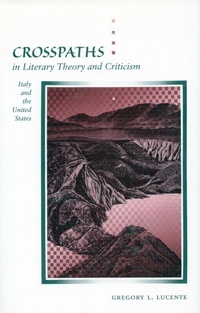
Crosspaths in Literary Theory and Criticism
Italy and the United States
Published on 1. August 1997
Book
Paperback/Softback
212 pages
978-0-8047-2830-0 (ISBN)
Description
Crosspaths in Literary Theory and Criticism traces several of the most recent trends in both the Italian and the American critical traditions, exploring the points at which the two traditions intersect or for specific reasons fail to intersect. Though the primary focus is on literary questions, attention is also given to the broader concerns of the creative force of culture and, when relevant, to economic, social, and political phenomena. Throughout, it aims to illuminate not only the forms of literary and critical discourse but also their underlying generative principles-their ideologies.
The book is in three parts. Part I studies recent theoretical trends, including deconstruction, Marxism, and feminism; critical pluralism; the history of Marxist critique; and the use of the thought of Antonio Gramsci in recent cultural studies. Part II discusses the views of Italian writers (principally Giambattista Vico and Gramsci) who have engaged the problems of the historical imagination; history and myth in Luigi Pirandello's last plays; and the depiction of social life in the "historical" novels of Elsa Morante, William Faulkner, and Mario Vargas Llosa.
Part III considers the reaction in the United States to the discovery of the wartime writings of Paul de Man and to the "against theory" debate. The book concludes by setting forth a model of cultural analysis that avoids the mystifications of Gianni Vattimo's "weak thought" and the reductive drawbacks of Marxist views of literary production and expression (both Italian and American) as well as suggesting the advantages of recent materialist perspectives, in the process delineating the differences between modernism and postmodernism.
The book is in three parts. Part I studies recent theoretical trends, including deconstruction, Marxism, and feminism; critical pluralism; the history of Marxist critique; and the use of the thought of Antonio Gramsci in recent cultural studies. Part II discusses the views of Italian writers (principally Giambattista Vico and Gramsci) who have engaged the problems of the historical imagination; history and myth in Luigi Pirandello's last plays; and the depiction of social life in the "historical" novels of Elsa Morante, William Faulkner, and Mario Vargas Llosa.
Part III considers the reaction in the United States to the discovery of the wartime writings of Paul de Man and to the "against theory" debate. The book concludes by setting forth a model of cultural analysis that avoids the mystifications of Gianni Vattimo's "weak thought" and the reductive drawbacks of Marxist views of literary production and expression (both Italian and American) as well as suggesting the advantages of recent materialist perspectives, in the process delineating the differences between modernism and postmodernism.
Reviews / Votes
"This is an important work that gives an original analytical account of prevalent modes of critical thought (deconstruction, feminism, Marxism) from the standpoint of the philosophical theories of Vico and Gramsci. Lucente's passionate critique of the sundry narcissistic and self-enclosed shapes of modern thought in terms of the consciousness of history is fresh and persuasive, and the economy and crispness of his writing is admirable."-Giuseppe Mazzotta, Yale UniversityMore details
Edition
New edition
Language
English
Place of publication
Palo Alto
United States
Target group
College/higher education
Professional and scholarly
Edition type
New edition
Product notice
Paperback (trade)
Dimensions
Height: 214 mm
Width: 139 mm
Thickness: 11 mm
Weight
249 gr
ISBN-13
978-0-8047-2830-0 (9780804728300)
Copyright in bibliographic data and cover images is held by Nielsen Book Services Limited or by the publishers or by their respective licensors: all rights reserved.
Schweitzer Classification
Content
Part I. Recent Theory: 1. Dec onstruction, Marxism and feminism in current theory; 2. Critical pluralism in the American and European traditions; 3. History with a future(?); 4. Could you elaborate on that? (well, yes and no); Part II. The Historical Imagination: 5. Vico, Hercules and the lion; 6. Hayden White's 'the content of the form'; 7. Yesterday, today, tomorrow; 8. Rationality and myth in Priandello's later works; 9. Literary representation and sociopolitical/cultural contexts in the historical novel; Part III. 10. The exercise of silence; 11. Against theory? Yes and no; 12. Weak thought/strong thought; Notes; Index.