

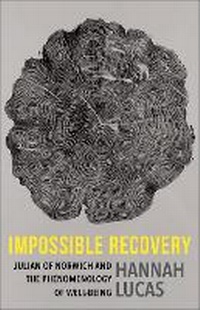
Impossible Recovery
Julian of Norwich and the Phenomenology of Well-Being
Published on 14. January 2025
Book
Hardback
424 pages
978-0-231-21867-2 (ISBN)
Description
Shortlisted, 2026 University English Book Prize, University English
The medieval mystic Julian of Norwich (1342-after 1416) is the first known woman to author a book in the English language, recognized today for her strikingly optimistic claim that "all shall be well." Her visionary text Revelations of Divine Love is the product of many years of contemplation, written and revised after a life-changing event of near-fatal illness and divine revelation.
Hannah Lucas explores the entanglement of illness and revelation in Julian's writings, illuminating the unexpected commonalities between the medical and the mystical and their significance for philosophies of health. Framed by an original application of post-Heideggerian philosophy, Impossible Recovery offers a vivid new interpretation of the medieval mystic as crafting a proto-phenomenological theology of well-being. Lucas's careful readings pay close attention to Julian's mystical language and poetics, revealing the surprising resonances of her writings with modern and postmodern thought. Refracted through Julian's Revelations, this book advances a powerful existential query about the possibilities of recovery-of well-being, and of medieval history.
The medieval mystic Julian of Norwich (1342-after 1416) is the first known woman to author a book in the English language, recognized today for her strikingly optimistic claim that "all shall be well." Her visionary text Revelations of Divine Love is the product of many years of contemplation, written and revised after a life-changing event of near-fatal illness and divine revelation.
Hannah Lucas explores the entanglement of illness and revelation in Julian's writings, illuminating the unexpected commonalities between the medical and the mystical and their significance for philosophies of health. Framed by an original application of post-Heideggerian philosophy, Impossible Recovery offers a vivid new interpretation of the medieval mystic as crafting a proto-phenomenological theology of well-being. Lucas's careful readings pay close attention to Julian's mystical language and poetics, revealing the surprising resonances of her writings with modern and postmodern thought. Refracted through Julian's Revelations, this book advances a powerful existential query about the possibilities of recovery-of well-being, and of medieval history.
Reviews / Votes
This is the most exhilarating book in medieval studies I've read in some time. * Studies in the Age of Chaucer * [Impossible Recovery] is fascinating and well written, and it does a remarkable job of explaining phenomenology to a nonphenomenologist. * Social History of Medicine * Lucid, detailed, and compellingly written...a stellar first monograph, one that should be read by anyone with an interest in Julian of Norwich and medieval ideas of health and healing. * Journal of Medieval Religious Cultures * This is a deeply creative and fresh study of one of the greatest medieval visionaries by a scholar who combines first-class historical and textual acumen with keen awareness of the way in which modern philosophies of embodied (and gendered) consciousness open up new questions and insights in the reading of premodern texts, especially around issues of suffering and healing. It is an invaluable contribution to the study of Julian of Norwich, but is also a brilliant intervention in a range of contemporary debates. -- Rowan Williams, former archbishop of Canterbury, author of <i>The Edge of Words: God and the Habits of Language</i> Lucas's highly adept use of contemporary theories of being, wellbeing, language, and existentialism in this study is both arresting and effective in offering new insights into Julian's work and her writerly mission. It comprises one of the most important recent interventions into the field of Julian studies and will be an essential book for those interested in the interplay between theory, women's writing, and the mystical encounter. -- Liz Herbert McAvoy, author of <i>The Enclosed Garden and the Medieval Religious Imaginary</i> An astoundingly original book. Its interpretive project blasts away the rote conventions of writing about the Middle Ages to chart a new sense of "recovery" in the writings of Julian of Norwich and beyond. Lucas has forged a luminous study that unites philosophy, theology, the history of mysticism, and poetics. -- Julie Orlemanski, author of <i>Symptomatic Subjects: Bodies, Medicine, and Causation in the Literature of Late Medieval England</i> Hannah Lucas has written a learned, immersive, intellectually wide-ranging, and often exhilarating analysis of Julian's book and the 'theory of human existence as an ongoing process of seeking understanding.' Impossible Recovery is one of the most original and compelling studies of a medieval contemplative text of the past twenty-five years. -- Nicholas Watson, author of <i>Balaam's Ass: Vernacular Theology Before the English Reformation, Volume 1: Frameworks, Arguments, English to 1250 </i>More details
Series
Language
English
Place of publication
New York
United States
Target group
College/higher education
Product notice
Trade binding
Dimensions
Height: 216 mm
Width: 140 mm
ISBN-13
978-0-231-21867-2 (9780231218672)
Copyright in bibliographic data and cover images is held by Nielsen Book Services Limited or by the publishers or by their respective licensors: all rights reserved.
Schweitzer Classification
Other editions
Additional editions
E-Book
01/2025
1st Edition
Columbia University Press
€39.49
Available for download
Person
Hannah Lucas is the Newby Trust Research Fellow at Newnham College, University of Cambridge.
Content
Acknowledgments
List of Abbreviations
Note on Editions and Translations
Introduction. Then and Now: Recovering Julian of Norwich
1. Mapping the Journey Home: A Phenomenology of Well-Being
2. Learning to Live: Julian's Illness and the Craft of Dying
3. Bearing Witness: Revelation, Suffering, and the Fiend
4. Seeking Understanding: Julian's Mystical Text
5. The Contemplative Way: The Performance of Prayer and Homlyhede
6. Make Straight the Paths: Christ, Providence, and Salvation
Conclusion. Not Yet Performed: Julian in Time
Notes
Bibliography
Index
List of Abbreviations
Note on Editions and Translations
Introduction. Then and Now: Recovering Julian of Norwich
1. Mapping the Journey Home: A Phenomenology of Well-Being
2. Learning to Live: Julian's Illness and the Craft of Dying
3. Bearing Witness: Revelation, Suffering, and the Fiend
4. Seeking Understanding: Julian's Mystical Text
5. The Contemplative Way: The Performance of Prayer and Homlyhede
6. Make Straight the Paths: Christ, Providence, and Salvation
Conclusion. Not Yet Performed: Julian in Time
Notes
Bibliography
Index