

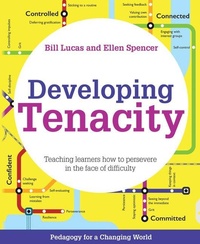
Developing Tenacity
Teaching learners how to persevere in the face of difficulty
Published on 19. April 2018
Book
Paperback/Softback
232 pages
978-1-78583-303-8 (ISBN)
Description
Bill Lucas and Ellen Spencer's Developing Tenacity: Teaching learners how to persevere in the face of difficulty is a powerful call to action and a practical handbook for all teachers who want to stimulate and strengthen their pupils' learning tenacity.
The UK's All-Party Parliamentary Group on Social Mobility recently proposed the adoption by schools of specific interventions in the areas of resilience and character; meanwhile, across the Atlantic, an end-of-high-school `score' for grit is also being considered in the USA. In line with this growing consensus, an increasing body of evidence suggests that cultivating these competencies is key to success both in school and in later life. In Developing Tenacity, the second instalment in the Pedagogy for a Changing World series, Lucas and Spencer show educators how.
Delving beyond `grit' and `growth mindset', and encompassing more than the formal curriculum, Developing Tenacity draws on the co-authors' research at the University of Winchester's Centre for Real-World Learning to offer a powerful synthesis of what it takes for learners to persevere when confronted with challenges. The resulting analysis depicts the true value of tenacity inside and outside the educational setting and provides teachers with action-oriented strategies as to how the four key `habits' of tenacity - confidence, control, commitment and connectivity - can be developed in learners.
The wealth of teaching and learning methods presented is accompanied by practical suggestions on how to embed tenacity more systematically into the curriculum, providing plenty of stimuli for lesson planning and for the drip-feeding of everyday activities which boost learners' agency and self-efficacy. The authors also investigate the effectiveness of various pedagogical approaches - including developmental self-evaluation, deliberate practice and service learning - and share inventive assessment methods which teachers can employ to track learners' progress along the way. Lucas and Spencer then go further by showcasing case studies that illustrate the successful adoption of a capabilities approach by various educational institutions, and offer expert advice on how teachers can overcome any potential obstacles as they journey towards cultivating a tenacious learning culture in their classrooms.
Suitable for all teachers and school leaders - in both primary and secondary settings - who want to instil a strong sense of tenacity in their pupils' approach to learning.
The UK's All-Party Parliamentary Group on Social Mobility recently proposed the adoption by schools of specific interventions in the areas of resilience and character; meanwhile, across the Atlantic, an end-of-high-school `score' for grit is also being considered in the USA. In line with this growing consensus, an increasing body of evidence suggests that cultivating these competencies is key to success both in school and in later life. In Developing Tenacity, the second instalment in the Pedagogy for a Changing World series, Lucas and Spencer show educators how.
Delving beyond `grit' and `growth mindset', and encompassing more than the formal curriculum, Developing Tenacity draws on the co-authors' research at the University of Winchester's Centre for Real-World Learning to offer a powerful synthesis of what it takes for learners to persevere when confronted with challenges. The resulting analysis depicts the true value of tenacity inside and outside the educational setting and provides teachers with action-oriented strategies as to how the four key `habits' of tenacity - confidence, control, commitment and connectivity - can be developed in learners.
The wealth of teaching and learning methods presented is accompanied by practical suggestions on how to embed tenacity more systematically into the curriculum, providing plenty of stimuli for lesson planning and for the drip-feeding of everyday activities which boost learners' agency and self-efficacy. The authors also investigate the effectiveness of various pedagogical approaches - including developmental self-evaluation, deliberate practice and service learning - and share inventive assessment methods which teachers can employ to track learners' progress along the way. Lucas and Spencer then go further by showcasing case studies that illustrate the successful adoption of a capabilities approach by various educational institutions, and offer expert advice on how teachers can overcome any potential obstacles as they journey towards cultivating a tenacious learning culture in their classrooms.
Suitable for all teachers and school leaders - in both primary and secondary settings - who want to instil a strong sense of tenacity in their pupils' approach to learning.
More details
Series
Language
English
Place of publication
United Kingdom
Target group
College/higher education
Professional and scholarly
Product notice
Paperback (trade)
Unsewn / adhesive bound
Dimensions
Height: 221 mm
Width: 182 mm
Thickness: 17 mm
Weight
489 gr
ISBN-13
978-1-78583-303-8 (9781785833038)
Copyright in bibliographic data and cover images is held by Nielsen Book Services Limited or by the publishers or by their respective licensors: all rights reserved.
Schweitzer Classification
Other editions
Additional editions
Bill Lucas | Ellen Spencer
Developing Tenacity
Teaching learners how to persevere in the face of difficulty
E-Book
04/2018
Crown House Publishing
€22.79
Available for download
Persons
Professor Bill Lucas is Director of the Centre for Real-World Learning at the University of Winchester and, with Ellen Spencer, the originator of a model of creativity in use in schools across the world. A global thought-leader, Bill was co-chair of the PISA 2022 test of creative thinking and curates the Creativity Exchange website. Dr Ellen Spencer is Senior Researcher at the Centre for Real-World Learning and, with Bill Lucas, author of Teaching Creative Thinking. Ellen is also a Researcher for Arts Council England's Creativity Collaboratives, a three-year project to test a range of innovative practices in teaching for creativity in schools.
Content
Contents include: Series Introduction: Capabilities and Pedagogy Chapter 1: Tenacity Chapter 2: Cultivating Tenacity Chapter 3: Getting Going Chapter 4: Going Deeper Chapter 5: Promising Practices Chapter 6: Signs of Success Chapter 7: Tenacity Challenges