

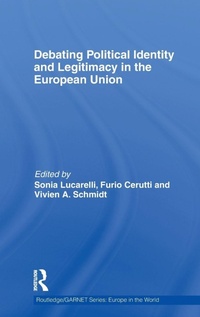
Debating Political Identity and Legitimacy in the European Union
Interdisciplinary Views
1st Edition
Published on 2. December 2010
Book
Hardback
240 pages
978-0-415-55100-7 (ISBN)
Description
How can we conceptualize identity and legitimacy in the context of the European union? What is the role of narratives, political symbols, public debate and institutional practices in the process of identity formation and legitimacy consolidation?
Debating Political Identity and Legitimacy in the European Union addresses these questions and brings together high profile scholars from various disciplinary backgrounds to debate the ontological and epistemological aspects of research on identity and legitimacy formation in the EU. Part I investigates key elements such as the relationship between 'Europeanization' of the EU member states and its effect on the political identity of their citizens; the relationship between the politicization of the EU and processes of identity and legitimacy formation; and the indispensability of European identity for legitimizing the EU. Part II looks at pathways to identity formation and legitimacy construction in the EU by considering alternative types of constitutional legitimacy; political symbolism; Europeanization and politicization of the debate on EU focusing on the foreign policy domain.
Bringing together a wide but coherent range of high profile perspectives, this book will of interest to students and scholars of European studies, Political Science, Philosophy, Sociology and Law.
Debating Political Identity and Legitimacy in the European Union addresses these questions and brings together high profile scholars from various disciplinary backgrounds to debate the ontological and epistemological aspects of research on identity and legitimacy formation in the EU. Part I investigates key elements such as the relationship between 'Europeanization' of the EU member states and its effect on the political identity of their citizens; the relationship between the politicization of the EU and processes of identity and legitimacy formation; and the indispensability of European identity for legitimizing the EU. Part II looks at pathways to identity formation and legitimacy construction in the EU by considering alternative types of constitutional legitimacy; political symbolism; Europeanization and politicization of the debate on EU focusing on the foreign policy domain.
Bringing together a wide but coherent range of high profile perspectives, this book will of interest to students and scholars of European studies, Political Science, Philosophy, Sociology and Law.
More details
Series
Language
English
Place of publication
London
United Kingdom
Publishing group
Taylor & Francis Ltd
Target group
College/higher education
Illustrations
11 s/w Tabellen
11 Tables, black and white
Dimensions
Height: 240 mm
Width: 161 mm
Thickness: 18 mm
Weight
529 gr
ISBN-13
978-0-415-55100-7 (9780415551007)
Copyright in bibliographic data and cover images is held by Nielsen Book Services Limited or by the publishers or by their respective licensors: all rights reserved.
Schweitzer Classification
Other editions
Additional editions
Sonia Lucarelli | Furio Cerutti | Vivien Schmidt
Debating Political Identity and Legitimacy in the European Union
Book
05/2015
1st Edition
Routledge
€76.40
Shipment within 10-20 days
Sonia Lucarelli | Furio Cerutti | Vivien Schmidt
Debating Political Identity and Legitimacy in the European Union
E-Book
08/2012
1st Edition
Routledge
€69.99
Available for download
Sonia Lucarelli | Furio Cerutti | Vivien Schmidt
Debating Political Identity and Legitimacy in the European Union
E-Book
08/2012
1st Edition
Routledge
€69.99
Available for download
Persons
Furio Cerutti is Professor of Political Philosophy at the Department of Philosophy, University of Florence. In recent years he has been Visiting Scholar at the Center for European Studies of Harvard University (2003-04) and Visiting Professor at the Universite de Paris 8 (Spring 2005) and the Humboldt University in Berlin (September 2007). A member of GARNET, a Network of excellence funded by the European Union under the Sixth Framework Programme, he coordinates a transnational research group on normative issues of regional and global governance and participates in an other group on environmental governance.
Sonia Lucarelli is Senior Researcher and Lecturer of International Relations at the University of Bologna at Forli and Vice President of the Forum on the Problems of Peace and War in Florence. She is member of the Board of the Network of Excellence GARNET. Lucarelli teaches regularly at the Institute Sant'Anna in Pisa and at the Italian Air Force War College in Florence. She has been Associate Professor at the Universities of Pisa, Siena and Bologna.
Professor Schmidt is the recipient of numerous awards and distinctions. She was awarded a French National Council for Scientific Research (CNRS) Visiting Researcher Fellowship to the Center for the Study of Politics (CEVIPOF) at Sciences Po in Paris (July-Dec. 2007) and named to the Franqui Interuniversity Chair for Foreign Scholars to lecture in Belgium at the Free University of Brussels and the Catholic University of Louvain (Jan.-June 2007). She has been decorated by the French government as a Chevalier in the Order of the Palmes Academiques; honored by the University of Massachusetts Boston with the Distinguished Scholar Award; and given a special award for her book, Democratizing France, at the Gaston Defferre Prize Ceremony in Marseilles. She has also held many grants and fellowships, including a Rockefeller Foundation Residency grant for the Bellagio Center, a Fulbright EU Research Award held in the UK, a Fulbright Senior Research Scholar Award in France, and a pre-dissertation fellowship under the Fulbright-Hays program. Professor Schmidt is past head of the European Union Studies Association-USA. She directs European Studies activities at Boston University, and was founding Director of the European Studies Program at the University of Massachusetts, an interdisciplinary program with courses, lectures, and a European Scholar in Residence Program.
Sonia Lucarelli is Senior Researcher and Lecturer of International Relations at the University of Bologna at Forli and Vice President of the Forum on the Problems of Peace and War in Florence. She is member of the Board of the Network of Excellence GARNET. Lucarelli teaches regularly at the Institute Sant'Anna in Pisa and at the Italian Air Force War College in Florence. She has been Associate Professor at the Universities of Pisa, Siena and Bologna.
Professor Schmidt is the recipient of numerous awards and distinctions. She was awarded a French National Council for Scientific Research (CNRS) Visiting Researcher Fellowship to the Center for the Study of Politics (CEVIPOF) at Sciences Po in Paris (July-Dec. 2007) and named to the Franqui Interuniversity Chair for Foreign Scholars to lecture in Belgium at the Free University of Brussels and the Catholic University of Louvain (Jan.-June 2007). She has been decorated by the French government as a Chevalier in the Order of the Palmes Academiques; honored by the University of Massachusetts Boston with the Distinguished Scholar Award; and given a special award for her book, Democratizing France, at the Gaston Defferre Prize Ceremony in Marseilles. She has also held many grants and fellowships, including a Rockefeller Foundation Residency grant for the Bellagio Center, a Fulbright EU Research Award held in the UK, a Fulbright Senior Research Scholar Award in France, and a pre-dissertation fellowship under the Fulbright-Hays program. Professor Schmidt is past head of the European Union Studies Association-USA. She directs European Studies activities at Boston University, and was founding Director of the European Studies Program at the University of Massachusetts, an interdisciplinary program with courses, lectures, and a European Scholar in Residence Program.
Content
Preface Furio Cerutti, Sonia Lucarelli and Vivien Schmidt Part 1: Reflections on Identity and Legitimacy in the European Union 1. How Not to (mis)Understand Political Identity in the European Union Furio Cerutti 2. The Problems of Identity and Legitimacy in the European Union: Is More Politics the Answer? Vivien A. Schmidt 3.Europe as a Narrative Network: Taking the Social Embeddedness of Identity Constructions Seriously Klaus Eder 4. European Identity and Support for European Integration Dieter Fuchs 5. Does the Power Exerted by the EU need a Legitimacy Based on the Citizens' European Identity? Nicolas Levrat Part 2: Pathways to Identity Formation and Legitimacy Construction 6. Three European Constitutionalisms and their Respective Legitimacy Requirements: Explaining the Longue Duree Stability of the EU Polity Mario Telo 7. False Expectations: The Counterproductive Side Effects of the EU's use of Political Symbols Albrecht Sonntag 8. Gaining European Legitimacy and Identity through Unlocking the Public Spheres of Nation States: The Case of The Netherlands Jos De Beus and Jeannette Mak 9. Mirrors of Us: European Political Identity and the Others' Image of the EU Sonia Lucarelli 10. Public Visibility and Citizen Participation: The Europeanization of Foreign Policy Debates in the British and German Public Spheres Martin Federico Meyer 11. Debating Identity and Legitimacy in the EU: Concluding Remarks Sonia Lucarelli