

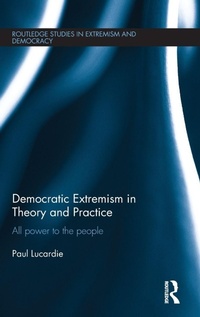
Democratic Extremism in Theory and Practice
All Power to the People
1st Edition
Published on 21. November 2013
Book
Hardback
208 pages
978-0-415-60312-6 (ISBN)
Description
Democracy and extremism are usually considered as opposites. We assume that our system (in the UK, the USA, the Netherlands etc.) is democratic, and extremists try to destroy our system and introduce some kind of dictatorship, if not chaos and anarchy. Yet in many cases, the extremists seem sincere in their attempt to construct a more democratic polity. Hence, they can be called democrats and yet also extremists, in so far as they strive for a regime with characteristics that are more extreme in a significant sense.
This book analyses radical and extreme democratic theories and ideas in their historical context, interlocked with critical descriptions of historical institutions and experiments that help to evaluate the theories. Cases range from ancient Athens to recent experiments with citizen juries and citizen assemblies, from the time-honoured Swiss Landsgemeinde to contemporary (and controversial) workers' councils in Venezuela and participatory budgeting in Porto Alegre. Among the theorists discussed here are familiar names as well as relatively unknown persons: Jean-Jacques Rousseau and Karl Marx, Murray Bookchin and John Burnheim, William Godwin and Barbara Goodwin, Anton Pannekoek and Heinz Dieterich. Whereas the extreme ideas do not seem to work very well in practice, they do indicate ways by which we could make existing political systems more democratic.
This book will be of interest to students of Politics and Current Affairs, as well as inspiration to political activists and reformists.
This book analyses radical and extreme democratic theories and ideas in their historical context, interlocked with critical descriptions of historical institutions and experiments that help to evaluate the theories. Cases range from ancient Athens to recent experiments with citizen juries and citizen assemblies, from the time-honoured Swiss Landsgemeinde to contemporary (and controversial) workers' councils in Venezuela and participatory budgeting in Porto Alegre. Among the theorists discussed here are familiar names as well as relatively unknown persons: Jean-Jacques Rousseau and Karl Marx, Murray Bookchin and John Burnheim, William Godwin and Barbara Goodwin, Anton Pannekoek and Heinz Dieterich. Whereas the extreme ideas do not seem to work very well in practice, they do indicate ways by which we could make existing political systems more democratic.
This book will be of interest to students of Politics and Current Affairs, as well as inspiration to political activists and reformists.
More details
Series
Language
English
Place of publication
London
United Kingdom
Publishing group
Taylor & Francis Ltd
Target group
College/higher education
Illustrations
1 s/w Abbildung, 1 s/w Zeichnung, 1 s/w Tabelle
1 Tables, black and white; 1 Line drawings, black and white; 1 Illustrations, black and white
Dimensions
Height: 240 mm
Width: 161 mm
Thickness: 16 mm
Weight
482 gr
ISBN-13
978-0-415-60312-6 (9780415603126)
Copyright in bibliographic data and cover images is held by Nielsen Book Services Limited or by the publishers or by their respective licensors: all rights reserved.
Schweitzer Classification
Other editions
Additional editions
Book
04/2016
1st Edition
Routledge
€57.00
Shipment within 10-20 days
E-Book
12/2013
1st Edition
Routledge
€49.99
Available for download
E-Book
12/2013
1st Edition
Routledge
€49.99
Available for download
Person
Paul Lucardie was affiliated with the Documentation Centre on Dutch Political Parties at the University of Groningen, the Netherlands, from 1979 till 2011. He has done research on Dutch parties, and especially new and extreme parties, as well as on ideologies.
Content
1. Definitions of extremism 2. Revolutionary or libertarian municipalism 3. Varieties of radical democracy 4. Radical Democracy in Action I 5. Radical Democracy in Action II 6. Conclusions