

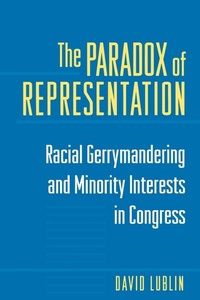
The Paradox of Representation
Racial Gerrymandering and Minority Interests in Congress
Published on 8. August 1999
Book
Paperback/Softback
176 pages
978-0-691-01010-6 (ISBN)
Description
In The Paradox of Representation David Lublin offers an unprecedented analysis of a vast range of rigorous, empirical evidence that exposes the central paradox of racial representation: Racial redistricting remains vital to the election of African Americans and Latinos but makes Congress less likely to adopt policies favored by blacks. Lublin's evidence, together with policy recommendations for improving minority representation, will make observers of the political scene reconsider the avenues to fair representation. Using data on all representatives elected to Congress between 1972 and 1994, Lublin examines the link between the racial composition of a congressional district and its representative's race as well as ideology. The author confirms the view that specially drawn districts must exist to ensure the election of African Americans and Latinos. He also shows, however, that a relatively small number of minorities in a district can lead to the election of a representative attentive to their interests.
When African Americans and Latinos make up 40 percent of a district, according to Lublin's findings, they have a strong liberalizing influence on representatives of both parties; when they make up 55 percent, the district is almost certain to elect a minority representative. Lublin notes that particularly in the South, the practice of concentrating minority populations into a small number of districts decreases the liberal influence in the remaining areas. Thus, a handful of minority representatives, almost invariably Democrats, win elections, but so do a greater number of conservative Republicans. The author proposes that establishing a balance between majority-minority districts and districts where the minority population would be slightly more dispersed, making up 40 percent of a total district, would allow more African Americans to exercise more influence over their representatives.
When African Americans and Latinos make up 40 percent of a district, according to Lublin's findings, they have a strong liberalizing influence on representatives of both parties; when they make up 55 percent, the district is almost certain to elect a minority representative. Lublin notes that particularly in the South, the practice of concentrating minority populations into a small number of districts decreases the liberal influence in the remaining areas. Thus, a handful of minority representatives, almost invariably Democrats, win elections, but so do a greater number of conservative Republicans. The author proposes that establishing a balance between majority-minority districts and districts where the minority population would be slightly more dispersed, making up 40 percent of a total district, would allow more African Americans to exercise more influence over their representatives.
Reviews / Votes
"A soundly reasoned and persuasively argued analysis of a pressing contemporary issue."--ChoiceMore details
Language
English
Place of publication
New Jersey
United States
Target group
Professional and scholarly
College/higher education
Product notice
Paperback (trade)
Illustrations
28 line illus. 15 tables
Dimensions
Height: 234 mm
Width: 156 mm
Thickness: 10 mm
Weight
278 gr
ISBN-13
978-0-691-01010-6 (9780691010106)
Copyright in bibliographic data and cover images is held by Nielsen Book Services Limited or by the publishers or by their respective licensors: all rights reserved.
Schweitzer Classification
Other editions
Additional editions
E-Book
02/2021
1st Edition
Princeton University Press
€48.99
Available for download
Person
David Lublin is Assistant Professor in the Department of Government and International Studies at the University of South Carolina.
Content
List of Figures and TablesPrefaceIntroduction3Pt. IBlack and Latino Descriptive Representation15The History of Black and Latino Representation17The Election of Black and Latino Representatives39Pt. IIBlack and Latino Substantive Representation55African-American and Latino Representation57Race and Representation72Racial Redistricting and Public Policy98The Outlook for the Future120Notes135References147Index155