

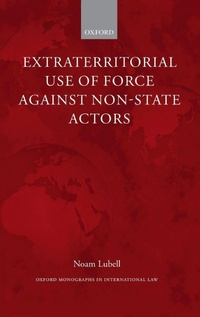
Extraterritorial Use of Force Against Non-State Actors
1st Edition
Published on 27. May 2010
Book
Hardback
312 pages
978-0-19-958484-0 (ISBN)
Description
This book analyses the primary relevant rules of international law applicable to extra-territorial use of force by states against non-state actors. Force in this context takes many forms, ranging from targeted killings and abductions of individuals to large-scale military operations amounting to armed conflict. Actions of this type have occurred in what has become known as the 'war on terror', but are not limited to this context. Three frameworks of international law are examined in detail. These are the United Nations Charter and framework of international law regulating the resort to force in the territory of other states; the law of armed conflict, often referred to as international humanitarian law; and the law enforcement framework found in international human rights law. The book examines the applicability of these frameworks to extra-territorial forcible measures against non-state actors, and analyses the difficulties and challenges presented by application of the rules to these measures.
The issues covered include, among others: the possibility of self-defence against non-state actors, including anticipatory self-defence; the lawfulness of measures which do not conform to the parameters of self-defence; the classification of extra-territorial force against non-state actors as armed conflict; the 'war on terror' as an armed conflict; the laws of armed conflict regulating force against groups and individuals; the extra-territorial applicability of international human rights law; and the regulation of forcible measures under human rights law. Many of these issues are the subject of ongoing and longstanding debate. The focus in this work is on the particular challenges raised by extra-territorial force against non-state actors and the book offers a number of solutions to these challenges.
The issues covered include, among others: the possibility of self-defence against non-state actors, including anticipatory self-defence; the lawfulness of measures which do not conform to the parameters of self-defence; the classification of extra-territorial force against non-state actors as armed conflict; the 'war on terror' as an armed conflict; the laws of armed conflict regulating force against groups and individuals; the extra-territorial applicability of international human rights law; and the regulation of forcible measures under human rights law. Many of these issues are the subject of ongoing and longstanding debate. The focus in this work is on the particular challenges raised by extra-territorial force against non-state actors and the book offers a number of solutions to these challenges.
Reviews / Votes
This book is an important contribution to the discourse on how contemporary international law can react to the challenge of Non-State Actors participating in armed conflicts. Lubell is the first author to bring together the area of international law that regulates the resort to force in the territory of other States, IHL and IHRL with respect to the extraterritorial forcible measures against Non-State Actors in one book. As such, the book serves both as a primer for those who want to familiarize themselves with the system of international law concerning armed conflicts, and -- more particularly -- as an attempt to apply the international law system to Non-State Actors...it is a worthwhile read for students and scholars studying the use of force in international law, and practitioners working in this area. * Hadassa A. Noorda, University of Amsterdam * Lobell's writing is clear, logical, and organized...Lucid and well-argued, Extraterritorial Use of Force against Non-State Actors is recommended for those seeking to better understand international law's treatment of self-defense or non-state actors. * Humza Kazmi, Military Law and the Law War Review * Lubell's study makes a substantial contribution...through a well-argued analysis of the current state of international law applicable to the use of force extraterritorial against non-state actors. * Richard Burchill, Legal Studies * This is a balanced and cogent work on a very topical aspect of the international law on the use of force. The author covers all relevant dimensions: the jus ad bellum, international humanitarian law and international human rights law. The writing is clear, the use of sources and analysis rigorous and convincing. * Sir Michael Wood * Lubell's monograph presents an objective and above all well-balanced account of the law as it currently stands with respect to the use of force against non-State actors...[A] very recommendable read. * German Yearbook of International Law * Lubell's study makes a substantial contribution to this debate through a well-argued analysis of the current state...Lubell's work provides an excellent base for further engagement with these difficult issues. * Richard Burchill, Legal Studies * Libraries, professors, researchers, and international decision-makers would be far better equipped for their respective tasks by including this book on their must read list. Novices and seasoned publicists will appreciate the insightful, provocative, and common sense approach herein presented. It is a superbly written mini-treatise on self-defense and the evolving principles which govern - and should govern - the contemporary challenges posed by non-State actors. * ASIL * ...the book contains a thorough, detailed, and accomplished discussion of the law that applies to the extraterritorial use of force against non-state actors. * Nicholas Tsagourias, University of Glasgow *More details
Series
Language
English
Place of publication
Oxford
United Kingdom
Target group
College/higher education
Professional and scholarly
Scholars and students of international law and the use of force; government and NGO legal officers working in the area; practitioners involved in cases concerning the use of force; scholars and students of international relations
Dimensions
Height: 240 mm
Width: 161 mm
Thickness: 21 mm
Weight
634 gr
ISBN-13
978-0-19-958484-0 (9780199584840)
Copyright in bibliographic data and cover images is held by Nielsen Book Services Limited or by the publishers or by their respective licensors: all rights reserved.
Schweitzer Classification
Other editions
Additional editions
Book
08/2011
Oxford University Press
€85.00
Shipment within 15-20 days
E-Book
05/2010
1st Edition
OUP eBook
€33.99
Available for download
E-Book
05/2010
1st Edition
OUP eBook
€33.99
Available for download
Person
Dr. Noam Lubell is a Lecturer in international law at the Irish Centre for Human Rights, National University of Ireland, Galway. In previous years he was the Co-Director of an International Law Clinic at the Concord Research Centre in Israel, a Visiting Research Fellow at the Hebrew University, Jerusalem, and prior to that he was a Senior Researcher at the Human Rights Centre at the University of Essex. He has taught courses on international human rights law and the laws of armed conflict in a number of academic institutions, in the UK, Israel, Ireland, and the US. Alongside his academic work Dr. Lubell has worked with various human rights organisations and has provided consultancies and training in human rights law and the laws of armed conflict for a variety of governmental and non-governmental bodies.
Content
Introduction ; PART I: THE INTER-STATE RELATIONSHIP: EXTRATERRITORIAL USE OF FORCE AND SELF-DEFENCE AGAINST NON-STATE ACTORS ; 1. The Possibility of Self-Defence Against Non-State Actors ; 2. The Parameters of Self-Defence ; 3. Measures Taken Outside the Self-Defence Framework ; Part I Conclusion ; PART II: INTERNATIONAL HUMANITARIAN LAW ; 4. Force Against Non-State Actors as Armed Conflict ; 5. Non-Traditional Models of Armed Conflict ; 6. Status of Individuals and the Regulation of Force ; Part II Conclusion ; PART III: INTERNATIONAL HUMAN RIGHTS LAW ; 7. The Principal Practices and Primarily Affected Rights ; 8. Extraterritorial Applicability of Human Rights Law ; 9. Concurrent Applicability of International Humanitarian Law and International Human Rights Law ; Part III Conclusion ; Concluding Chapter