

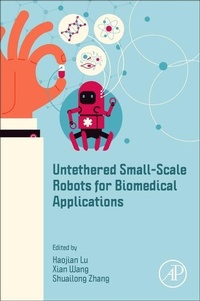
Untethered Small-Scale Robots for Biomedical Applications
Published on 15. June 2023
Book
Paperback/Softback
162 pages
978-0-12-822125-9 (ISBN)
Description
Untethered Small-Scale Robots for Biomedical Applications introduces the principle, design, fabrication and application of small-scale robots for biomedical applications. Robots in the scale of nanometer, micrometer and millimeter are described in detail, along with their impact on the field of biomedical engineering. The selected examples of robots across different scales are of the most essential and innovative designs in a small-scale robot with various application settings for biomechanics characterization, drug delivery and surgical procedure. The representative robots represented operate robustly and safely in complex physiological environments where they have a transformative impact in bioengineering and healthcare.
This book will lead the audience to the field of small-scale robots through the description of the physics in the small scale, design and fabrication of small-scale robots, and how these robots may impact the future of biomedical studies and minimally-invasive surgical procedures.
This book will lead the audience to the field of small-scale robots through the description of the physics in the small scale, design and fabrication of small-scale robots, and how these robots may impact the future of biomedical studies and minimally-invasive surgical procedures.
More details
Language
English
Place of publication
San Diego
United States
Publishing group
Elsevier Science Publishing Co Inc
Target group
Professional and scholarly
Product notice
Paperback (trade)
Unsewn / adhesive bound
Illustrations
Approx. 100 illustrations; Illustrations
Dimensions
Height: 229 mm
Width: 152 mm
Weight
450 gr
ISBN-13
978-0-12-822125-9 (9780128221259)
Copyright in bibliographic data and cover images is held by Nielsen Book Services Limited or by the publishers or by their respective licensors: all rights reserved.
Schweitzer Classification
Other editions
Additional editions
Haojian Lu | Xian Wang | Shuailong Zhang
Untethered Small-Scale Robots for Biomedical Applications
E-Book
06/2023
Academic Press
€131.00
Available for download
Persons
Haojian LU received B.S. degree in mechatronical engineering (1st major) and business administration (2nd major) from Beijing Institute of Technology in 2015. He is currently a doctoral candidate at City University of Hong Kong, and fully expected to receive his Dr. Eng. Degree in Robotics by August 2019. He is interested in the research at the interface of micro/nano robotics, soft robotics, and bioinspired robotics. He has published over 20 peer-reviewed papers in international journals including Nature Communications, Scientific Reports, IEEE Transactions on Robotics, IEEE/ASME Transactions on Mechatronics, IEEE Transactions on Automation Science and Engineering, Applied Physics Letters, Advanced Biosystems, etc. He received best paper finalist awards in 2015 IEEE International Conference on Information and Automation and 2017 ICME International Conference on Complex Medical Engineering. He is also nominated for attending Global Young Scientists Summit 2019 by National Research Foundation (Prime Minister's Office, Singapore). He has served as program committee member for The 2018 IEEE International Conference on Real-time Computing and Robotics, and also peer reviewer for IEEE Robotics and Automation Letters, The IEEE International Conference on Robotics and Automation, The IEEE/RSJ International Conference on Intelligent Robots and Systems, Advanced Engineering Materials. He has become the member of IEEE and AAAS since 2015 and 2017 respectively. Xian WANG received B.S. degree in Engineering from Tianjin University in 2011. He is currently a doctoral candidate at University of Toronto, in the collaborative Ph.D. program in Mechanical Engineering and Biomedical Engineering. He has published over 20 peer-reviewed papers in international journals including Science Robotics, Nature Communications, PNAS, IEEE Transactions on Robotics, Biophysical Journal, and Journal of Cell Science etc. He received best paper award on automation in 2019 IEEE International Conference on Robotics and Automation, Best Poster Presentation in2018 MIE symposium, awarded Ontario Graduate Fellowship and Mitacs Graduate Fellowship in Canada and awarded National Scholarship in China. Based on the excellence in academic, he was entitled to be 2018 Milligan Fellow in University of Toronto. He is currently student member of AAAS, Nature Biomedical Engineering Society, IEEE Robotics and Automation Society, and Biophysical Society, served as peer reviewer for IEEE Robotics and Automation Letters, The IEEE International Conference on Robotics and Automation, and The IEEE/RSJ International Conference on Intelligent Robots and Systems. Prof. Zhang Shuailong is a full professor with School of Mechatronical Engineering in Beijing Institute of Technology under the "National Outstanding Talent Abroad Program?. He completed his PhD in 2015 at the University of Strathclyde (UK) and worked as a postdoc at the University of Glasgow (UK). In 2017, Shuailong joined the University of Toronto (Canada) as a postdoctoral fellow based at Wheeler Microfluidic lab. He has published over 70 papers on peer-reviewed journals and international conferences.
Editor
Professor, College of Control Science and Engineering, Zhejiang University, China
Assistant professor, Department of Mechanical and Materials Engineering, Queen's University at Kingston, Ontario, Canada
Full professor, School of Mechatronical Engineering, Beijing Institute of Technology, PR China
Content
1. Introduction: Small-scale Robots for Biomedical Applications
2. Nanoscale Single Magnetic Particle Robots
3. Ultra-extensible ribbon-like magnetic microswarm
4. Advances in Biohybrid Microrobots Driven By Sperm
5. Minimalist milliscale robot construction by M-spray
6. Optoelectronic Micromachines
7. Milliscale Programmable robots
8. Conclusions
2. Nanoscale Single Magnetic Particle Robots
3. Ultra-extensible ribbon-like magnetic microswarm
4. Advances in Biohybrid Microrobots Driven By Sperm
5. Minimalist milliscale robot construction by M-spray
6. Optoelectronic Micromachines
7. Milliscale Programmable robots
8. Conclusions