

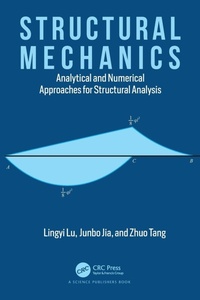
Structural Mechanics
Analytical and Numerical Approaches for Structural Analysis
1st Edition
Published on 7. October 2024
Book
Paperback/Softback
250 pages
978-0-367-55915-1 (ISBN)
Description
This book covers both standard and advanced topics of structural mechanics. Standard subjects covered include geometric stability, forces and displacements of statically determinate structures, force and displacement method, and influence lines. Advanced topics include matrix displacement method, dynamics of structures, and limit loading. The book serves both as a classroom textbook and as a permanent engineering reference. It is written in such a way that it can be followed by anyone with a basic knowledge of classical and material mechanics.
More details
Language
English
Place of publication
London
United Kingdom
Publishing group
Taylor & Francis Ltd
Target group
Professional and scholarly
Academic
Illustrations
320 s/w Abbildungen, 320 s/w Zeichnungen, 15 s/w Tabellen
15 Tables, black and white; 320 Line drawings, black and white; 320 Illustrations, black and white
Dimensions
Height: 234 mm
Width: 156 mm
Thickness: 14 mm
Weight
401 gr
ISBN-13
978-0-367-55915-1 (9780367559151)
Copyright in bibliographic data and cover images is held by Nielsen Book Services Limited or by the publishers or by their respective licensors: all rights reserved.
Schweitzer Classification
Other editions
Additional editions
Lingyi Lu | Junbo Jia | Zhuo Tang
Structural Mechanics
Analytical and Numerical Approaches for Structural Analysis
Book
06/2022
1st Edition
CRC Press
€171.10
Shipment within 15-20 days
Lingyi Lu | Junbo Jia | Zhuo Tang
Structural Mechanics
Analytical and Numerical Approaches for Structural Analysis
E-Book
06/2022
1st Edition
CRC Press
€63.49
Available for download
Lingyi Lu | Junbo Jia | Zhuo Tang
Structural Mechanics
Analytical and Numerical Approaches for Structural Analysis
E-Book
06/2022
1st Edition
CRC Press
€63.49
Available for download
Persons
Lingyi Lu (1963 - 2019) was a Professor in the School of Civil Engineering at Southeast University Nanjing, Jiangsu, China, which he joined in 1994 after obtaining his PhD from the Department of Modern Mechanics at University of Science and Technology of China. His research interests included Nonlinear Dynamics, Random Vibration Theory and their application in Wind Engineering and Seismic Engineering. Professor Lu's research covers a wide range of projects sponsored by the National Natural Science Foundation of China, the National Program on Key Basic Research Projects of China (973 Programs), and the Science Foundation of Ministry of Education of China. The results of his research have also been applied in the design standard of the first AP1000 nuclear power plant in the world, the analysis of the largest crane project in Asia ? 1200-ton Hadi Power Harbor Base, and the construction of the highest special-shaped concrete chimney in China.
Junbo Jia is an engineering expert at Aker Solutions, Norway. He has been extensively involved in engineering projects for offshore and energy industries, associated with different types of offshore and onshore infrastructures. He is a committee member of ISO TC67/SC7 Offshore Structures and an invited expert group member of Eurocode 3. He currently serves as the general secretary of the International Seismic Safety Organization (ISSO) and advisory committee members of several international scientific organizations. He is the sole author of 3 scientific
monographs by Springer and also has an edited volume with CRC Press. He is listed in several global versions of the Who's Who publications. Dr. Jia is an elected member of the Norwegian Academy of Technological Sciences (2019).
Zhuo Tang is currently a Research Scientist in the National Wind Institute at Texas Tech University. Before working at Texas Tech University, Dr. Tang was a researcher at Zhengzhou University, Henan, China, after obtaining his Ph.D. from Southeast University, Nanjing, China. His main research interests are wind effects on engineering structures. He is particularly interested in the research of non-synoptic extreme winds, such as tornadoes and downbursts, and their loading on structures. These interests stem from his time as a Ph.D. student, when he worked on his dissertation on tornado loading of major structures in a nuclear power plant, which is the first AP1000 nuclear power plant in the world, designed by Westinghouse Electric Corporation.
Junbo Jia is an engineering expert at Aker Solutions, Norway. He has been extensively involved in engineering projects for offshore and energy industries, associated with different types of offshore and onshore infrastructures. He is a committee member of ISO TC67/SC7 Offshore Structures and an invited expert group member of Eurocode 3. He currently serves as the general secretary of the International Seismic Safety Organization (ISSO) and advisory committee members of several international scientific organizations. He is the sole author of 3 scientific
monographs by Springer and also has an edited volume with CRC Press. He is listed in several global versions of the Who's Who publications. Dr. Jia is an elected member of the Norwegian Academy of Technological Sciences (2019).
Zhuo Tang is currently a Research Scientist in the National Wind Institute at Texas Tech University. Before working at Texas Tech University, Dr. Tang was a researcher at Zhengzhou University, Henan, China, after obtaining his Ph.D. from Southeast University, Nanjing, China. His main research interests are wind effects on engineering structures. He is particularly interested in the research of non-synoptic extreme winds, such as tornadoes and downbursts, and their loading on structures. These interests stem from his time as a Ph.D. student, when he worked on his dissertation on tornado loading of major structures in a nuclear power plant, which is the first AP1000 nuclear power plant in the world, designed by Westinghouse Electric Corporation.
Content
1. Geometric Stability and Types of Structures 2. Internal Forces in Statically Determinate Structures 3. Deflections of Statically Determinate Structures 4. Force Method 5. Displacement Method 6. Influence Lines for Statically Determinate Structures 7. Matrix Displacement Analysis 8. Dynamics of Structures 9. Limit Loads of Structures