

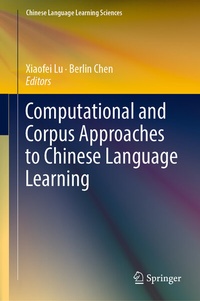
Computational and Corpus Approaches to Chinese Language Learning
Published on 25. February 2019
Book
Hardback
VIII, 269 pages
978-981-13-3569-3 (ISBN)
Description
This book presents a collection of original research articles that showcase the state of the art of research in corpus and computational linguistic approaches to Chinese language teaching, learning and assessment. It offers a comprehensive set of corpus resources and natural language processing tools that are useful for teaching, learning and assessing Chinese as a second or foreign language; methods for implementing such resources and techniques in Chinese pedagogy and assessment; as well as research findings on the effectiveness of using such resources and techniques in various aspects of Chinese pedagogy and assessment.
More details
Series
Edition
2019 ed.
Language
English
Place of publication
Singapore
Singapore
Target group
Professional and scholarly
Illustrations
30 farbige Abbildungen, 77 s/w Abbildungen
VIII, 269 p. 107 illus., 30 illus. in color.
Dimensions
Height: 241 mm
Width: 160 mm
Thickness: 21 mm
Weight
588 gr
ISBN-13
978-981-13-3569-3 (9789811335693)
DOI
10.1007/978-981-13-3570-9
Schweitzer Classification
Other editions
Additional editions
Xiaofei Lu | Berlin Chen
Computational and Corpus Approaches to Chinese Language Learning
E-Book
02/2019
1st Edition
Springer
€96.29
Available for download
Persons
Xiaofei Lu is an Associate Professor of Applied Linguistics and Asian Studies at The Pennsylvania State University, where he directs the graduate programs in the Department of Applied Linguistics. His research interests include corpus linguistics, computational linguistics, intelligent computer-assisted language learning, English for academic purposes, and second language writing. He is the author of
Computational Methods for Corpus Annotation and Analysis
(Springer, 2014), and his work has been published in the
American Educational Research Journal
,
Applied Linguisti
cs,
Educational Researcher
,
English for Specific Purposes
,
International Journal of Corpus Linguistics
,
Journal of Pragmatics
,
Journal of Second Language Writing
,
Language Learning and Technology
,
Language Resources and Evaluation
,
Language Testing
,
ReCALL
,
TESOL Quarterly
, and
The Modern Language Journal
.
Berlin Chen is a Professor and Chair of the Computer Science and Information Engineering Department at National Taiwan Normal University. He received his Ph.D. in Computer Science and Information Engineering from National Taiwan University in June 2001, and joined NTNU as an Assistant Professor in August 2002. He became an Associate Professor in August 2006 and was promoted to the rank of Professor in February 2010. His research interests lie in the general areas of speech and natural language processing, multimedia information retrieval, and computer-assisted language learning. He is the author/coauthor of over 150 academic publications. Prof. Chen is a member of IEEE, ISCA and ACLCLP.
Berlin Chen is a Professor and Chair of the Computer Science and Information Engineering Department at National Taiwan Normal University. He received his Ph.D. in Computer Science and Information Engineering from National Taiwan University in June 2001, and joined NTNU as an Assistant Professor in August 2002. He became an Associate Professor in August 2006 and was promoted to the rank of Professor in February 2010. His research interests lie in the general areas of speech and natural language processing, multimedia information retrieval, and computer-assisted language learning. He is the author/coauthor of over 150 academic publications. Prof. Chen is a member of IEEE, ISCA and ACLCLP.
Content
Part I Introduction.- Computational and Corpus Approaches to Chinese Language Learning: An Introduction.- Usage-based Theory of Language Learning Necessitates Computational and Corpus Methods in Language Teaching.- The Corpus Approach to the Teaching and Learning of Chinese as an L1 and an L2 in Retrospect.- Part II Tools, Resources and General Applications.- Academic Chinese: From Corpora to Language Teaching.- Pedagogical Applications of Chinese Parallel Corpora.- Data-driven Adapting for Fine-tuning Chinese Teaching Materials: Using Corpora as Benchmarks.- Part III Specific Applications.- Context Analysis for Computer-Assisted Near-Synonym Learning.- Visualization of Stylistic Differences between Chinese Synonyms.- Using Corpus-based Analysis of Neologisms on China's New Media for Teaching.- Part IV Learner Language Analysis and Assessment.- Acquisition of the Chinese Particle
le
by L2 Learners: A Corpus-based Approach.- Mandarin Chinese Mispronunciation Detection and Diagnosis Leveraging Deep Neural Network based Acoustic Modeling and Training Techniques.- Automated Chinese Error Diagnosis for Language Learners: Resources and Evaluations.- Automated Chinese Essay Scoring based on Multi-level Linguistic Features.