

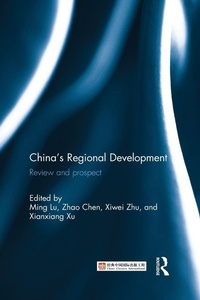
China's Regional Development
Review and Prospect
1st Edition
Published on 22. May 2015
Book
Paperback/Softback
430 pages
978-1-138-91481-0 (ISBN)
Description
China is a large developing economy and it has been deeply involved in globalization since its economic reform and opening-up. Simultaneously, China has seen a significant change in the spatial distribution of economic resources, especially capital and labor. In the recent 10 years, economists have made significant progress in both theoretical and empirical studies on related topics.
The book provides an overview on the existing literature and current policy debates on what we have known and what we have misunderstood. This book includes an analytical framework of the New Economic Geography (NEG) with political economy to help us understand China's regional development issues. The book of 10 chapters is organized into four thematic sections. The first section is a theoretical discussion on the relationship between economic agglomeration and interregional balanced development. The second section is a political economy analysis on regional and urban-rural development. The third section provides a summary on empirical literatures concerning from market segmentation and institutional barriers to production factor mobility. The final section consists of four empirical chapters on the relationship between agglomeration and balance, which is the core of relevant policy debates.
The book argues that for China to achieve both efficiency and balance for regional development, China may need to reform its systems which constrain production factors mobility. This book is a valuable reference for readers who are interested in spatial economics and the Chinese economy, especially its regional and urban development.
The book provides an overview on the existing literature and current policy debates on what we have known and what we have misunderstood. This book includes an analytical framework of the New Economic Geography (NEG) with political economy to help us understand China's regional development issues. The book of 10 chapters is organized into four thematic sections. The first section is a theoretical discussion on the relationship between economic agglomeration and interregional balanced development. The second section is a political economy analysis on regional and urban-rural development. The third section provides a summary on empirical literatures concerning from market segmentation and institutional barriers to production factor mobility. The final section consists of four empirical chapters on the relationship between agglomeration and balance, which is the core of relevant policy debates.
The book argues that for China to achieve both efficiency and balance for regional development, China may need to reform its systems which constrain production factors mobility. This book is a valuable reference for readers who are interested in spatial economics and the Chinese economy, especially its regional and urban development.
More details
Language
English
Place of publication
London
United Kingdom
Publishing group
Taylor & Francis Ltd
Target group
College/higher education
Illustrations
89 s/w Abbildungen, 89 s/w Zeichnungen, 44 s/w Tabellen
44 Tables, black and white; 89 Line drawings, black and white; 89 Illustrations, black and white
Dimensions
Height: 234 mm
Width: 156 mm
Thickness: 24 mm
Weight
676 gr
ISBN-13
978-1-138-91481-0 (9781138914810)
Copyright in bibliographic data and cover images is held by Nielsen Book Services Limited or by the publishers or by their respective licensors: all rights reserved.
Schweitzer Classification
Other editions
Additional editions
E-Book
07/2013
1st Edition
Routledge
€64.49
Available for download
E-Book
07/2013
1st Edition
Routledge
€64.49
Available for download
Book
07/2013
1st Edition
Routledge
€233.10
Shipment within 15-20 days
Persons
Ming Lu is Professor of Economics and Director of Center for Industrial Development Studies at Fudan University, China. He is also Research Fellow of Peking University-Lincoln Institute and Adjunct Professor of Zhejiang University. He has consulted for the World Bank and Asian Development Bank. He has a Ph.D. in Economics from Fudan University. His recent research covers Labor Economics (income distribution, and migration), Regional and Urban Economics (urbanization, and regional development) and Social Economics (social network and economic development).
Zhao Chen is Professor of Economics and Deputy Director of China Centre for Economic Studies at Fudan University, China. His recent research covers development economics (urbanization, migration, income inequality), industrial economics (industry policy, FDI, Outward FDI) and political economy (political connections).
Xiwei Zhu is Associate Professor of Economics at Center for Research of Private Economy, Zhejiang University, China. He obtained his PhD in economics from Zhejiang University in 2005. Currently, his main research interests are new economic geography, industrial organization and international trade.
Xianxiang Xu is Professor of Economics and Chair of Economics department at Sun Yat-sen University, China. His recent research covers economic growth and political elite.
Zhao Chen is Professor of Economics and Deputy Director of China Centre for Economic Studies at Fudan University, China. His recent research covers development economics (urbanization, migration, income inequality), industrial economics (industry policy, FDI, Outward FDI) and political economy (political connections).
Xiwei Zhu is Associate Professor of Economics at Center for Research of Private Economy, Zhejiang University, China. He obtained his PhD in economics from Zhejiang University in 2005. Currently, his main research interests are new economic geography, industrial organization and international trade.
Xianxiang Xu is Professor of Economics and Chair of Economics department at Sun Yat-sen University, China. His recent research covers economic growth and political elite.
Content
I: Economic agglomeration and interregional development; 1: Agglomeration and regional coordination; II: Political economy and analysis; 2: The political economy of regional development in China; 3: The political economy of urban and rural development in China; III: Segmentation and integration; 4: Labor mobility and laggard urbanization under institutional restrictions; 5: Foreign trade, interregional trade, and regional specialization; 6: Transportation infrastructure investment and economic development 1; IV: Agglomeration and balance; 7: The trends in geographical agglomeration of Chinese manufacturing industries; 8: The impact of spatial agglomeration on Chinese manufacturing; 9: Urban spatial structure; 10: The equalized intergovernmental transfer in China