

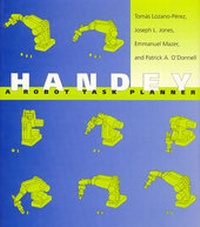
Handey
Robot Task Planner
Published on 1. July 1992
Book
Hardback
252 pages
978-0-262-12172-9 (ISBN)
Description
HANDEY is a task-level robot system that requires only a geometric description of a pick-and-place task rather than the specific robot motions necessary to carry out the task.
HANDEY is a task-level robot system that requires only a geometric description of a pick-and-place task rather than the specific robot motions necessary to carry out the task. The system-building process this book describes is an important step toward eliminating the current programming bottleneck that is keeping robots from fulfilling their scientific and economic potential. The HANDEY system, the state-of-the art technologies for developing it, and the problems encountered are clearly presented, aided by numerous marginal illustrations.
The development of HANDEY is part of the authors' long-term goal of achieving systems that can manipulate a variety of objects in different environments using a wide class of robots. HANDEY has been tested on numerous pick-and-place tasks, including parts ranging from wooden cubes to electric motors; it can be used to generate commands for different types of industrial robots, can coordinate two arms working in the same workspace, and has been tested with a module that locates the position of a specific part in a jumble of other parts.
The first three chapters introduce the HANDEY system and task-level robot programming systems in general, address the problem of planning pick-and-place tasks, review areas of geometric modeling and kinematics required for subsequent chapters, and introduce the concept of configuration space, which plays a prominent role in HANDEY. The next four chapters describe how HANDEY operates.
Tomaacute;s Lozano-Peacute;rez, is a Professor in the Electrical Engineering and Computer Science Department and Associate Director of the Artificial Intelligence Laboratory at the Massachusetts Institute of Technology, where Joseph L. Jones and Patrick A. O'Donnell are Research. Engineers. Emmanuel Mazer is Co-Director of the robotics group of Laboratoire d'Informatique Fondamentale et d'Intelligence in Grenoble, and a CNRS Research Fellow.
HANDEY is a task-level robot system that requires only a geometric description of a pick-and-place task rather than the specific robot motions necessary to carry out the task. The system-building process this book describes is an important step toward eliminating the current programming bottleneck that is keeping robots from fulfilling their scientific and economic potential. The HANDEY system, the state-of-the art technologies for developing it, and the problems encountered are clearly presented, aided by numerous marginal illustrations.
The development of HANDEY is part of the authors' long-term goal of achieving systems that can manipulate a variety of objects in different environments using a wide class of robots. HANDEY has been tested on numerous pick-and-place tasks, including parts ranging from wooden cubes to electric motors; it can be used to generate commands for different types of industrial robots, can coordinate two arms working in the same workspace, and has been tested with a module that locates the position of a specific part in a jumble of other parts.
The first three chapters introduce the HANDEY system and task-level robot programming systems in general, address the problem of planning pick-and-place tasks, review areas of geometric modeling and kinematics required for subsequent chapters, and introduce the concept of configuration space, which plays a prominent role in HANDEY. The next four chapters describe how HANDEY operates.
Tomaacute;s Lozano-Peacute;rez, is a Professor in the Electrical Engineering and Computer Science Department and Associate Director of the Artificial Intelligence Laboratory at the Massachusetts Institute of Technology, where Joseph L. Jones and Patrick A. O'Donnell are Research. Engineers. Emmanuel Mazer is Co-Director of the robotics group of Laboratoire d'Informatique Fondamentale et d'Intelligence in Grenoble, and a CNRS Research Fellow.
More details
Series
Language
English
Place of publication
Cambridge, Mass.
United States
Publishing group
MIT Press Ltd
Target group
College/higher education
Professional and scholarly
Illustrations
illustrations, bibliography, index
Dimensions
Height: 229 mm
Width: 203 mm
Thickness: 22 mm
Weight
681 gr
ISBN-13
978-0-262-12172-9 (9780262121729)
Copyright in bibliographic data and cover images is held by Nielsen Book Services Limited or by the publishers or by their respective licensors: all rights reserved.
Schweitzer Classification