

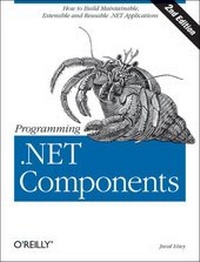
Programming .NET Components
2nd Edition
Published on 12. July 2005
Book
Paperback/Softback
648 pages
978-0-596-00762-1 (ISBN)
Description
Brilliantly compiled by author Juval Lowy, "Programming .NET Components", Second Edition is the consummate introduction to the Microsoft .NET Framework - the technology of choice for building components on Windows platforms. From its many lessons, tips, and guidelines, readers will learn how to use the .NET Framework to program reusable, maintainable, and robust components. Following in the footsteps of its best-selling predecessor, Programming .NET Components, Second Edition has been updated to cover .NET 2.0. It remains one of the few practical books available on this topic. This invaluable resource is targeted at anyone who develops complex or enterprise-level applications with the .NET platform - an ever-widening market. In fact, nearly two million Microsoft developers worldwide now work on such systems. "Programming .NET Components", Second Edition begins with a look at the fundamentals of component-oriented programming and then progresses from there. It takes the time to carefully examine how components can simplify and add flexibility to complex applications by allowing users to extend their capabilities. Next, the book introduces a variety of .NET essentials, as well as .N
ET development techniques. Within this discussion on component development, a separate chapter is devoted to each critical development feature, including asynchronous calls, serialization, remoting, security, and more. All the while, hazardous programming pitfalls are pointed out, saving the reader from experiencing them the hard way. A .NET expert and noted authority on component-oriented programming, Lowy uses his unique access to Microsoft technical teams to the best possible advantage, conveying detailed, insider information in easy-to-grasp, activity-filled language. This hands-on approach is designed to allow individuals to learn by doing rather than just reading. Indeed, after digesting "Programming .NET Components", Second Edition, readers should be able to start developing .NET components immediately.
ET development techniques. Within this discussion on component development, a separate chapter is devoted to each critical development feature, including asynchronous calls, serialization, remoting, security, and more. All the while, hazardous programming pitfalls are pointed out, saving the reader from experiencing them the hard way. A .NET expert and noted authority on component-oriented programming, Lowy uses his unique access to Microsoft technical teams to the best possible advantage, conveying detailed, insider information in easy-to-grasp, activity-filled language. This hands-on approach is designed to allow individuals to learn by doing rather than just reading. Indeed, after digesting "Programming .NET Components", Second Edition, readers should be able to start developing .NET components immediately.
More details
Other editions
New editions
Juval Lowy
Programming .NET Components
Design and Build .NET Applications Using Component-Oriented Programming
Book
08/2005
2nd Edition
O'Reilly
€47.00
Shipment within 10-20 days
Previous edition
Juval Lowy
Programming .NET Components
Book
05/2003
1st Edition
O'Reilly
€32.00
Article exhausted; check for reprint
Person
Juval Lowy is a seasoned software architect and the principal of IDesign, a consulting and training company focused on .NET design and .NET migration. A Microsoft Regional Director for the Silicon Valley, he works with Microsoft on helping the industry adopt .NET. Juval participates in the Microsoft internal design reviews for future versions of .NET. He also helped found Bay.NET - the California Bay Area .NET User Group and he chairs its program committee. Juval is a frequent speaker at the major international software development conferences, where he talks about .NET, component-oriented design, and development process. Juval published numerous articles, regarding almost every aspect of .NET development. He is a contributing editor to the Visual Studio Magazine and a regular columnist to the CoDe Magazine. He has also written for MSDN magazine. Microsoft recognized Juval as a Software Legend as one of the world top .NET experts and industry leaders.
Content
Preface 1. Introducing Component-Oriented Programming Basic Terminology Component-Oriented Versus Object-Oriented Programming Principles of Component-Oriented Programming .NET Adherence to Component Principles Developing .NET Components 2. .NET Component-Oriented Programming Essentials Language Independence: The CLR Packaging and Deployment: Assemblies Binary Compatibility 3. Interface-Based Programming Separating Interface from Implementation Working with Interfaces Interfaces and Generics Designing and Factoring Interfaces Interfaces in Visual Studio 2005 4. Lifecycle Management The Managed Heap Traditional Memory De-allocation Schemas .NET Garbage Collection Object Finalization Deterministic Finalization 5. Versioning Assembly Version Number Assembly Deployment Models Strong Assembly Names Visual Studio 2005 and Versioning Custom Version Policies CLR Versioning 6. Events Delegate-Based Events Working with .NET Events 7. Asynchronous Calls Requirements for an Asynchronous Mechanism Revisiting Delegates Asynchronous Call Programming Models Asynchronous Error Handling Fire-and-Forget Methods Asynchronous Events Asynchronous Invocation Pitfalls Synchronous Versus Asynchronous Processing 8. Multithreading and Concurrency Management Threads and Multithreading Components and Threads Working with Threads Synchronizing Threads Automatic Synchronization Manual Synchronization The WorkerThread Wrapper Class Synchronizing Delegates Using .NET Multithreading Services 9. Serialization and Persistence Automatic Serialization Serialization Formatters Serialization Events Serialization and Streams Custom Serialization Serialization and Class Hierarchies 10. Remoting Application Domains Remote Object Types Marshaling-by-Reference Activation Modes The .NET Remoting Architecture Building a Distributed Application Leasing and Sponsorship .NET and Location Transparency 11. Context and Interception .NET Component Services The .NET Context Custom Component Services 12. Security The .NET Security Architecture Configuring Permissions Programmatic Security Visual Studio 2005 and Security Principal-Based Security Addressing Other Security Issues A. Interface-Based Web Services B. Unifying Windows Forms and ASP.NET Security C. Reflection and Attributes D. Generics E. C# Coding Standard Index