

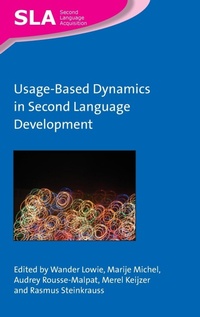
Usage-Based Dynamics in Second Language Development
Published on 14. July 2020
Book
Hardback
328 pages
978-1-78892-524-2 (ISBN)
Description
This book honours the contribution of Marjolijn Verspoor to the development and implementation of dynamic usage-based (DUB) approaches in second language (L2) research and pedagogy. With chapters written by renowned experts in the field, the book addresses the dynamics of language, language learning and language teaching from a usage-based perspective. The book contains both theory and empirical work: the initial theoretical chapters present cutting-edge thinking in relation to both the scope of DUB theory and its applications, providing conceptual perspectives from cognitive grammar and linguistics, thinking-for-speaking (TFS), and Complex Dynamic Systems Theory (CDST) approaches, united by their shared underpinnings of language as a dynamic system of conventionalized routines. The second half of the volume showcases state-of-the-art methodologies to study dynamic trajectories of language learning, empirical investigations into the above-mentioned theoretical concepts, and innovative classroom implementations of DUB language pedagogy.
Reviews / Votes
In 14 contributions, 30 seasoned and novice researchers of linguistics and L2 learning and teaching pay tribute to Marjolijn Verspoor's scholarship. The umbrella provided by the Dynamic Usage-Based (DUB) account of L2 acquisition appears to be much wider than I had thought. DUB clearly is alive (and kicking). Warmly recommended. * Jan Hulstijn, University of Amsterdam, The Netherlands * This volume effectively illustrates how Complex Dynamic Systems Theory (CDST) helps us construct an empirically grounded, ecologically realistic understanding of second language learning, with each chapter exploring a different dimension of the approach. Together, these studies provide us with a real feast of ideas and data, all in support of this new perspective. * Brian MacWhinney, Carnegie Mellon University, USA *More details
Series
Language
English
Place of publication
Bristol
United Kingdom
Target group
College/higher education
Dimensions
Height: 240 mm
Width: 161 mm
Thickness: 22 mm
Weight
658 gr
ISBN-13
978-1-78892-524-2 (9781788925242)
Copyright in bibliographic data and cover images is held by Nielsen Book Services Limited or by the publishers or by their respective licensors: all rights reserved.
Schweitzer Classification
Other editions
Additional editions
Wander Lowie | Marije Michel | Audrey Rousse-Malpat
Usage-Based Dynamics in Second Language Development
Book
07/2020
Multilingual Matters
€61.10
Shipment within 3-4 weeks
Complete work / Part of the work

David Singleton | Simone E. Pfenninger
Second Language Acquisition (Vols 141-150)
Book
Multilingual Matters
€1,032.48
The article will not be published
Persons
Wander Lowie is Full Professor and Chair of the Department of Applied Linguistics, University of Groningen, the Netherlands.
Marije Michel is Associate Professor and Chair of Language Learning, University of Groningen, the Netherlands.
Audrey Rousse-Malpat is Assistant Professor of Language Learning in the European Languages and Cultures program, University of Groningen, the Netherlands.
Merel Keijzer is Full Professor and Chair of English Linguistics and English as a Second Language, University of Groningen, the Netherlands.
Rasmus Steinkrauss is Assistant Professor of Applied Linguistics, University of Groningen, the Netherlands.
Marije Michel is Associate Professor and Chair of Language Learning, University of Groningen, the Netherlands.
Audrey Rousse-Malpat is Assistant Professor of Language Learning in the European Languages and Cultures program, University of Groningen, the Netherlands.
Merel Keijzer is Full Professor and Chair of English Linguistics and English as a Second Language, University of Groningen, the Netherlands.
Rasmus Steinkrauss is Assistant Professor of Applied Linguistics, University of Groningen, the Netherlands.
Content
Contributors
Prologue Kees de Bot
Introduction
Chapter 1. Teresa Cadierno: Thinking for Speaking in an L2: From Research Findings to Pedagogical Implications
Chapter 2. Akira Murakami: On the Sample Size Required to Identify the Longitudinal L2 Development of Complexity and Accuracy Indices
Chapter 3. Bram Bulte & Alex Housen: A DUB-inspired Case Study of Multidimensional L2 Complexity Development: Competing or Connected Growers?
Chapter 4. Hongying Peng, Sake Jager, Steven Thorne, & Wander Lowie: A Holistic Person-centred Approach to Mobile-Assisted Language Learning
Chapter 5. Soren Eskildsen: Creativity and Routinization in L2 English: Two Usage-Based Case-Studies
Chapter 6. Attila Wind & Luke Harding: Attractor States in the Development of Linguistic Complexity in Second Language Writing and the Role of Self-Regulation: A Longitudinal Case Study
Chapter 7. Peter MacIntyre & Samantha Ayers-Glassey: Competence Appraisals: Dynamic Judgements of Communication Competence in Real Time
Chapter 8. Giulia Sulis, Joanna Davidson, & Marije Michel: Dynamic Changes in Motivation and Willingness to Communicate (WTC) in the Second Language (L2) Classroom: A Multiple Case Study
Chapter 9. Ronald W. Langacker: Nested Locatives: Conceptual Basis and Theoretical Import
Chapter 10. Andrea Tyler, Hana Jan, Nargas Mahpeykar, & Brandon Tullock: Getting Out the Word on Phrasal Verbs: It Turns Out Phrasal Verb Construction (PVC) Meanings are Systematic and Teachable
Chapter 11. Leslie Piggott, Elena Tribushinina, & Rick de Graaff: The Icing on the Cake? Effects of Explicit Form-Focused Instruction After Two Years of Implicit EFL Learning
Chapter 12. Tim Kassenberg, Fabio Galati, Diana de Vries-Zhuravleva, & Iryna Menke-Bazhutkina: Film-Language-Integrated-Learning (FLIL): A Usage-Inspired L2 Teaching Approach
Epilogue Diane Larsen-Freeman
Index
Prologue Kees de Bot
Introduction
Chapter 1. Teresa Cadierno: Thinking for Speaking in an L2: From Research Findings to Pedagogical Implications
Chapter 2. Akira Murakami: On the Sample Size Required to Identify the Longitudinal L2 Development of Complexity and Accuracy Indices
Chapter 3. Bram Bulte & Alex Housen: A DUB-inspired Case Study of Multidimensional L2 Complexity Development: Competing or Connected Growers?
Chapter 4. Hongying Peng, Sake Jager, Steven Thorne, & Wander Lowie: A Holistic Person-centred Approach to Mobile-Assisted Language Learning
Chapter 5. Soren Eskildsen: Creativity and Routinization in L2 English: Two Usage-Based Case-Studies
Chapter 6. Attila Wind & Luke Harding: Attractor States in the Development of Linguistic Complexity in Second Language Writing and the Role of Self-Regulation: A Longitudinal Case Study
Chapter 7. Peter MacIntyre & Samantha Ayers-Glassey: Competence Appraisals: Dynamic Judgements of Communication Competence in Real Time
Chapter 8. Giulia Sulis, Joanna Davidson, & Marije Michel: Dynamic Changes in Motivation and Willingness to Communicate (WTC) in the Second Language (L2) Classroom: A Multiple Case Study
Chapter 9. Ronald W. Langacker: Nested Locatives: Conceptual Basis and Theoretical Import
Chapter 10. Andrea Tyler, Hana Jan, Nargas Mahpeykar, & Brandon Tullock: Getting Out the Word on Phrasal Verbs: It Turns Out Phrasal Verb Construction (PVC) Meanings are Systematic and Teachable
Chapter 11. Leslie Piggott, Elena Tribushinina, & Rick de Graaff: The Icing on the Cake? Effects of Explicit Form-Focused Instruction After Two Years of Implicit EFL Learning
Chapter 12. Tim Kassenberg, Fabio Galati, Diana de Vries-Zhuravleva, & Iryna Menke-Bazhutkina: Film-Language-Integrated-Learning (FLIL): A Usage-Inspired L2 Teaching Approach
Epilogue Diane Larsen-Freeman
Index