

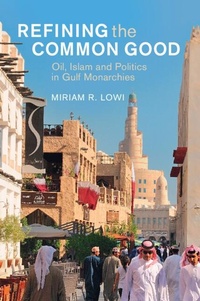
Refining the Common Good
Oil, Islam and Politics in Gulf Monarchies
Published on 21. November 2024
Book
Paperback/Softback
228 pages
978-1-009-46328-7 (ISBN)
Description
How has Islam as a set of beliefs and practices shaped the allocation of oil revenues in Arab Gulf monarchies? In turn, how has oil wealth impacted the role of Islamic doctrine in politics? Refining the Common Good explores the relationship between Islamic norms and the circulation of oil wealth in Gulf monarchies. The study demonstrates how both oil (revenues) and Islam (as doctrine) are manipulated as tools of state power, and how religious norms are refined for the sake of achieving narrow secular interests. Miriam R. Lowi examines different institutionalized practices financed by hydrocarbon revenues and sanctioned, either implicitly or explicitly, by Islam, and uses evidence from Kuwait, Qatar, Oman and Saudi Arabia to show how these practices are infused with political purpose. The dynamic relationship between oil wealth and Islamic doctrine is exploited to contribute to the management and control of society, and the consolidation of dynastic autocracy.
Reviews / Votes
'Lowi explores the material and the moral sides of Gulf politics, showing how they are linked through the political process in general and by regime strategies and tactics in particular.' Nathan J. Brown, George Washington University 'Refining the Common Good is an outstanding book which breaks genuinely new ground - conceptually as well as empirically - in its comparative study of the interplay between religion and distribution in the Gulf States. Miriam Lowi makes a highly original and compelling addition not only to the literature on the political economy of the Gulf States but also to the literature on Islam and politics more broadly.' Kristian Coates Ulrichsen, Rice University 'Refining the Common Good marshals original research on the political economy, religious discourses, and political logics in Arabia. Miriam Lowi vividly argues that in Saudi Arabia, Kuwait, Qatar, and Oman both revenues from hydrocarbons and Islam as a normative system are instrumentalized to achieve the goals of ruling elites, specifically enhancing their privileges and maintaining their control and domination over society. This is a book that will enlighten area experts and enrich scholarship on oil, redistribution, and regime survival.' Arang Keshavarzian, New York UniversityMore details
Series
Language
English
Place of publication
Cambridge
United Kingdom
Target group
College/higher education
Product notice
Paperback (trade)
Illustrations
Worked examples or Exercises
Dimensions
Height: 229 mm
Width: 152 mm
Thickness: 12 mm
Weight
337 gr
ISBN-13
978-1-009-46328-7 (9781009463287)
Copyright in bibliographic data and cover images is held by Nielsen Book Services Limited or by the publishers or by their respective licensors: all rights reserved.
Schweitzer Classification
Other editions
Additional editions
Book
11/2024
Cambridge University Press
€107.00
Shipment within 15-20 days
Person
Miriam R. Lowi is Professor in the Department of Political Science at The College of New Jersey. She is the author of Oil Wealth and the Poverty of Politics: Algeria Compared (Cambridge University Press, 2009) and Water and Power: the Politics of a Scarce Resource in the Jordan River Basin (Cambridge University Press, 1993).
Content
1. Oil and Islam in the Gulf; 2. Islamic norms, interpretations, applications; 3. The state and the political economy of distribution; 4. Society responds; 5. Imported labor: building/appeasing the nation; 6. Charity as politics 'writ small'; 7. Islamic banking and finance: a political economy of accumulation; 8. Reflections on Islam and politics in the oil era.