

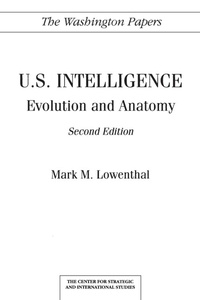
U.S. Intelligence: Evolution and Anatomy
Evolution and Anatomy Second Edition
2nd Edition
Published on 21. August 1992
Book
Paperback/Softback
196 pages
978-0-275-94434-6 (ISBN)
Description
No major twentieth-century power has so short a history of national intelligence agencies or activities as does the United States, and few have been as public or as tumultuous. A major debate has now opened over the future structure, size, and role of U.S. intelligence in the aftermath of the cold war. This unique and fully updated book is a history of the U.S. intelligence community--as well as a detailed description of the organization and function of the major components of the community as they existed at the beginning of 1992. A welcome and timely update of one of the most concise and objective guides to the history and structure of U.S. intelligence. Representative Dave McCurdy, Chairman, Permanent Select Committee on Intelligence, U.S. House of Representatives
The history of the intelligence community can be divided into three distinct periods. From its creation in 1947 until the revelations and investigations of 1974-1975, the intelligence community operated under fairly broad grants of authority based on trust. After the Nixon administration, a previously dormant Congress was galvanized to write new oversight provisions and also took on a greater role as a shaper and consumer of intelligence. With the collapse of the Soviet Union and the end of the cold war in 1991, the intelligence community found its role and even its necessity questioned due to the sudden absence of its major target. Lowenthal emphasizes that a competent and challenged intelligence capability is an essential part of the U.S. national security structure, despite the status of external events or threats. The major requirement of this structure, he says, is providing timely, objective, and pointed analysis to policymakers across a wide range of issues.
The history of the intelligence community can be divided into three distinct periods. From its creation in 1947 until the revelations and investigations of 1974-1975, the intelligence community operated under fairly broad grants of authority based on trust. After the Nixon administration, a previously dormant Congress was galvanized to write new oversight provisions and also took on a greater role as a shaper and consumer of intelligence. With the collapse of the Soviet Union and the end of the cold war in 1991, the intelligence community found its role and even its necessity questioned due to the sudden absence of its major target. Lowenthal emphasizes that a competent and challenged intelligence capability is an essential part of the U.S. national security structure, despite the status of external events or threats. The major requirement of this structure, he says, is providing timely, objective, and pointed analysis to policymakers across a wide range of issues.
More details
Series
Edition
2nd edition
Language
English
Place of publication
United States
Publishing group
Bloomsbury Publishing Plc
Target group
College/higher education
Interest Age: From 7 to 17 years
Dimensions
Height: 234 mm
Width: 156 mm
Thickness: 11 mm
Weight
310 gr
ISBN-13
978-0-275-94434-6 (9780275944346)
Copyright in bibliographic data and cover images is held by Nielsen Book Services Limited or by the publishers or by their respective licensors: all rights reserved.
Schweitzer Classification
Person
MARK M. LOWENTHAL is the senior specialist in U.S. foreign policy at the Congressional Research Service (CRS) of the Library of Congress. From 1985 to 1989, he served in the State Department's Bureau of Intelligence and Research, first as director of the Office of Strategic Forces Analysis and then as deputy assistant secretary for functional analysis. Prior to that he was a specialist in national defense at CRS and also served as head of CRS's Defense/Arms Control and Europe/Middle East/Africa sections. His publications include Leadership and Indecision: American War Planning and Policy Proccess, 1937-1942, as well as numerous articles and congressional studies on national security issues.
Content
Foreword
Summary
The Evolution of U.S. Intelligence
Antecedents of the Modern U.S. Intelligence Community
The National Security Apparatus
The Age of Smith and Dulles
Intelligence and an Activist Foreign Policy
The Great Intelligence Investigation
Politicized Intelligence
A "Restored" Intelligence Community
Intelligence in the Post-Cold War World
Observations
The Anatomy of U.S. Intelligence
Central Coordination and Management
Intelligence Agencies and Components
Oversight Bodies
Observations
Notes
Index
Summary
The Evolution of U.S. Intelligence
Antecedents of the Modern U.S. Intelligence Community
The National Security Apparatus
The Age of Smith and Dulles
Intelligence and an Activist Foreign Policy
The Great Intelligence Investigation
Politicized Intelligence
A "Restored" Intelligence Community
Intelligence in the Post-Cold War World
Observations
The Anatomy of U.S. Intelligence
Central Coordination and Management
Intelligence Agencies and Components
Oversight Bodies
Observations
Notes
Index