

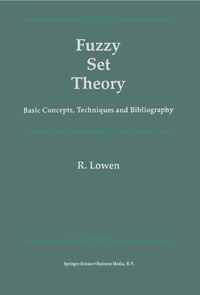
Fuzzy Set Theory
Basic Concepts, Techniques and Bibliography
Published on 31. May 1996
Book
Hardback
XIV, 408 pages
978-0-7923-4057-7 (ISBN)
Description
The purpose of this book is to provide the reader who is interested in applications of fuzzy set theory, in the first place with a text to which he or she can refer for the basic theoretical ideas, concepts and techniques in this field and in the second place with a vast and up to date account of the literature. Although there are now many books about fuzzy set theory, and mainly about its applications, e. g. in control theory, there is not really a book available which introduces the elementary theory of fuzzy sets, in what I would like to call "a good degree of generality". To write a book which would treat the entire range of results concerning the basic theoretical concepts in great detail and which would also deal with all possible variants and alternatives of the theory, such as e. g. rough sets and L-fuzzy sets for arbitrary lattices L, with the possibility-probability theories and interpretations, with the foundation of fuzzy set theory via multi-valued logic or via categorical methods and so on, would have been an altogether different project. This book is far more modest in its mathematical content and in its scope.
More details
Edition
1996 ed.
Language
English
Place of publication
Dordrecht
Netherlands
Target group
Professional and scholarly
Research
Illustrations
XIV, 408 p.
Dimensions
Height: 241 mm
Width: 160 mm
Thickness: 28 mm
Weight
805 gr
ISBN-13
978-0-7923-4057-7 (9780792340577)
DOI
10.1007/978-94-015-8741-9
Schweitzer Classification
Other editions
Additional editions
Book
12/2010
Springer
€106.99
Shipment within 15-20 days
Person
Robert Lowen is an author of more than 140 journal publications and four books, Promotor of 16 PhD theses, Founding Editor and Editor-in-Chief of Applied Categorical Structures, Associate Editor of 3 other mathematical journals, Member of the Scientific Committees of national and several international Science Foundations.
Content
1 Elementary Set Theory.- Section 1 Sets and subsets.- Section 2 Functions and relations.- Section 3 Partially ordered sets.- Section 4 The lattice of subsets of a set.- Section 5 Characteristic functions.- Section 6 Notes.- 2 Fuzzy Sets.- Section 1 Definitions and examples.- Section 2 Lattice theoretical operations on fuzzy sets.- Section 3 Pseudocomplementation.- Section 4 Fuzzy sets, functions and fuzzy relations.- Section 5 ?-levels.- Section 6 Notes.- 3 t-Norms, t-Conorms and Negations.- Section 1 Pointwise extensions.- Section 2 t-Norms and t-Conorms.- Section 3 Negations.- Section 4 Notes.- 4 Special Types of Fuzzy Sets.- Section 1 Normal fuzzy sets.- Section 2 Convex fuzzy sets.- Section 3 Piecewise linear fuzzy sets.- Section 4 Compact fuzzy sets.- Section 5 Notes.- 5 Fuzzy Real Numbers.- Section 1 The probabilistic view.- Section 2 The non-probabilistic view.- Section 3 Interpolation.- Section 4 Notes.- 6 Fuzzy Logic.- Section 1 Connectives in classical logic.- Section 2 Fundamental classical theorems.- Section 3 Basic principles of fuzzy logic.- Section 4 Lattice generated fuzzy connectives.- Section 5 t-Norm generated fuzzy connectives.- Section 6 Probabilistically generated fuzzy connectives.- Section 7 Notes.- 7 Bibliography.- Section 1 Books.- Section 2 Articles.