

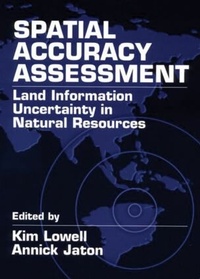
Spatial Accuracy Assessment
Land Information Uncertainty in Natural Resources
1st Edition
Published on 1. March 2000
Book
Hardback
450 pages
978-1-57504-119-3 (ISBN)
Description
Spatial technologies such as GIS and remote sensing are widely used for environmental and natural resource studies. Spatial Accuracy Assessment provides state-of-the-science methods, techniques and real-world solutions designed to validate spatial data, to meet quality assurance objectives, and to ensure cost-effective project implementation and completion. If you use GIS, remote sensing and other spatial mapping technologies for resource management, land use planning, engineering or environmental studies, this vital reference will save you time and money.
More details
Language
English
Place of publication
London
United Kingdom
Target group
College/higher education
Professional and scholarly
Dimensions
Height: 229 mm
Width: 152 mm
Weight
1387 gr
ISBN-13
978-1-57504-119-3 (9781575041193)
Copyright in bibliographic data and cover images is held by Nielsen Book Services Limited or by the publishers or by their respective licensors: all rights reserved.
Schweitzer Classification
Other editions
Additional editions

Kim Lowell | Annick Jaton
Spatial Accuracy Assessment
Land Information Uncertainty in Natural Resources
Other
04/2000
CRC Press
€152.83
Article exhausted; check different version
Kim Lowell | Annick Jaton
Spatial Accuracy Assessment
Land Information Uncertainty in Natural Resources
E-Book
03/2000
1st Edition
CRC Press
€211.99
Available for download
Kim Lowell | Annick Jaton
Spatial Accuracy Assessment
Land Information Uncertainty in Natural Resources
E-Book
03/2000
CRC Press
€211.99
Available for download
Persons
Lowell\, Kim; Jaton\, Annick
Content
Chapter 1: Selling uncertainty assessment to the uncertain. Chapter 2: Sensitivity of Decision-making to Spatial Uncertainty. Chapter 3: Methods of Characterizing Uncertainty. Chapter 4: Representing Spatial Uncertainty. Chapter 5: Spatial Uncertainty Models. Chapter 6: Generalization and Aggregation. Chapter 7: Decreasing Spatial Uncertainty. Chapter 2: Sensitivity of Decision-making to Spatial Uncertainty. Chapter 3: Methods of Characterizing Uncertainty. Chapter 4: Representing Spatial Uncertainty. Chapter 5: Spatial Uncertainty Models. Chapter 6: Generalization and Aggregation. Chapter 7: Decreasing Spatial Uncertainty.