

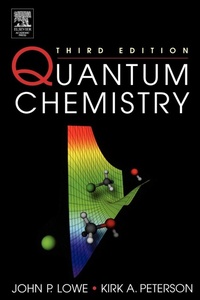
Quantum Chemistry
3rd Edition
Published on 27. October 2005
Book
Hardback
728 pages
978-0-12-457551-6 (ISBN)
Description
Lowe's new edition assumes little mathematical or physical sophistication and emphasizes an understanding of the techniques and results of quantum chemistry. It can serve as a primary text in quantum chemistry courses, and enables students and researchers to comprehend the current literature. This third edition has been thoroughly updated and includes numerous new exercises to facilitate self-study and solutions to selected exercises.
Reviews / Votes
"This new edition is based closely on the already outstanding second edition, with the addition of a co-author and appropriate updating, reworking, and elaboration of the material. The overall quality of this book is on par with the excellent work by Ira N. Leveine, Quantum Chemistry (5th ed., 2000). The authors aim at conceptual understanding as well as mathematical development. The book includes a large and varied set of homework problems, together with hints and brief solutions. A distinctive feature is the inclusion of some multiple-choice questions. Generous numbers of more traditional problems are provided as well. Summing Up: Highly recommended. Upper-division undergraduates through professionals. " --A. Viste, emeritus, Augustana College, CHOICE, September 2006, Vol. 44, No. 1"The book is very well written and in contrast to many other texts it focuses on the understanding of the concepts. This should provide the reader the knowledge to evaluate the various computation methods, and to make informed choices about specific quantum chemical methods for a given problem. Another attractive feature of this book are the end of chapter problems. In summary, this is an excellent text for a graduate level introduction to quantum chemistry and every teacher of these types of classes should give this text serious consideration." --S. Saebo, Mississippi State University, Starkville, MS, USA, STRUCT CHEM (2006)
More details
Edition
3rd edition
Language
English
Place of publication
San Diego
United States
Publishing group
Elsevier Science Publishing Co Inc
Target group
College/higher education
Physical chemists, and organic and inorganic chemists; upper-level undergraduate and first-year graduate students taking quantum chemistry
Edition type
New edition
Product notice
Laminated cover
Dimensions
Height: 269 mm
Width: 192 mm
Thickness: 40 mm
Weight
1446 gr
ISBN-13
978-0-12-457551-6 (9780124575516)
Copyright in bibliographic data and cover images is held by Nielsen Book Services Limited or by the publishers or by their respective licensors: all rights reserved.
Schweitzer Classification
Other editions
Additional editions
John P. Lowe | Kirk Peterson
Quantum Chemistry
E-Book
08/2011
3rd Edition
Academic Press
€71.99
Available for download

John P. Lowe | Kirk Peterson
Quantum Chemistry
Book
09/2005
3rd Edition
Academic Press
€141.22
No shipping information available
Previous edition
John P. Lowe
Quantum Chemistry
Book
06/1993
2nd Edition
Academic Press
€80.59
Article exhausted; check for reprint
Persons
By Dr. John P. Lowe and Kirk Peterson
Content
Dedication
THE MOLECULAR CHALLENGE
Preface to the Third Edition
Preface to the Second Edition
Preface to the First Edition
Chapter 1: Classical Waves and the Time-Independent Schroedinger Wave Equation
Chapter 2: Quantum Mechanics of Some Simple Systems
Chapter 3: The One-Dimensional Harmonic Oscillator
Chapter 4: The Hydrogenlike Ion, Angular Momentum, and the Rigid Rotor
Chapter 5: Many-Electron Atoms
Chapter 6: Postulates and Theorems of Quantum Mechanics
Chapter 7: The Variation Method
Chapter 8: The Simple Hueckel Method and Applications
Chapter 9: Matrix Formulation of the Linear Variation Method
Chapter 10: The Extended Hueckel Method
Chapter 11: The SCF-LCAO-MO Method and Extensions
Chapter 12: Time-Independent Rayleigh-Schroedinger Perturbation Theory
Chapter 13: Group Theory
Chapter 14: Qualitative Molecular Orbital Theory
Chapter 15: Molecular Orbital Theory of Periodic Systems
Appendix 1: Useful Integrals
Appendix 2: Determinants
Appendix 3: Evaluation of the Coulomb Repulsion Integral Over 1s AOs
Appendix 4: Angular Momentum Rules
Appendix 5: The Pairing Theorem
Appendix 6: Hueckel Molecular Orbital Energies, Coefficients, Electron Densities, and Bond Orders for Some Simple Molecules
Appendix 7: Derivation of the Hartree-Fock Equation
Appendix 8: The Virial Theorem for Atoms and Diatomic Molecules
Appendix 9: Bra-ket Notation
Appendix 10: Values of Some Useful Constants and Conversion Factors
Appendix 11: Group Theoretical Charts and Tables
Appendix 12: Hints for Solving Selected Problems
Appendix 13: Answers to Problems
Index
THE MOLECULAR CHALLENGE
Preface to the Third Edition
Preface to the Second Edition
Preface to the First Edition
Chapter 1: Classical Waves and the Time-Independent Schroedinger Wave Equation
Chapter 2: Quantum Mechanics of Some Simple Systems
Chapter 3: The One-Dimensional Harmonic Oscillator
Chapter 4: The Hydrogenlike Ion, Angular Momentum, and the Rigid Rotor
Chapter 5: Many-Electron Atoms
Chapter 6: Postulates and Theorems of Quantum Mechanics
Chapter 7: The Variation Method
Chapter 8: The Simple Hueckel Method and Applications
Chapter 9: Matrix Formulation of the Linear Variation Method
Chapter 10: The Extended Hueckel Method
Chapter 11: The SCF-LCAO-MO Method and Extensions
Chapter 12: Time-Independent Rayleigh-Schroedinger Perturbation Theory
Chapter 13: Group Theory
Chapter 14: Qualitative Molecular Orbital Theory
Chapter 15: Molecular Orbital Theory of Periodic Systems
Appendix 1: Useful Integrals
Appendix 2: Determinants
Appendix 3: Evaluation of the Coulomb Repulsion Integral Over 1s AOs
Appendix 4: Angular Momentum Rules
Appendix 5: The Pairing Theorem
Appendix 6: Hueckel Molecular Orbital Energies, Coefficients, Electron Densities, and Bond Orders for Some Simple Molecules
Appendix 7: Derivation of the Hartree-Fock Equation
Appendix 8: The Virial Theorem for Atoms and Diatomic Molecules
Appendix 9: Bra-ket Notation
Appendix 10: Values of Some Useful Constants and Conversion Factors
Appendix 11: Group Theoretical Charts and Tables
Appendix 12: Hints for Solving Selected Problems
Appendix 13: Answers to Problems
Index