

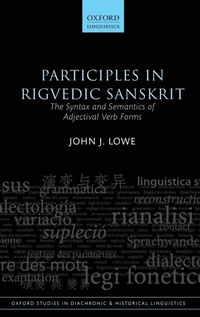
Participles in Rigvedic Sanskrit
The Syntax and Semantics of Adjectival Verb Forms
Published on 23. April 2015
Book
Hardback
434 pages
978-0-19-870136-1 (ISBN)
Description
This book examines several thousand examples of tense-aspect stem participles in the Rigveda, and the passages in which they appear, in terms of both their syntax and semantics. The Rigveda is an ancient collection of sacred Indian hymns, written in Vedic Sanskrit, and is one of the oldest extant texts in any Indo-European language. It is also a poetic text in which deliberate obscurity is the governing aesthetic and in which the rules of language are pushed to their limits in order to produce the ideal poetic expression. Many Vedic sentences are of controversial, disputed meaning, and Vedic scholarship is thus fraught with controversy.
John J. Lowe applies formal linguistic analysis to the data and produces a comprehensive formal model of how participles are used. The author uses his findings to recategorize the data, by defining certain stems and stem-types as outside the synchronic category of participle on the basis of their syntactic and semantic properties. He suggests alternative sources for these forms and considers the linguistic processes that transformed old participles into non-participial entities. In his conclusion he reassesses the category of participles within the verbal and nominal systems, looks at their prehistory in Proto-Indo-European, and describes their universal, typological characteristics. Among his conclusions are that tense-aspect-stem participles have the technical properties of adjectival verbs, not verbal adjectives, and that such participles are not fully dependent on corresponding finite verbal forms. That is, a perfect participle, for example, need not share all the semantic and functional features of the finite perfect forms built to the same stem. These and many other conclusions drawn either directly challenge or radically revise received opinion and recent work.
John J. Lowe applies formal linguistic analysis to the data and produces a comprehensive formal model of how participles are used. The author uses his findings to recategorize the data, by defining certain stems and stem-types as outside the synchronic category of participle on the basis of their syntactic and semantic properties. He suggests alternative sources for these forms and considers the linguistic processes that transformed old participles into non-participial entities. In his conclusion he reassesses the category of participles within the verbal and nominal systems, looks at their prehistory in Proto-Indo-European, and describes their universal, typological characteristics. Among his conclusions are that tense-aspect-stem participles have the technical properties of adjectival verbs, not verbal adjectives, and that such participles are not fully dependent on corresponding finite verbal forms. That is, a perfect participle, for example, need not share all the semantic and functional features of the finite perfect forms built to the same stem. These and many other conclusions drawn either directly challenge or radically revise received opinion and recent work.
Reviews / Votes
There can be no doubt that this ambitious and higly successful work represents a milestone in the study of Rigvedic syntax and semantics. * Eystein Dahl, Journal of Historical Linguistics *More details
Series
Language
English
Place of publication
Oxford
United Kingdom
Target group
College/higher education
Dimensions
Height: 240 mm
Width: 161 mm
Thickness: 28 mm
Weight
813 gr
ISBN-13
978-0-19-870136-1 (9780198701361)
Copyright in bibliographic data and cover images is held by Nielsen Book Services Limited or by the publishers or by their respective licensors: all rights reserved.
Schweitzer Classification
Other editions
Additional editions
E-Book
04/2015
1st Edition
OUP eBook
€74.49
Available for download
Person
John J. Lowe is a Leverhulme Early Career Research Fellow in the Faculty of Linguistics, Philology, and Phonetics at the University of Oxford, and a Postdoctoral Fellow at Christ Church, Oxford. He has published papers in a number of linguistic and philological journals, including Natural Language and Linguistic Theory, Transactions of the Philological Society, and Historische Sprachforschung.
Content
1. Introduction ; 2. The Rigvedic Sanskrit language ; 3. Lexical-Functional Grammar ; 4. The syntax of participles ; 5. The semantics of participles ; 6. The category of participles ; 7. Conclusion ; Appendix: Participles in the Indian Grammatical Tradition ; References ; Index