

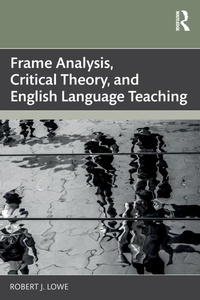
Frame Analysis, Critical Theory, and English Language Teaching
1st Edition
Published on 18. August 2025
Book
Paperback/Softback
188 pages
978-1-032-53280-6 (ISBN)
Description
In this book, Robert J. Lowe introduces frame analysis, a qualitative research approach grounded in the critical theory of the early Frankfurt School and framing in the social sciences. Lowe sets out the principles of the frame analysis approach and provides a guide to conducting this kind of research in practice.
Focused on identifying and challenging ideology through immanent critique, Lowe presents a methodological guide and research report. He begins by explaining early critical theory and the frame analysis approach, followed by a detailed example of its application. This example illustrates the key stages: identifying participants' ideological presuppositions through their "master framing," questioning the internal logic of this framing, and presenting contradictions to participants. Finally, the researcher observes reactions and documents emerging counter-framing, marking the first signs of resistance to dominant ideology.
By applying this approach to issues in English language teaching, the book questions some of the ways in which the rhetoric of pluralism and diversity around English as an international language may stand at odds with the realities of a world in which some varieties of the language have more prestige than others. Through the frame analysis approach, the author suggests that researchers can play a role in empowering language learners and users to advocate for a world in which they can take true ownership of the language. Key reading for all qualitative researchers and advanced students in applied linguistics, sociolinguistics, ELT/TESOL and linguistic anthropology.
Focused on identifying and challenging ideology through immanent critique, Lowe presents a methodological guide and research report. He begins by explaining early critical theory and the frame analysis approach, followed by a detailed example of its application. This example illustrates the key stages: identifying participants' ideological presuppositions through their "master framing," questioning the internal logic of this framing, and presenting contradictions to participants. Finally, the researcher observes reactions and documents emerging counter-framing, marking the first signs of resistance to dominant ideology.
By applying this approach to issues in English language teaching, the book questions some of the ways in which the rhetoric of pluralism and diversity around English as an international language may stand at odds with the realities of a world in which some varieties of the language have more prestige than others. Through the frame analysis approach, the author suggests that researchers can play a role in empowering language learners and users to advocate for a world in which they can take true ownership of the language. Key reading for all qualitative researchers and advanced students in applied linguistics, sociolinguistics, ELT/TESOL and linguistic anthropology.
More details
Language
English
Place of publication
London
United Kingdom
Publishing group
Taylor & Francis Ltd
Target group
College/higher education
Professional and scholarly
Postgraduate and Professional
Illustrations
2 s/w Abbildungen, 2 s/w Photographien bzw. Rasterbilder
2 Halftones, black and white; 2 Illustrations, black and white
Dimensions
Height: 234 mm
Width: 156 mm
Thickness: 11 mm
Weight
307 gr
ISBN-13
978-1-032-53280-6 (9781032532806)
Copyright in bibliographic data and cover images is held by Nielsen Book Services Limited or by the publishers or by their respective licensors: all rights reserved.
Schweitzer Classification
Other editions
Additional editions
E-Book
08/2025
1st Edition
Routledge
€55.49
Available for download
E-Book
08/2025
1st Edition
Routledge
€55.49
Available for download
Book
08/2025
1st Edition
Routledge
€206.10
Shipment within 10-20 days
Person
Robert J. Lowe is an associate professor in the Department of Languages and Culture, Ochanomizu University, Japan.
Content
Acknowledgements
Chapter 1
Introducing the book: Goals and structure
Chapter 2
Theoretical foundations for a critical approach to ELT research
Chapter 3
Frame analysis, ideology, and critical qualitative research
Chapter 4
Identifying and examining master framing
Chapter 5
Addressing contradictions and fostering counter-framing
Chapter 6
Tracking the post-intervention evolution of framing
Chapter 7
Conclusion
Appendix
Index
Chapter 1
Introducing the book: Goals and structure
Chapter 2
Theoretical foundations for a critical approach to ELT research
Chapter 3
Frame analysis, ideology, and critical qualitative research
Chapter 4
Identifying and examining master framing
Chapter 5
Addressing contradictions and fostering counter-framing
Chapter 6
Tracking the post-intervention evolution of framing
Chapter 7
Conclusion
Appendix
Index