

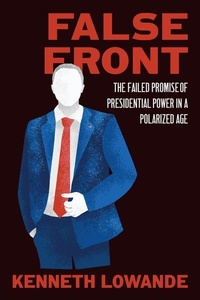
False Front
The Failed Promise of Presidential Power in a Polarized Age
Published on 17. October 2024
Book
Paperback/Softback
240 pages
978-0-226-83725-3 (ISBN)
Description
A provocative new perspective on presidential power.
Border walls, school bathrooms, student loans, gun control, diversity, abortion, climate change-today, nothing seems out of reach for the president's pen. But after all the press releases, ceremonies, and speeches, shockingly little gets done. The American presidency promises to solve America's problems, but presidents' unilateral solutions are often weak, even empty.
Kenneth Lowande argues this is no accident. The US political system is not set up to allow presidents to solve major policy problems, yet it lays these problems at their doorstep, and there is no other elected official better positioned to attract attention by appearing to govern. Like any politician, presidents are strategic actors who seek symbolic wins. They pursue executive actions, even when they know that these will fail, because doing so allows them to put on a compelling show for key constituencies. But these empty presidential actions are not without their costs: they divert energy from effective government-and, over time, undermine public trust. Drawing on thousands of executive actions, news coverage, interviews, and presidential archives, False Front shows that the real root of presidential power is in what presidents can get away with not doing.
Border walls, school bathrooms, student loans, gun control, diversity, abortion, climate change-today, nothing seems out of reach for the president's pen. But after all the press releases, ceremonies, and speeches, shockingly little gets done. The American presidency promises to solve America's problems, but presidents' unilateral solutions are often weak, even empty.
Kenneth Lowande argues this is no accident. The US political system is not set up to allow presidents to solve major policy problems, yet it lays these problems at their doorstep, and there is no other elected official better positioned to attract attention by appearing to govern. Like any politician, presidents are strategic actors who seek symbolic wins. They pursue executive actions, even when they know that these will fail, because doing so allows them to put on a compelling show for key constituencies. But these empty presidential actions are not without their costs: they divert energy from effective government-and, over time, undermine public trust. Drawing on thousands of executive actions, news coverage, interviews, and presidential archives, False Front shows that the real root of presidential power is in what presidents can get away with not doing.
Reviews / Votes
"False Front is an engaging and timely book. It establishes that although the president's executive authority is extensive, presidents are rewarded for the perception that they are governing, not for solving policy problems...this is an important work, one that advances the field and provides an accessible read to all students of presidential power and executive action." * Presidential Studies Quarterly * "False Front provides a new perspective on the incentives for presidential leadership and connects these incentives to presidents' efforts to address the major policy issues of the day. Through a rich tapestry of empirical analyses, Lowande seeks to recast how we understand the presidency as an institution and the president as a political actor. Lowande's provocative argument succeeds in challenging dominant ways of thinking about the presidency and raising urgent questions about the link between presidential behavior and American democracy" -- Jon Rogowski | University of Chicago "False Front is a tour de force that will reorient scholarship on the American presidency. Lowande demonstrates how presidents' incentives to cultivate their public image pervasively drive presidential behavior, often in ways that neglect or compromise good public policy. False Front is a must-read not just for those interested in the American presidency but for those concerned with democratic accountability, public opinion, news media, and the overall performance of U.S. national government." -- Frances Lee | author of "Insecure Majorities: Congress and the Perpetual Campaign" "In this stimulating book, Lowande challenges the conventional wisdom about presidential power. Case-by-case and data point-by-data point he argues that presidential unilateral actions have not delivered what presidents promised. Lowande argues that executive orders and memoranda are less about changing policy than credit-claiming and public relations. It is an important argument about the fundamental power and behavior of modern presidents." -- David E. Lewis | Vanderbilt UniversityMore details
Series
Language
English
Place of publication
Chicago
United States
Publishing group
The University of Chicago Press
Target group
Professional and scholarly
Product notice
Paperback (trade)
Unsewn / adhesive bound
Illustrations
17 halftones, 1 line drawings
Dimensions
Height: 229 mm
Width: 152 mm
Thickness: 15 mm
Weight
381 gr
ISBN-13
978-0-226-83725-3 (9780226837253)
Copyright in bibliographic data and cover images is held by Nielsen Book Services Limited or by the publishers or by their respective licensors: all rights reserved.
Schweitzer Classification
Person
Kenneth Lowande is associate professor of political science and public policy at the University of Michigan, where he is also a faculty associate in the Center for Political Studies at the Institute for Social Research.
Content
1. Presidential Power in a Polarized Age
2. The Presidency for Realists
3. Counting on Action
4. How Presidents Act
5. The Public Demands
6. Most Press Is Good Press
7. Help with What?
8. Executive Power in Democracy
Author's Note
Acknowledgments
Notes
Bibliography
Vignette Bibliographies
Index
2. The Presidency for Realists
3. Counting on Action
4. How Presidents Act
5. The Public Demands
6. Most Press Is Good Press
7. Help with What?
8. Executive Power in Democracy
Author's Note
Acknowledgments
Notes
Bibliography
Vignette Bibliographies
Index