

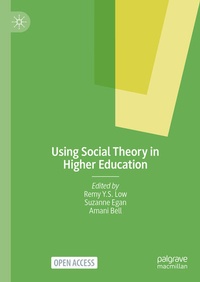
Using Social Theory in Higher Education
Description
Reviews / Votes
"This book is a beautiful demonstration of social theory coming down to earth. Through personal stories, vignettes, anecdotes, and skilful, critical analysis, the varied authors reinforce the legitimacy of social theory grounded in people's lived experiences. This is a timely contribution to our decolonial age, embracing social theory in the most inclusive way, while also acknowledging the challenges and conflicts we face. The book is a stunning statement about the democratisation of social theory in higher education."─Jan McArthur , Senior Lecturer in Education and Social Justice, Department of Educational Research, Lancaster University, UK
"This rich tapestry of deeply personal stories and insightful reflections highlights the usefulness of social theory in educational practice. By describing contexts and stories behind how an author applied social theory in their practice, this book helps readers gauge how they might use social theory in their own contexts. The writing is critical yet accessible, tackling challenging contemporary issues such as social justice, race, and Indigenous Sovereignty, while drawing upon diverse theories originating from around the globe."
─ Maha Bali , Professor of Practice, Center for Learning and Teaching, The American University in Cairo, Egypt
"Books about social theory rarely commence with autobiographical moments but then Using Social Theory in Higher Education is no ordinary publication. From the opening page, when we are invited into Remy's lived experience of 'discovering' the self in theory, I was hooked. This book challenges us to rethink our relationship with theory, not simply as a 'tool' to apply but rather an opportunity for self-learning, or as the authors say, to 'act in the world differently'. Applying theory can be both messy and demanding, but by removing it from the abstract, the book allows theory to be considered in more embodied and nuanced ways, inextricably linked to our stories and life histories."
─Sarah O'Shea , Higher Education Researcher, Curtin University, Australia
"This volume offers a meticulous dissection of and reflection on choices of social theory in the study of higher education. This makes it valuable both to younger scholars starting their research and choosing their conceptual toolkits, and to established scholars reflecting on their own choice of theories. The contributors give attention to a range of emerging theories which challenge the established canons in higher education research."
─Manja Klemencic , Department of Sociology, Faculty of Arts and Sciences, Harvard University, USA
More details
Other editions
Additional editions
Persons
Remy Y.S. Low is Senior Lecturer at the University of Sydney, Australia
Suzanne Egan is Lecturer in the School of Social Sciences, Western Sydney University, Australia
Amani Bell is Associate Professor at the University of Sydney, AustraliaContent
Chapter 1 Other people's ideas: An introduction to using social theory in higher education.- Chapter 2 Sit Down, be Humble: The influence of the Work of Linda Tuhiwai Smith on our research.- Chapter 3 The decolonial imperative - text and context: a response to Amani Bell and Gulwanyang Moran .- Chapter 4 After Belonging: Aileen Moreton-Robinson's 'I Still Call Australia Home' .- Chapter 5 In belonging: a response to Timothy Laurie .- Chapter 6 Deploying Rose and Abi-Rached to 'make sense' of the rise of the 'brain sciences' in the field of violence against women.- Chapter 7 What do we talk about when we talk about neuro? A response to Suzanne Egan.- Chapter 8 The power, passions, and perils of identity: On Chantal Mouffe, .- Chapter 9 Connections, engagements and troubles: a response to Remy Y.S. Low.- Chapter 10 The Foggy Window: Passive empathy and the fight for testimonial reading in neoliberal higher education.- Chapter 11 Performing empathy with neoliberalism, or Kendall Jenneron the streets, Thomas Gradgrind in the sheets: a response to Lauren Weber.- Chapter 12 Understanding higher education enrolment through Michel Foucault's biopolitics.- Chapter 13 Students, biopolitics, and state racism: a response to Ren-Hao Xu.- Chapter 14 Wrestling with monsters: critique, climate change, and comets.- Chapter 15 Still wrestling with monsters: a response to Pat Norman.- Chapter 16 Dialogues between activist knowledge and Southern Theory .- Chapter 17 Approximate Geographies: a response to José Fernando Serrano Amaya.- Chapter 18 The historian as pedagogue: on Hayden White's practical past.- Chapter 19 What stories to tell: a response to Remy Low .- Chapter 20 The good university? Colourful histories, ongoing troubles and changing contexts.- Chapter 21 The good university examined: a response to Meenakshi Krishnaraj, Ren-Hao Xu, and Pat Norman.- Chapter 22 How we use social theory: common threads and concluding thoughts.