

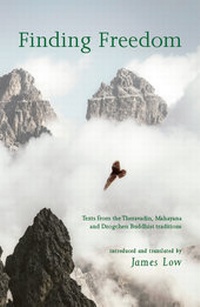
Finding Freedom
Texts from the Theravadin, Mahayana and Dzogchen Buddhist traditions
1st Edition
Published on 4. August 2019
Book
Hardback
292 pages
978-3-942380-27-0 (ISBN)
Description
This book offers three approaches to awakening. The first section, Fighting the Good Fight, is concerned with how we can commit ourselves to the mindful activity of renouncing our familiar and often comforting limiting habits. Here the orientation is towards leaving our familiar ego-home and going on a journey to seek something which seems only to be available elsewhere.
The second section, Mistaken Identities, points to how we can develop the honesty and courage to face our lives as they manifest, resolving our limiting habits and releasing ourselves from misleading identities. Here the orientation is towards recognising how our self-centredness has harmed others and made us blind to our interdependency.
The third section, Sweet Simplicity, is concerned with how we can relax and release ourselves from all limiting habits and thus effortlessly abide in our limitless intrinsic freedom. Here the orientation is towards awakening to the actuality of our mind as it is.
These three sections are quite different in tone, yet are harmonious and compatible in their underlying message of freedom. The Buddha offered all he was to help us, and if we offer ourselves fully to the path we will awaken with the same smile he offers us.
The book contains The Dhammapada by Buddha Shakyamuni, the Sharp Weapon Wheel by Dharmarakshita, and four Dzogchen texts by Tulku Tsulo, Gonpo Wangyal, Ayu Khandro and the famous Kunzang Mönlam - The Evocation of Samantabhadra. All texts were translated from Tibetan by James Low with the guidance of C R Lama and have been revised for this book. Each section is accompanied by a comprehensive introduction that touches the depth and heart of Buddha's teaching and points to the end of sorrow for all beings and the attainment of lasting freedom.
The second section, Mistaken Identities, points to how we can develop the honesty and courage to face our lives as they manifest, resolving our limiting habits and releasing ourselves from misleading identities. Here the orientation is towards recognising how our self-centredness has harmed others and made us blind to our interdependency.
The third section, Sweet Simplicity, is concerned with how we can relax and release ourselves from all limiting habits and thus effortlessly abide in our limitless intrinsic freedom. Here the orientation is towards awakening to the actuality of our mind as it is.
These three sections are quite different in tone, yet are harmonious and compatible in their underlying message of freedom. The Buddha offered all he was to help us, and if we offer ourselves fully to the path we will awaken with the same smile he offers us.
The book contains The Dhammapada by Buddha Shakyamuni, the Sharp Weapon Wheel by Dharmarakshita, and four Dzogchen texts by Tulku Tsulo, Gonpo Wangyal, Ayu Khandro and the famous Kunzang Mönlam - The Evocation of Samantabhadra. All texts were translated from Tibetan by James Low with the guidance of C R Lama and have been revised for this book. Each section is accompanied by a comprehensive introduction that touches the depth and heart of Buddha's teaching and points to the end of sorrow for all beings and the attainment of lasting freedom.
More details
Series
Language
English
Other
Place of publication
Berlin
Germany
Edition type
New edition
Multilingual edition
Product notice
Unsewn / adhesive bound
With ribbon marker(s)
Illustrations
Yamantaka, Yama Dharmaraja, 19. Jahrhundert
Dimensions
Height: 22 cm
Width: 15 cm
Weight
500 gr
ISBN-13
978-3-942380-27-0 (9783942380270)
Schweitzer Classification
Persons
Author
James Low studierte Sozialanthropologie und kam Ende der sechziger Jahre nach Indien und an die Visvabharati-Universität im westbengalischen Shantiniketan. Er wurde Schüler des tibetischen Tantra- und Dzogchen-Meisters Chimed Rigdzin Rinpoche, unter dessen Anleitung er buddhistische Philosophie und Praxis sowie die tibetische Sprache studierte. Gemeinsam mit Rinpoche übersetzte er viele Praxistexte. Er erhielt einen Doktortitel der Nyingma Research Society und unternahm wiederholt ausgedehnte Meditations-Retreats. Seine weiteren Hauptlehrer waren Dudjom Rinpoche (1904-1987), Kangyur Rinpoche (1897-1975) und Kalu Rinpoche (1905-1987).
Zu Beginn der achtziger Jahre arbeitete er in London zunächst als Übersetzer und Tibetisch-Lehrer und wandte sich dann der Psychotherapie zu. Ausgebildet in Psychoanalyse, Gestalt-, Kunst- und Sexualtherapie, arbeitete er im öffentlichen Krankenhaus, in eigener Praxis und als Ausbilder und Supervisor.
Seit 1980 hält er auf Ersuchen seines Mentors in Europa Dharma-Vorträge und Dzogchen-Seminare. In seinem Buch »Aus dem Handgepäck eines tibetischen Yogi« hat James Low Quellentexte der Dzogchen-Tradition übersetzt und erläutert.
ISNI: GND:
ISNI: GND:
Yogini
Ayu Khandro (Long Life Dakini), also known as Dorje Paldrön, lived from 1839 to 1953. She was a practitioner, yogini, and terton of Tibetan Buddhism in Eastern Tibet. An accomplished Dzogchen meditator, she is renowned for her extensive pilgrimages throughout Tibet, long periods of dark retreat[1] practice, the gongter[2] of the practice of the yidam Senge Dongma (the Lion-Faced Dakini), various forms of Chöd,[3] and her lifelong dedication to spiritual practice. The information we have about Ayu Khandro comes from the oral commentary that she personally gave to Chogyal Namkhai Norbu in Dzongsa, 1951. He wrote her namthar, or spiritual biography, which was later published in Women of Wisdom[4] by Tsultrim Allione. Ayu Khandro met, and was taught by, many great masters of her day ; Jamyang Khyentse Wangpo,[5] Jamgon Kongtrul the First, Chokgyur Lingpa,[6] Nyala Pema Dündul, Adzom Drukpa,[7] Togden Rangrig and the ninth Tai Situpa, Pema Nyingche Wangpo. She led the life of a hidden yogini, spending a significant amount of her life in retreat or as a wandering chodma.[8] She was recognised as an emanation of Vajrayogini. from Wikipedia
Ayu Khandro (Long Life Dakini), also known as Dorje Paldrön, lived from 1839 to 1953. She was a practitioner, yogini, and terton of Tibetan Buddhism in Eastern Tibet. An accomplished Dzogchen meditator, she is renowned for her extensive pilgrimages throughout Tibet, long periods of dark retreat[1] practice, the gongter[2] of the practice of the yidam Senge Dongma (the Lion-Faced Dakini), various forms of Chöd,[3] and her lifelong dedication to spiritual practice. The information we have about Ayu Khandro comes from the oral commentary that she personally gave to Chogyal Namkhai Norbu in Dzongsa, 1951. He wrote her namthar, or spiritual biography, which was later published in Women of Wisdom[4] by Tsultrim Allione. Ayu Khandro met, and was taught by, many great masters of her day ; Jamyang Khyentse Wangpo,[5] Jamgon Kongtrul the First, Chokgyur Lingpa,[6] Nyala Pema Dündul, Adzom Drukpa,[7] Togden Rangrig and the ninth Tai Situpa, Pema Nyingche Wangpo. She led the life of a hidden yogini, spending a significant amount of her life in retreat or as a wandering chodma.[8] She was recognised as an emanation of Vajrayogini. from Wikipedia