

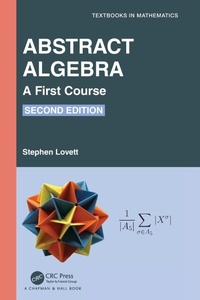
Abstract Algebra
A First Course
2nd Edition
Published on 26. August 2024
Book
Paperback/Softback
557 pages
978-1-032-28941-0 (ISBN)
Description
When a student of mathematics studies abstract algebra, he or she inevitably faces questions in the vein of, "What is abstract algebra" or "What makes it abstract?"
Algebra, in its broadest sense, describes a way of thinking about classes of sets equipped with binary operations. In high school algebra, a student explores properties of operations (+, ?, x, and /) on real numbers.
Abstract algebra studies properties of operations without specifying what types of number or object we work with. Any theorem established in the abstract context holds not only for real numbers but for every possible algebraic structure that has operations with the stated properties.
This textbook intends to serve as a first course in abstract algebra. The selection of topics serves both of the common trends in such a course: a balanced introduction to groups, rings, and fields; or a course that primarily emphasizes group theory.
The writing style is student-centered, conscientiously motivating definitions and offering many illustrative examples. Various sections or sometimes just examples or exercises introduce applications to geometry, number theory, cryptography and many other areas.
This book offers a unique feature in the lists of projects at the end of each section. the author does not view projects as just something extra or cute, but rather an opportunity for a student to work on and demonstrate their potential for open-ended investigation.
The projects ideas come in two flavors: investigative or expository. The investigative projects briefly present a topic and posed open-ended questions that invite the student to explore the topic, asking and to trying to answer their own questions.
Expository projects invite the student to explore a topic with algebraic content or pertain to a particular mathematician's work through responsible research.
The exercises challenge the student to prove new results using the theorems presented in the text. The student then becomes an active participant in the development of the field.
Algebra, in its broadest sense, describes a way of thinking about classes of sets equipped with binary operations. In high school algebra, a student explores properties of operations (+, ?, x, and /) on real numbers.
Abstract algebra studies properties of operations without specifying what types of number or object we work with. Any theorem established in the abstract context holds not only for real numbers but for every possible algebraic structure that has operations with the stated properties.
This textbook intends to serve as a first course in abstract algebra. The selection of topics serves both of the common trends in such a course: a balanced introduction to groups, rings, and fields; or a course that primarily emphasizes group theory.
The writing style is student-centered, conscientiously motivating definitions and offering many illustrative examples. Various sections or sometimes just examples or exercises introduce applications to geometry, number theory, cryptography and many other areas.
This book offers a unique feature in the lists of projects at the end of each section. the author does not view projects as just something extra or cute, but rather an opportunity for a student to work on and demonstrate their potential for open-ended investigation.
The projects ideas come in two flavors: investigative or expository. The investigative projects briefly present a topic and posed open-ended questions that invite the student to explore the topic, asking and to trying to answer their own questions.
Expository projects invite the student to explore a topic with algebraic content or pertain to a particular mathematician's work through responsible research.
The exercises challenge the student to prove new results using the theorems presented in the text. The student then becomes an active participant in the development of the field.
More details
Series
Edition
2nd edition
Language
English
Place of publication
Boca Raton
United Kingdom
Publishing group
Taylor & Francis Ltd
Illustrations
47 s/w Abbildungen, 47 s/w Zeichnungen
47 Line drawings, black and white; 47 Illustrations, black and white
Dimensions
Height: 234 mm
Width: 156 mm
Thickness: 30 mm
Weight
854 gr
ISBN-13
978-1-032-28941-0 (9781032289410)
Copyright in bibliographic data and cover images is held by Nielsen Book Services Limited or by the publishers or by their respective licensors: all rights reserved.
Schweitzer Classification
Other editions
Additional editions
E-Book
07/2022
2nd Edition
Chapman & Hall/CRC
€78.99
Available for download
E-Book
07/2022
2nd Edition
Chapman & Hall/CRC
€78.99
Available for download
Book
07/2022
2nd Edition
Chapman & Hall/CRC
€173.20
Shipment within 10-20 days
Person
Stephen Lovett is an associate professor of mathematics at Wheaton College. He earned a PhD from Northeastern University. He is a member of the Mathematical Association of America, American Mathematical Society, and Association of Christians in the Mathematical Sciences.. His research interests include commutative algebra, algebraic geometry, differential geometry, cryptography, and discrete dynamical systems. Dr. Lovett's other books are: Differential Geometry of Curves and Surfaces, Third Edition with Thomas F. Banchoff, Differential Geometry of Manifolds, Second Edition, and Transition to Advanced Mathematics, with Danilo R. Diedrichs, all from CRC Press.
Content
1. Groups. 1.1. Symmetries of a Regular Polygon. 1.2. Introduction to Groups. 1.3. Properties of Group Elements. 1.4. Concept of a Classification Theorem. 1.5. Symmetric Groups. 1.6. Subgroups. 1.7. Abstract Subgroups. 1.8. Lattice of Subgroups. 1.9. Group Homomorphisms. 1.10. Group Presentations. 1.11. Groups in Geometry. 1.12. Diffie-Hellman Public Key. 1.13. Semigroups and Monoids. 1.14. Projects. 2. Quotient Groups. 2.1. Cosets and Lagrange's Theorem. 2.2. Conjugacy and Normal Subgroups. 2.3. Quotient Groups. 2.4. Isomorphism Theorems. 2.5. Fundamental Theorem of Finitely Generated Abelian Groups. 2.6. Projects. 3. Rings. 3.1. Introduction to Rings. 3.2. Rings Generated by Elements. 3.3. Matrix Rings. 3.4. Ring Homomorphisms. 3.5. Ideals. 3.6. Operations on Ideals. 3.7. Quotient Rings. 3.8. Maximal Ideals and Prime Ideals. 3.9. Projects. 4. Divisibility in Integral Domains. 4.1. Divisibility in Commutative Rings. 4.2. Rings of Fractions. 4.3. Euclidean Domains. 4.4. Unique Factorization Domains. 4.5. Factorization of Polynomials. 4.6. RSA Cryptography. 4.7. Algebraic Integers. 4.8. Projects. 5. Field Extensions. 5.1. Introduction to Field Extensions. 5.2. Algebraic and Transcendental Elements. 5.3. Algebraic Extensions. 5.4. Solving Cubic and Quartic Equations. 5.5. Constructible Numbers. 5.6. Cyclotomic Extensions. 5.7. Splitting Fields and Algebraic Closure. 5.8. Finite Fields. 5.9. Projects. 6. Topics in Group Theory. 6.1. Introduction to Group Actions. 6.2. Orbits and Stabilizers. 6.3. Transitive Group Actions. 6.4. Groups Acting on Themselves. 6.5. Sylow's Theorem. 6.6. Semidirect Product. 6.7. Classification Theorems. A. Appendix. Bibliography. Index.