

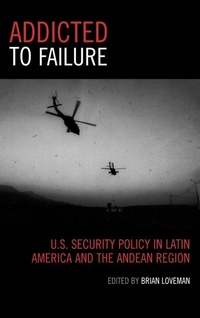
Addicted to Failure
U.S. Security Policy in Latin America and the Andean Region
Published on 11. September 2006
Book
Hardback
394 pages
978-0-7425-4097-2 (ISBN)
Description
For supplementary documentation and useful websites, click here.
This perceptive book critically explores why the United States continues to pursue failed policies in Latin America. What elements of the U.S. and Latin American political systems have allowed the Cold War, the war on drugs, and the war on terror to be conflated? Why do U.S. policies-ostensibly designed to promote the rule of law, human rights, and democracy-instead contribute to widespread corruption, erosion of government authority, human rights violations, and increasing destabilization? Why have the war on drugs and the war on terror neither reduced narcotics trafficking nor increased citizen security in Latin America? Why do Latin American governments, the European Union, and U.S. policymakers often work at cross-purposes when they all claim to be committed to "democratization" and "development" in the region?
Leading scholars answer these questions by detailing the nature of U.S. economic and security strategies in Latin America and the Andean region since 1990. They analyze the impacts and responses to these strategies by policymakers, political leaders, and social movements throughout the region, explaining how programs often generate or exacerbate the very problems they were intended to solve. Reviewing official policy and its defenders and critics alike, this indispensable book focuses on the reasons for the failure of U.S. policies and their disastrous significance for Latin America and the United States alike.
Contributions by: Adrian Bonilla, Pilar Gaitan, Monica Herz, Kenneth Lehman, Brian Loveman, Enrique Obando, Orlando J. Perez, Eduardo Pizarro, Philipp Schoenrock-Martinez, and Juan Gabriel Tokatlian
This perceptive book critically explores why the United States continues to pursue failed policies in Latin America. What elements of the U.S. and Latin American political systems have allowed the Cold War, the war on drugs, and the war on terror to be conflated? Why do U.S. policies-ostensibly designed to promote the rule of law, human rights, and democracy-instead contribute to widespread corruption, erosion of government authority, human rights violations, and increasing destabilization? Why have the war on drugs and the war on terror neither reduced narcotics trafficking nor increased citizen security in Latin America? Why do Latin American governments, the European Union, and U.S. policymakers often work at cross-purposes when they all claim to be committed to "democratization" and "development" in the region?
Leading scholars answer these questions by detailing the nature of U.S. economic and security strategies in Latin America and the Andean region since 1990. They analyze the impacts and responses to these strategies by policymakers, political leaders, and social movements throughout the region, explaining how programs often generate or exacerbate the very problems they were intended to solve. Reviewing official policy and its defenders and critics alike, this indispensable book focuses on the reasons for the failure of U.S. policies and their disastrous significance for Latin America and the United States alike.
Contributions by: Adrian Bonilla, Pilar Gaitan, Monica Herz, Kenneth Lehman, Brian Loveman, Enrique Obando, Orlando J. Perez, Eduardo Pizarro, Philipp Schoenrock-Martinez, and Juan Gabriel Tokatlian
Reviews / Votes
Brian Loveman and his collaborators combine to provide a valuable contribution, one that is enhanced by clear writing, ample referencing, and the high qualifications of all the contributors. . . . A hard-hitting analysis. -- David Scott Palmer, Boston University * Hispanic American Historical Review * [A] scathing and devastating indictment of the ways in which security policy has failed in almost every way imaginable. . . . From an analytical but also, importantly, pedagogical point of view, one of the strengths of Addicted to Failure is its emphasis on primary documents. The chapters are well bound together, not only thematically but also methodologically, bringing official policy statements and postures to the fore. * Latin American Research Review * The story of the United States in Latin America has not changed for a century, just the terminology. The United States is still dumping Monsanto's 'Roundup' on the fields of poor farmers, now in the name of fighting 'narco-terrorism.' The United States is still training Latin American military officers in repression at Fort Benning, now in the name of spreading democracy and markets. The United States is still forging 'military-to-military ties,' only now it's part of the 'global war on terrorism.' Addicted to Failure brilliantly exposes the hypocrisy and deceit of U.S. security policy and imperialist activities in Latin America. -- Chalmers Johnson, author of The Sorrows of EmpireMore details
Series
Language
English
Place of publication
United States
Publishing group
Bloomsbury Publishing Plc
Target group
College/higher education
US School Grade: From College Freshman to College Graduate Student
Dimensions
Height: 235 mm
Width: 157 mm
Thickness: 28 mm
Weight
792 gr
ISBN-13
978-0-7425-4097-2 (9780742540972)
Copyright in bibliographic data and cover images is held by Nielsen Book Services Limited or by the publishers or by their respective licensors: all rights reserved.
Schweitzer Classification
Other editions
Additional editions
E-Book
09/2006
1st Edition
Rowman & Littlefield Publishers
€55.99
Available for download
Person
Brian Loveman is professor of political science and the Fred J. Hansen Chair for Peace Studies at San Diego State University.
Content
Chapter 1: U.S. Security Policies in Latin America and the Andean Region, 1990-2006
Chapter 2: Plan Colombia and the Regional Andean Initiative: Lights and Shadows
Chapter 3: Regional Security Policy and U.S.-Venezuelan Relations
Chapter 4: U.S. Andean Policy, the Colombian Conflict, and Security in Ecuador
Chapter 5: A "Medicine of Death"? U.S. Policy and Political Disarray in Bolivia, 1985-2006
Chapter 6: U.S. Policy toward Peru: At Odds for Twenty Years
Chapter 7: Brazil, Andean Security, and U.S. Regional Security Policy
Chapter 8: The European Union and Security and Defense Policy in the Andean Region
Chapter 9: After Iraq: Next Colombia? The United States and (In)Security in South America
Chapter 2: Plan Colombia and the Regional Andean Initiative: Lights and Shadows
Chapter 3: Regional Security Policy and U.S.-Venezuelan Relations
Chapter 4: U.S. Andean Policy, the Colombian Conflict, and Security in Ecuador
Chapter 5: A "Medicine of Death"? U.S. Policy and Political Disarray in Bolivia, 1985-2006
Chapter 6: U.S. Policy toward Peru: At Odds for Twenty Years
Chapter 7: Brazil, Andean Security, and U.S. Regional Security Policy
Chapter 8: The European Union and Security and Defense Policy in the Andean Region
Chapter 9: After Iraq: Next Colombia? The United States and (In)Security in South America