

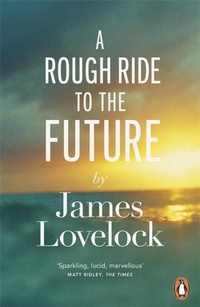
A Rough Ride to the Future
Published on 2. April 2015
Book
Paperback/Softback
208 pages
978-0-241-96141-4 (ISBN)
Description
In A Rough Ride to the Future, James Lovelock - the great scientific visionary of our age - presents a radical vision of humanity's future as the thinking brain of our Earth-system
James Lovelock, who has been hailed as 'the man who conceived the first wholly new way of looking at life on earth since Charles Darwin' (Independent) and 'the most profound scientific thinker of our time' (Literary Review) continues, in his 95th year, to be the great scientific visionary of our age. This book introduces two new Lovelockian ideas. The first is that three hundred years ago, when Thomas Newcomen invented the steam engine, he was unknowingly beginning what Lovelock calls 'accelerated evolution', a process which is bringing about change on our planet roughly a million times faster than Darwinian evolution. The second is that as part of this process, humanity has the capacity to become the intelligent part of Gaia, the self-regulating Earth system whose discovery Lovelock first announced nearly 50 years ago. In addition, Lovelock gives his reflections on how scientific advances are made, and his own remarkable life as a lone scientist.
The contribution of human beings to our planet is, Lovelock contends, similar to that of the early photosynthesisers around 3.4 billion years ago, which made the Earth's atmosphere what it was until very recently. By our domination and our invention, we are now changing the atmosphere again. There is little that can be done about this, but instead of feeling guilty about it we should recognise what is happening, prepare for change, and ensure that we survive as a species so we can contribute to - perhaps even guide - the next evolution of Gaia. The road will be rough, but if we are smart enough life will continue on Earth in some form far into the future.
Elected a Fellow of the Royal Society in 1974, JAMES LOVELOCK is the author of more than 200 scientific papers and the originator of the Gaia Hypothesis (now Gaia Theory). His many books on the subject include Gaia: A New Look at Life on Earth (1979), The Revenge of Gaia (2006), and The Vanishing Face of Gaia (2009). In 2003 he was made a Companion of Honour by Her Majesty the Queen, in 2005 Prospect magazine named him one of the world's top 100 public intellectuals, and in 2006 he received the Wollaston Medal, the highest Award of the UK Geological Society.
James Lovelock, who has been hailed as 'the man who conceived the first wholly new way of looking at life on earth since Charles Darwin' (Independent) and 'the most profound scientific thinker of our time' (Literary Review) continues, in his 95th year, to be the great scientific visionary of our age. This book introduces two new Lovelockian ideas. The first is that three hundred years ago, when Thomas Newcomen invented the steam engine, he was unknowingly beginning what Lovelock calls 'accelerated evolution', a process which is bringing about change on our planet roughly a million times faster than Darwinian evolution. The second is that as part of this process, humanity has the capacity to become the intelligent part of Gaia, the self-regulating Earth system whose discovery Lovelock first announced nearly 50 years ago. In addition, Lovelock gives his reflections on how scientific advances are made, and his own remarkable life as a lone scientist.
The contribution of human beings to our planet is, Lovelock contends, similar to that of the early photosynthesisers around 3.4 billion years ago, which made the Earth's atmosphere what it was until very recently. By our domination and our invention, we are now changing the atmosphere again. There is little that can be done about this, but instead of feeling guilty about it we should recognise what is happening, prepare for change, and ensure that we survive as a species so we can contribute to - perhaps even guide - the next evolution of Gaia. The road will be rough, but if we are smart enough life will continue on Earth in some form far into the future.
Elected a Fellow of the Royal Society in 1974, JAMES LOVELOCK is the author of more than 200 scientific papers and the originator of the Gaia Hypothesis (now Gaia Theory). His many books on the subject include Gaia: A New Look at Life on Earth (1979), The Revenge of Gaia (2006), and The Vanishing Face of Gaia (2009). In 2003 he was made a Companion of Honour by Her Majesty the Queen, in 2005 Prospect magazine named him one of the world's top 100 public intellectuals, and in 2006 he received the Wollaston Medal, the highest Award of the UK Geological Society.
More details
Language
English
Place of publication
London
United Kingdom
Target group
College/higher education
Professional and scholarly
Product notice
Paperback (UK-B)
Dimensions
Height: 198 mm
Width: 126 mm
Thickness: 17 mm
Weight
160 gr
ISBN-13
978-0-241-96141-4 (9780241961414)
Copyright in bibliographic data and cover images is held by Nielsen Book Services Limited or by the publishers or by their respective licensors: all rights reserved.
Schweitzer Classification
Other editions
Additional editions

James Lovelock
A Rough Ride to the Future
E-Book
04/2014
1st Edition
Penguin Books Ltd
€9.49
Available for download
Person
Elected to the Royal Society in 1974, James Lovelock is the originator of Gaia Theory. His many books include Gaia: A New Look at Life on Earth (1979), The Revenge of Gaia (2006), and The Vanishing Face of Gaia (2009). In 2003 he was made a Royal Companion of Honour, in 2005 Prospect placed him among the world's top 100 public intellectuals, and in 2006 he received the Wollaston Medal.