

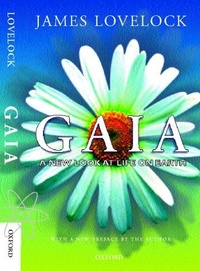
Gaia
A New Look at Life on Earth
Published on 28. September 2000
Book
Paperback/Softback
176 pages
978-0-19-286218-1 (ISBN)
Description
In this classic work that continues to inspire its many readers, Jim Lovelock puts forward his idea that life on earth functions as a single organism. Written for non-scientists, Gaia is a journey through time and space in search of evidence with which to support a new and radically different model of our planet. In contrast to conventional belief that living matter is passive in the face of threats to its existence, the book explores the hypothesis that the earth's living matter air, ocean, and land surfaces forms a complex system that has the capacity to keep the Earth a fit place for life. Since Gaia was first published, many of Jim Lovelock's predictions have come true and his theory has become a hotly argued topic in scientific circles. In a new Preface to this reissued title, he outlines his present state of the debate.
More details
Language
English
Place of publication
Oxford
United Kingdom
Publishing group
Oxford University Press
Illustrations
1 halftone, 8 line drawings
Dimensions
Height: 197 mm
Width: 131 mm
Thickness: 11 mm
Weight
138 gr
ISBN-13
978-0-19-286218-1 (9780192862181)
Copyright in bibliographic data and cover images is held by Nielsen Book Services Limited or by the publishers or by their respective licensors: all rights reserved.
Schweitzer Classification
Other editions
New editions
Book
04/2016
Oxford University Press
€12.03
Available immediately
Person
James Lovelock is an independent scientist, inventor, and author. He was elected Fellow of the Royal Society in 1974 and in 1990 was awarded the first Amsterdam Prize for the Environment by the Royal Netherlands Academy of Arts and Sciences. One of his inventions is the electron capture detector, which was important in the development of environmental awareness. It revealed for the first time the ubiquitous distribution of pesticide residues. He co-operated with NASA and some of his inventions were adopted in their programme of planetary exploration.