

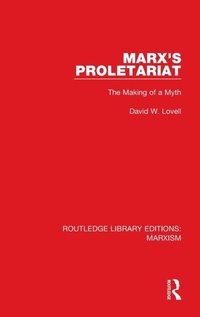
Marx's Proletariat (RLE Marxism)
The Making of a Myth
1st Edition
Published on 8. April 2015
Book
Hardback
274 pages
978-1-138-88852-4 (ISBN)
Description
George Orwell wrote in Nineteen Eighty Four that 'If there is hope, it lies in the proles.' A century earlier Marx was unequivocal: the future belonged to the proletariat. Today such confidence might seem misplaced. The proletariat has not yet fulfilled Marx's expectations, and seems unlikely ever to do so. How could Marx have entertained the notion that the proletariat would emancipate humanity from capitalism and from class rule itself? This book, first published in 1988, attempts an explanation by examining the sources and development of Marx's concept of the proletariat. It contends that this was not only a crucial element in Marx's theory but a significant departure in socialist thought. By examining this concept in detail the book uncovers a major contradiction in Marxian thought: although the proletariat is assigned a momentous task it is chiefly depicted as the class of suffering which is why, historically, it has preferred security to enterprise.
More details
Series
Language
English
Place of publication
London
United Kingdom
Publishing group
Taylor & Francis Ltd
Target group
College/higher education
Dimensions
Height: 240 mm
Width: 161 mm
Thickness: 19 mm
Weight
578 gr
ISBN-13
978-1-138-88852-4 (9781138888524)
Copyright in bibliographic data and cover images is held by Nielsen Book Services Limited or by the publishers or by their respective licensors: all rights reserved.
Schweitzer Classification
Other editions
Additional editions
Book
10/2016
1st Edition
Routledge
€67.11
Shipment within 10-20 days
E-Book
04/2015
Routledge
€52.49
Available for download
E-Book
04/2015
Routledge
€52.49
Available for download
Person
David W. Lovell
Content
1. Introduction 2. The Dialectic of Universal and Particular 3. Sources 4. Marx's Proletariat Challenged 5. A Proletarian Ethic? 6. A Proletarian Ideology? 7. The Proletariat as an Economic Class 9. Conclusion