

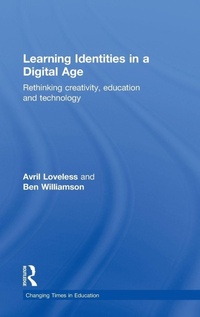
Learning Identities in a Digital Age
Rethinking creativity, education and technology
1st Edition
Published on 28. February 2013
Book
Hardback
208 pages
978-0-415-67571-0 (ISBN)
Description
Digital media are increasingly interwoven into how we understand society and ourselves today. From lines of code to evolving forms of online conduct, they have become an ever-present layer of our age. The rethinking of education has now become the subject of intense global policy debates and academic research, paralleled by the invention and promotion of new learning identities, which are intended to incite teachers and students to think, feel, and act as social operators in schools and beyond.
Learning Identities in a Digital Age provides a critical exploration of how education has been reimagined for the digital future. It argues that education is now the subject of a "cybernetic" mode of thought: a contemporary style of thinking about society and identity that is saturated with metaphors of networks, flexibility, interactivity, and connectedness. This book examines how shifts in thought have translated into fresh ideas about creative learning, interactive tools, curriculum reform, and teacher identity. The text identifies how learning identities have been promoted, and position young people as networked learners, equipped for political, economic and cultural participation in the digital age.
Included in the text:
- mapping the digital age
- reconstructing the future of education
-making up digital learning identities
-assembling creative learning
-thinking with digital tools
- protoyping the curriculum of the future
-being a teacher in a digital age.
This book situates education and technology in an intergenerational and interdisciplinary conversation. It will be of interest to students, researchers and practising education professionals who want to understand the wider sociological and psychological significance of new technologies on education and learner identity.
Learning Identities in a Digital Age provides a critical exploration of how education has been reimagined for the digital future. It argues that education is now the subject of a "cybernetic" mode of thought: a contemporary style of thinking about society and identity that is saturated with metaphors of networks, flexibility, interactivity, and connectedness. This book examines how shifts in thought have translated into fresh ideas about creative learning, interactive tools, curriculum reform, and teacher identity. The text identifies how learning identities have been promoted, and position young people as networked learners, equipped for political, economic and cultural participation in the digital age.
Included in the text:
- mapping the digital age
- reconstructing the future of education
-making up digital learning identities
-assembling creative learning
-thinking with digital tools
- protoyping the curriculum of the future
-being a teacher in a digital age.
This book situates education and technology in an intergenerational and interdisciplinary conversation. It will be of interest to students, researchers and practising education professionals who want to understand the wider sociological and psychological significance of new technologies on education and learner identity.
Reviews / Votes
"This book works on several different levels. It's an enlightening introduction to, and application of, recent (broadly postmodern) theory, which should be of interest to a readership well beyond the field of new technology. It exemplifies a critically reflexive research approach. It's a genealogy of how we have come to view the so-called digital age and an exploration of what these perspectives mean for teachers, students and pedagogies. And finally, it enacts intellectual collaboration and dialogue within its pages between different disciplines, research approaches and theoretical orientations."-Sara Bragg, Research in EducationMore details
Series
Language
English
Place of publication
London
United Kingdom
Publishing group
Taylor & Francis Ltd
Target group
College/higher education
Illustrations
1 s/w Zeichnung, 1 s/w Tabelle
1 Tables, black and white; 1 Line drawings, black and white
Dimensions
Height: 240 mm
Width: 161 mm
Thickness: 16 mm
Weight
482 gr
ISBN-13
978-0-415-67571-0 (9780415675710)
Copyright in bibliographic data and cover images is held by Nielsen Book Services Limited or by the publishers or by their respective licensors: all rights reserved.
Schweitzer Classification
Other editions
Additional editions
Avril Loveless | Ben Williamson
Learning Identities in a Digital Age
Rethinking creativity, education and technology
Book
02/2013
1st Edition
Routledge
€74.20
Shipment within 15-20 days
Avril Loveless | Ben Williamson
Learning Identities in a Digital Age
Rethinking creativity, education and technology
E-Book
02/2013
Routledge
€68.49
Available for download
Avril Loveless | Ben Williamson
Learning Identities in a Digital Age
Rethinking creativity, education and technology
E-Book
02/2013
Routledge
€68.49
Available for download
Persons
Avril Loveless is Professor of Education and Head of Education Research at the University of Brighton, UK, with interests in creativity and pedagogy.
Ben Williamson is Lecturer of Education at the University of Stirling, UK, with particular interests in childhood and new media, curriculum innovation, and science, technology and society.
Ben Williamson is Lecturer of Education at the University of Stirling, UK, with particular interests in childhood and new media, curriculum innovation, and science, technology and society.
Content
1: Shaping Society, Technology and Learning Identity 2: Mapping the Digital Age 3: Reconstructing the Future of Education 4: Making up Digital Learning Identities 5: Assembling Creative Learning 6: Thinking with Digital Tools 7: Prototyping the Curriculum of the Future 8: Being a Teacher in a Digital Age