

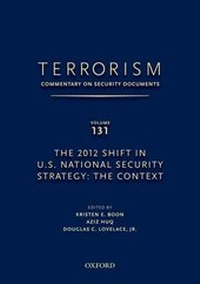
TERRORISM: COMMENTARY ON SECURITY DOCUMENTS VOLUME 131
The 2012 Shift in U.S. National Security Strategy: The Context
Published on 21. March 2013
Book
Hardback
522 pages
978-0-19-997854-0 (ISBN)
Description
Terrorism: Commentary on Security Documents is a series that provides primary source documents and expert commentary on various topics in the worldwide effort to combat terrorism. Among the documents collected are transcripts of Congressional testimony, reports by such federal government bodies as the Congressional Research Service (CRS) and the Government Accountability Office (GAO), United Nations Security Council resolutions, reports and investigations by the United Nations Secretary-General and other dedicated UN bodies, and case law from the U.S. and around the globe covering issues related to terrorism. Most volumes carry a single theme, and inside each volume the documents appear within topic-based categories. The series also includes a subject index and other indices that guide the user through this complex area of the law.
Volume 131, The 2012 Shift in U.S. National Security Strategy: The Context, focuses on the Obama administration's general shift beyond the conflicts in the Middle East and Central Asia and towards a more Asia-Pacific national security strategy in early 2012. In this volume, Professor Douglas Lovelace, Jr., provides a context for the shift and describes its most important components: the multidimensional domestic and international security and economic threats posed by China, the North Korean threat, the rise of Southeast Asian terrorism, and U.S. geostrategic posturing throughout Asia. Professor Lovelace discusses and frames these issues through reports by the U.S. Department of Defense, Congressional Research Service, U.S. Army War College, U.S.-China Economic and Security Commission, and the U.S. General Accountability Office.
Volume 131, The 2012 Shift in U.S. National Security Strategy: The Context, focuses on the Obama administration's general shift beyond the conflicts in the Middle East and Central Asia and towards a more Asia-Pacific national security strategy in early 2012. In this volume, Professor Douglas Lovelace, Jr., provides a context for the shift and describes its most important components: the multidimensional domestic and international security and economic threats posed by China, the North Korean threat, the rise of Southeast Asian terrorism, and U.S. geostrategic posturing throughout Asia. Professor Lovelace discusses and frames these issues through reports by the U.S. Department of Defense, Congressional Research Service, U.S. Army War College, U.S.-China Economic and Security Commission, and the U.S. General Accountability Office.
More details
Series
Language
English
Place of publication
New York
United States
Dimensions
Height: 185 mm
Width: 257 mm
Thickness: 23 mm
Weight
839 gr
ISBN-13
978-0-19-997854-0 (9780199978540)
Copyright in bibliographic data and cover images is held by Nielsen Book Services Limited or by the publishers or by their respective licensors: all rights reserved.
Schweitzer Classification
Persons
Douglas Lovelace, Jr. is the Director of the Strategic Studies Institute at the US Army War College. Earlier in his military career, he worked on national security directives. He holds an MBA degree from Embry Riddle Aeronautical University and a JD from Widener School of Law.
Kristen E Boon is Director of International Programs at Seton Hall University School of Law. Her writings have appeared in the Vanderbilt Journal of Transnational Law and the New York University Journal of International Law. A former clerk to the Supreme Court of Canada's Justice Ian Binnie, she holds an M.A. in Political Science from McGill University and a J.D. from New York University School of Law.
Kristen E Boon is Director of International Programs at Seton Hall University School of Law. Her writings have appeared in the Vanderbilt Journal of Transnational Law and the New York University Journal of International Law. A former clerk to the Supreme Court of Canada's Justice Ian Binnie, she holds an M.A. in Political Science from McGill University and a J.D. from New York University School of Law.
Content
- VOLUME 131
- THE 2012 SHIFT IN U.S. NATIONAL SECURITY STRATEGY: THE CONTEXT
- PREFACE
- INTRODUCTION
- A. THE PEOPLE'S REPUBLIC OF CHINA: THREAT OR OPPORTUNITY?
- Commentary by Douglas C. Lovelace, Jr.
- DOCUMENT NO. 1: Executive Summary of the 2011 Report to Congress of the U.S.-China Economic and Security Review Commission, U.S.-China Economic and Security Review Commission, November 2011
- DOCUMENT NO. 2: Occupying the Information High Ground: Chinese Capabilities for Computer Network Operations and Cyber Espionage, prepared by the Northrop Grumman Corporation for the U.S.-China Economic and Security Review Commission, Bryan Krekel, Patton Adams and George Bakos, March 7, 2011
- DOCUMENT NO. 3: The Chinese Communist Party and Its Emerging Next-Generation Leaders, U.S.-China Economic and Security Review Commission, China Rising Leaders Project Research Report Series: Part 1, John Dotson, Shelly Zhao and Andrew Taffer, March 23, 2012
- DOCUMENT NO. 4: Military and Security Developments Involving the People's Republic of China 2012: A Report to Congress Pursuant to the National Defense Authorization Act for Fiscal Year 2000, Office of the Secretary of Defense, May 2012
- B. THE NORTH KOREA PROBLEM
- Commentary by Douglas C. Lovelace, Jr.
- DOCUMENT NO. 5: Understanding the North Korea Problem: Why It Has Become the "Land of Lousy Options", William Boik, Strategic Studies Institute, U.S. Army War College, July 2011
- C. SOUTHEAST ASIA CONCERNS
- Commentary by Douglas C. Lovelace, Jr.
- DOCUMENT NO. 6: Terrorism in Southeast Asia, CRS Report RL34194, Bruce Vaughn, Emma Chanlett-Avery, Ben Dolven, Mark E. Manyin, Michael F. Martin and Larry A. Niksch, October 16, 2009
- D. U.S. GEOSTRATEGIC POSTURE IN ASIA
- Commentary by Douglas C. Lovelace, Jr.
- DOCUMENT NO. 7: Comprehensive Cost Information and Analysis of Alternatives Needed to Assess Military Posture in Asia, GAO Report 11-316, May 25, 2011
- THE 2012 SHIFT IN U.S. NATIONAL SECURITY STRATEGY: THE CONTEXT
- PREFACE
- INTRODUCTION
- A. THE PEOPLE'S REPUBLIC OF CHINA: THREAT OR OPPORTUNITY?
- Commentary by Douglas C. Lovelace, Jr.
- DOCUMENT NO. 1: Executive Summary of the 2011 Report to Congress of the U.S.-China Economic and Security Review Commission, U.S.-China Economic and Security Review Commission, November 2011
- DOCUMENT NO. 2: Occupying the Information High Ground: Chinese Capabilities for Computer Network Operations and Cyber Espionage, prepared by the Northrop Grumman Corporation for the U.S.-China Economic and Security Review Commission, Bryan Krekel, Patton Adams and George Bakos, March 7, 2011
- DOCUMENT NO. 3: The Chinese Communist Party and Its Emerging Next-Generation Leaders, U.S.-China Economic and Security Review Commission, China Rising Leaders Project Research Report Series: Part 1, John Dotson, Shelly Zhao and Andrew Taffer, March 23, 2012
- DOCUMENT NO. 4: Military and Security Developments Involving the People's Republic of China 2012: A Report to Congress Pursuant to the National Defense Authorization Act for Fiscal Year 2000, Office of the Secretary of Defense, May 2012
- B. THE NORTH KOREA PROBLEM
- Commentary by Douglas C. Lovelace, Jr.
- DOCUMENT NO. 5: Understanding the North Korea Problem: Why It Has Become the "Land of Lousy Options", William Boik, Strategic Studies Institute, U.S. Army War College, July 2011
- C. SOUTHEAST ASIA CONCERNS
- Commentary by Douglas C. Lovelace, Jr.
- DOCUMENT NO. 6: Terrorism in Southeast Asia, CRS Report RL34194, Bruce Vaughn, Emma Chanlett-Avery, Ben Dolven, Mark E. Manyin, Michael F. Martin and Larry A. Niksch, October 16, 2009
- D. U.S. GEOSTRATEGIC POSTURE IN ASIA
- Commentary by Douglas C. Lovelace, Jr.
- DOCUMENT NO. 7: Comprehensive Cost Information and Analysis of Alternatives Needed to Assess Military Posture in Asia, GAO Report 11-316, May 25, 2011