

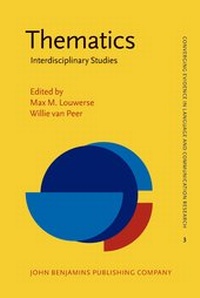
Thematics
Interdisciplinary Studies
Published on 29. May 2002
Book
Hardback
448 pages
978-90-272-3888-7 (ISBN)
Description
Themes play a central role in our everyday communication: we have to know what a text is about in order to understand it. Intended meaning cannot be understood without some knowledge of the underlying theme. This book helps to define the concept of 'themes' in texts and how they are structured in language use.
Much of the literature on Thematics is scattered over different disciplines (literature, psychology, linguistics, cognitive science), which this detailed collection pulls together in one coherent overview. The result is a new landmark for the study and understanding of themes in their everyday manifestation.
Much of the literature on Thematics is scattered over different disciplines (literature, psychology, linguistics, cognitive science), which this detailed collection pulls together in one coherent overview. The result is a new landmark for the study and understanding of themes in their everyday manifestation.
Reviews / Votes
"Thematics: Interdisciplinary Studies", edited by Max Louwerse and Willie van Peer, is obviously an essential book for academics from various disciplines concerned by thematics. The book is well balanced between theoretical and practical aspects. It also demonstrates clearly the importance of an interdisciplinary point of view to the study and analysis of thematics. Furthermore, it presents a good overview of the 'classical' perspective to the problem of thematics. It allows the reader to understand the importance and the complexity of the subject. Researchers concerned by the computational approach to thematic analysis will find in the section "Computational Approaches" very interesting methods of analysis endorsed by relevant experiments. -- Dominic Forest, in Linguist List Vol. 14-2171More details
Series
Language
English
Place of publication
Amsterdam
Netherlands
Target group
College/higher education
Professional and scholarly
Dimensions
Height: 225 mm
Width: 154 mm
Weight
750 gr
ISBN-13
978-90-272-3888-7 (9789027238887)
Copyright in bibliographic data and cover images is held by Nielsen Book Services Limited or by the publishers or by their respective licensors: all rights reserved.
Schweitzer Classification
Other editions
Additional editions
E-Book
05/2002
1st Edition
John Benjamins Publishing Company
€167.99
Available for download
Persons
Content
1. Preface; 2. Introduction (by Louwerse, Max M.); 3. Part I. Structure and processing; 4. Section 1. Theoretical approaches; 5. 1. Psychological and computational research on theme comprehension (by Graesser, Arthur C.); 6. 2. Situation models and themes (by Zwaan, Rolf A.); 7. 3. Conditions of updating during reading (by Oostendorp, Herre van); 8. Section 2. Experimental and corpus linguistic approaches; 9. 4. Evaluation devices as a coordinating mechanism for story points (by Shen, Yeshayahu); 10. 5. Responding to style: Cohesion, foregrounding and thematic interpretation (by Emmott, Catherine); 11. 6. The definite article the as a cue to map thematic information (by Gernsbacher, Morton Ann); 12. 7. Thematic management in Korean (by Kim, Myung-Hee); 13. Section 3. Computational approaches; 14. 8. On the notions of theme and topic in psychological process models of text comprehension (by Kintsch, Walter); 15. 9. Themes and hierarchical structure of written texts (by Le, Elisabeth); 16. 10. Computational retrieval of themes (by Louwerse, Max M.); 17. Part II. Contents and contexts; 18. Section 1. Theoretical approaches; 19. 11. Thematics today (by Sollors, Werner); 20. 12. Seven trends in recent thematics and a case study (by Pettersson, Bo); 21. 13. Where do literary themes come from? (by Peer, Willie van); 22. 14. Motives and motifs in visual thematics (by Roque, Georges); 23. Section 2. Interpretive approaches; 24. 15. Masking one's themes: Irony and the politics of indirectness (by Giora, Rachel); 25. 16. Themes of nation (by Hjort, Mette); 26. 17. Tracking a theme: War in contemporary German literature (by Daemmrich, Horst S.); 27. 18. Why themes matter: Literary knowledge and the thematic example of money (by Wolf, Phillipp); 28. Section 3. Computational approaches; 29. 19. Moving targets: The making and molding of a theme (by Hogenraad, Robert); 30. 20. Quantitative hermeneutics: Inferring the meaning of narratives from trends in their content (by Martindale, Colin); 31. 21. Prototype effect vs. rarity effect in literary style (by Fortier, Paul A.); 32. 22. Parsing for the theme: A computer based approach (by Christoph Meister, Jan); 33. Name index; 34. Subject index