

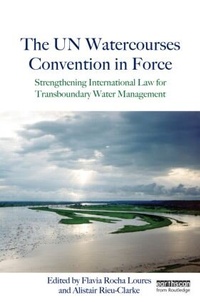
The UN Watercourses Convention in Force
Strengthening International Law for Transboundary Water Management
1st Edition
Published on 13. August 2013
Book
Hardback
392 pages
978-1-84971-446-4 (ISBN)
Description
At the UN General Assembly in 1997, an overwhelming majority of States voted for the adoption of the United Nations Convention on the Law of the Non-Navigational Uses of International Watercourses - a global overarching framework governing the rights and duties of States sharing freshwater systems. Globally, there are 263 internationally shared watersheds, which drain the territories of 145 countries and represent more than forty percent of the Earth's land surface. Hence, inter-State cooperation towards the sustainable management of transboundary water supplies, in accordance with applicable international legal instruments, is a topic of crucial importance, especially in the context of the current global water crisis.
This volume provides an assessment of the role and relevance of the UN Watercourses Convention and describes and evaluates its entry into force as a key component of transboundary water governance. To date, the Convention still requires further contracting States before it can enter into force. The authors describe the drafting and negotiation of the Convention and its relationship to other multilateral environmental agreements. A series of case studies assess the role of the Convention at various levels: regional (European Union, East Africa, West Africa, Central Asia, Central America and South America), river basin (e.g. the Mekong and Congo) and national (e.g. Ethiopia and Mexico). The book concludes by proposing how future implementation might further strengthen international cooperation in the management of water resources, to promote biodiversity conservation as well as sustainable and equitable use.
This volume provides an assessment of the role and relevance of the UN Watercourses Convention and describes and evaluates its entry into force as a key component of transboundary water governance. To date, the Convention still requires further contracting States before it can enter into force. The authors describe the drafting and negotiation of the Convention and its relationship to other multilateral environmental agreements. A series of case studies assess the role of the Convention at various levels: regional (European Union, East Africa, West Africa, Central Asia, Central America and South America), river basin (e.g. the Mekong and Congo) and national (e.g. Ethiopia and Mexico). The book concludes by proposing how future implementation might further strengthen international cooperation in the management of water resources, to promote biodiversity conservation as well as sustainable and equitable use.
More details
Language
English
Place of publication
London
United Kingdom
Publishing group
Taylor & Francis Ltd
Target group
College/higher education
Professional and scholarly
Postgraduate and Professional
Illustrations
5 s/w Abbildungen, 15 s/w Tabellen
15 Tables, black and white; 5 Illustrations, black and white
Dimensions
Height: 234 mm
Width: 156 mm
Weight
840 gr
ISBN-13
978-1-84971-446-4 (9781849714464)
Copyright in bibliographic data and cover images is held by Nielsen Book Services Limited or by the publishers or by their respective licensors: all rights reserved.
Schweitzer Classification
Other editions
Additional editions
Flavia Rocha Loures | Alistair Rieu-Clarke
The UN Watercourses Convention in Force
Strengthening International Law for Transboundary Water Management
Book
10/2017
1st Edition
Routledge
€79.51
Shipment within 10-20 days
Flavia Rocha Loures | Alistair Rieu-Clarke
The UN Watercourses Convention in Force
Strengthening International Law for Transboundary Water Management
E-Book
09/2013
1st Edition
Routledge
€67.49
Available for download
Flavia Rocha Loures | Alistair Rieu-Clarke
The UN Watercourses Convention in Force
Strengthening International Law for Transboundary Water Management
E-Book
09/2013
1st Edition
Routledge
€67.49
Available for download
Persons
Flavia Rocha Loures is a Senior Program Officer, International Law and Policy, in the Freshwater Program of WWF, based in Washington, DC.
Alistair Rieu-Clarke is a Reader in the Centre for Water Law, Policy & Science (under the auspices of UNESCO) at the University of Dundee, UK.
Alistair Rieu-Clarke is a Reader in the Centre for Water Law, Policy & Science (under the auspices of UNESCO) at the University of Dundee, UK.
Content
Part 1: Background and Evolution 1. Introduction 2. The progressive development of international water law 3. Possible Reasons Slowing Down the Ratification Process 4. Misconceptions Regarding the UN Watercourse Convention's Interpretation 5. Why Have States Joined the UN Watercourses Convention? Part 2: Entry into Force and Widespread Endorsement: Potential Effects on International Law and State Practice 6. The Authority and Function of the UN Watercourses Convention 7. Impacts on the International Architecture for Transboundary Waters 8. Factors that Could Limit the Effectiveness of the UN Watercourses Convention upon Entry into Force Part 3: The potential role and relevance of the UN Watercourses Convention in specific regions, basins and countries 9. West Africa 10. Southern Africa 11. Central America 12. Nile River Basin 13. Aral Sea Basin 14. Amazon Basin 15. Mekong Basin 16. Ethiopia 17. El Salvador Part 4: The UN Watercourses Convention, MEAs and International Water and Environmental Policy Goals 18. Convention on Climate Change 19. Convention to Combat Desertification 20. UNECE Water Convention 21. International Development and Environmental Goals Part 5: Beyond Entry into Force: Strengthening the Role and Relevance of the UN Watercourses Convention 22. An Institutional Structure to Support the Implementation Process 23. Filling Gaps: A Protocol to Govern Groundwater Resources of Relevance to International Law 24. Reconciling the UN Watercourses Convention with Recent Developments in Customary International Law Part 6: Emerging Challenges and Future Trends 25. Governing International Watercourses in an Era of Climate Change 26. Benefit Sharing in the UN Watercourses Convention and under International Water Law 27. Water Security - Legal Frameworks and the UN Watercourses Convention 28. Transboundary Water Interactions and the UN Watercourses Convention: Allocating Waters and Implementing Principles