

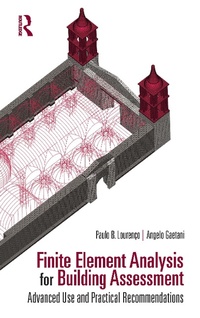
Finite Element Analysis for Building Assessment
Advanced Use and Practical Recommendations
1st Edition
Published on 24. May 2022
Book
Paperback/Softback
404 pages
978-1-032-22839-6 (ISBN)
Description
Existing structures represent a heterogeneous category in the global built environment as often characterized by the presence of archaic materials, damage and disconnections, uncommon construction techniques and subsequent interventions throughout the building history. In this scenario, the common linear elastic analysis approach adopted for new buildings is incapable of an accurate estimation of structural capacity, leading to overconservative results, invasive structural strengthening, added intervention costs, excessive interference to building users and possible losses in terms of aesthetics or heritage values. For a rational and sustainable use of the resources, this book deals with advanced numerical simulations, adopting a practical approach to introduce the fundamentals of Finite Element Method, nonlinear solution procedures and constitutive material models. Recommended material properties for masonry, timber, reinforced concrete, iron and steel are discussed according to experimental evidence, building standards and codes of practice. The examples examined throughout the book and in the conclusive chapter support the analyst's decision-making process toward a safe and efficient use of finite element analysis.
Written primarily for practicing engineers, the book is of value to students in engineering and technical architecture with solid knowledge in the field of continuum mechanics and structural design.
Written primarily for practicing engineers, the book is of value to students in engineering and technical architecture with solid knowledge in the field of continuum mechanics and structural design.
More details
Series
Language
English
Place of publication
London
United Kingdom
Publishing group
Taylor & Francis Ltd
Target group
College/higher education
Professional and scholarly
Postgraduate and Professional
Illustrations
545 s/w Abbildungen, 502 s/w Photographien bzw. Rasterbilder, 43 s/w Zeichnungen, 79 s/w Tabellen
79 Tables, black and white; 43 Line drawings, black and white; 502 Halftones, black and white; 545 Illustrations, black and white
Dimensions
Height: 227 mm
Width: 156 mm
Thickness: 22 mm
Weight
708 gr
ISBN-13
978-1-032-22839-6 (9781032228396)
Copyright in bibliographic data and cover images is held by Nielsen Book Services Limited or by the publishers or by their respective licensors: all rights reserved.
Schweitzer Classification
Other editions
Additional editions
Paulo B. Lourenco | Angelo Gaetani
Finite Element Analysis for Building Assessment
Advanced Use and Practical Recommendations
Book
05/2022
1st Edition
Routledge
€198.08
Shipment within 15-20 days
Paulo B. Lourenco | Angelo Gaetani
Finite Element Analysis for Building Assessment
Advanced Use and Practical Recommendations
E-Book
05/2022
1st Edition
Routledge
€100.99
Available for download
Paulo B. Lourenco | Angelo Gaetani
Finite Element Analysis for Building Assessment
Advanced Use and Practical Recommendations
E-Book
05/2022
1st Edition
Routledge
€100.99
Available for download
Persons
Paulo B. Lourenco is Professor at University of Minho, Portugal. He is Head of the Institute in Sustainability and Innovation in Structural Engineering, and an expert in structural conservation and forensic engineering.
Dr. Angelo Gaetani is a professional structural engineer and consultant in Rome, Italy, who leads structural restoration and seismic retrofit projects. He was a postdoctoral research fellow until 2020 at University of Minho, Portugal.
Dr. Angelo Gaetani is a professional structural engineer and consultant in Rome, Italy, who leads structural restoration and seismic retrofit projects. He was a postdoctoral research fellow until 2020 at University of Minho, Portugal.
Content
1. Fundamentals of the Finite Element Method. 2. Nonlinear Structural Analysis. 3. Constitutive Models. 4. Recommended Properties for Advanced Numerical Analysis. 5. Guidelines for Practical Use of Nonlinear Finite Element Analysis.