

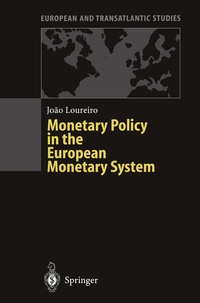
Monetary Policy in the European Monetary System
A Critical Appraisal
Published on 3. December 2011
Book
Paperback/Softback
X, 147 pages
978-3-642-80102-0 (ISBN)
Description
Monetary Policy in the European Monetary Systems
(EMS) provides the reader with a critical assessment of the EMS operation, focusing on key issues like intervention in money and foreign exchange markets and credibility of EMS exchange rate bands. The book also reopens the discussion on the "EMS discipline-credibility hypothesis" and the notion of "New EMS", testing both with an original methodology. The conflict between internal and external objectives is made clear and the empirical results show the choices made by the individual countries and the resulting implications. The book is written with an empirical orientation based on a unifying data description framework.
More details
Series
Edition
Softcover reprint of the original 1st ed. 1996
Language
English
Place of publication
Berlin
Germany
Publishing group
Springer Berlin
Target group
Professional and scholarly
Research
Illustrations
X, 147 p.
Dimensions
Height: 235 mm
Width: 155 mm
Thickness: 9 mm
Weight
254 gr
ISBN-13
978-3-642-80102-0 (9783642801020)
DOI
10.1007/978-3-642-80100-6
Schweitzer Classification
Other editions
Additional editions
E-Book
12/2012
Springer
€96.29
Available for download
Book
03/1996
1st Edition
Springer
€85.55
Article exhausted; check different version
Content
1 Introduction.- 2 The origins, design and working of the European Monetary System.- 2.1. The origins of the EMS.- 2.2. The design of the EMS.- 2.3. The working of the EMS.- 3 "Leaning against the wind" in the EMS: Did it work? An analysis of the period from 1979 to 1988.- 3.1. Introduction.- 3.2. An exchange market pressure model of the EMS.- 3.3. Assessing foreign exchange intervention: Methodology.- 3.4. Data.- 3.5. Results.- 3.6. Summary and conclusions.- Appendices.- 4 "Leaning against the wind" through interest rate management: The EMS in the period from 1979 to 1988.- 4.1. Introduction.- 4.2. Interest rate management and foreign exchange market effects.- 4.3. Methodology and data.- 4.4. Results and conclusions.- 5 Monetary autonomy in the EMS.- 5.1. Introduction.- 5.2. Assessing monetary autonomy.- 5.3. Data.- 5.4. Results.- 5.5. Summary and conclusions.- 6 The discipline hypothesis: What role for the EMS?.- 6.1. Introduction.- 6.2. The "tying-one's-hands" model of discipline.- 6.3. Some theoretical problems with the EMS discipline hypothesis.- 6.4. The EMS discipline/credibility hypotheses: Empirical evidence.- 6.5. The record of the unemployment/inflation trade-off.- 6.6. The EMS as a device for self-imposed discipline.- 6.7. Summary and conclusions.- Appendices.- 7 In search of a credible EMS.- 7.1. Introduction.- 7.2. Svensson's "simplest test of target zone credibility".- 7.3. Improvement of EMS exchange rate credibility.- 7.4. Summary and conclusions.- 8 Summary and conclusions.- References.- List of figures.- List of tables.