

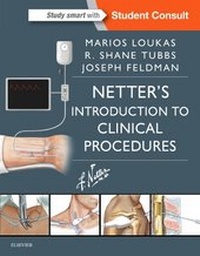
Netter's Introduction to Clinical Procedures
Published on 14. October 2016
Book
Paperback/Softback
304 pages
978-0-323-37055-4 (ISBN)
Description
Written with the student in mind, Netter's Introduction to Clinical Procedures, by Drs. Marios Loukas, R. Shane Tubbs, and Joseph Feldman, uses the well-known Netter anatomy art as a foundation for reinforcing the relevant clinical anatomy needed to successfully understand and perform basic procedures. Learn the practical application of this knowledge with step-by-step guides incorporating concise text, images, and animation.
Didactic Netter illustrations provide clear informative visuals for quick understanding of anatomical relationships.
Concise explanations enhance understanding of clinical underpinnings and implications.
More than 30 common clinical procedures are explained and demonstrated with step-by-step illustrations.
Multiple choice questions reinforce key concepts and challenge your knowledge.
Student Consult eBook version included with purchase. This enhanced eBook experience includes access -- on a variety of devices -- to the complete text, animation, "test yourself" images, and references from the book.
Didactic Netter illustrations provide clear informative visuals for quick understanding of anatomical relationships.
Concise explanations enhance understanding of clinical underpinnings and implications.
More than 30 common clinical procedures are explained and demonstrated with step-by-step illustrations.
Multiple choice questions reinforce key concepts and challenge your knowledge.
Student Consult eBook version included with purchase. This enhanced eBook experience includes access -- on a variety of devices -- to the complete text, animation, "test yourself" images, and references from the book.
Reviews / Votes
"a brilliant reference for those wanting to brush up on the exact way to perform procedures""This is an outstanding book that uses the extraordinary Netter images that medicine has relied upon for decades to provide an overview of many of the common procedures encountered in medical practice."
- Vincent Carr, DO, MSA, FACC, FACP (Uniformed Services University of the Health Sciences) Doody's Score: 92 - 4 Stars!
More details
Series
Language
English
Place of publication
Philadelphia
United States
Target group
College/higher education
Illustrations
125 illustrations (125 in full color); Illustrations
Dimensions
Height: 276 mm
Width: 216 mm
Weight
770 gr
ISBN-13
978-0-323-37055-4 (9780323370554)
Copyright in bibliographic data and cover images is held by Nielsen Book Services Limited or by the publishers or by their respective licensors: all rights reserved.
Schweitzer Classification
Other editions
Additional editions
MD Loukas | MSc Tubbs | Facep Feldman MD
Netter's Introduction to Clinical Procedures
E-Book
08/2016
Elsevier
€36.99
Available for download
Persons
Dr. Loukas is a highly accomplished physician-scientist and scholar, with more than 900 peer-reviewed publications, 25 books, and over 20 textbook chapters to his credit. He currently serves as co-editor of Clinical Anatomy and founding editor-in-chief of Translational Research in Anatomy. His leadership in the field has been recognized through his election as president of the American Association of Clinical Anatomists in 2017. R. Shane Tubbs, MS, PA-C, PhD is a native of Birmingham, Alabama, USA and a is a clinical anatomist, author, editor, educator, and researcher. He is Professor of Neurosurgery, Neurology, Surgery, and Structural & Cellular Biology, Director of Surgical Anatomy at Tulane School of Medicine and Program Director of Anatomical Research in the Clinical Neuroscience Research Center at Tulane University School of Medicine, New Orleans, Louisiana and Department of Neurosurgery and Ochsner Neuroscience Institute Ochsner Health System, New Orleans, LA. He has multiple honorary professorships/faculty positions both in the US and abroad. Dr. Tubbs is President-elect of the American Association of Clinical Anatomists (AACA) and serves as its Journal's (Clinical Anatomy) Editor-in-Chief. Dr. Tubbs' research interests are centered around what has been termed "reverse translational anatomy research? where clinical/surgical problems are identified and solved/explained with anatomical studies. This investigative paradigm in anatomy has resulted in over 1,800 peer reviewed publications from his laboratory. Dr. Tubbs' laboratory has made novel discoveries in human anatomy and in 2018, he was listed as a "hyperprolific author? in the journal Nature. Dr. Tubbs sits on the editorial board of over 10 anatomical journals and over 30 clinical journals and has reviewed for over 150 various scientific journals. He has authored/edited over 50 books and over 80 book chapters primarily in anatomical and neurosurgical textbooks. Lastly, Dr. Tubbs is Chair of the Federative International Programme on Anatomical Terminologies (FIPAT) and oversees six working groups dedicated to this topic. Under his leadership, the second edition of Terminologia Anatomica was just published.
Author
Dean School of Medicine, Professor, Department of Anatomical Sciences, Professor Department of Pathology, St. George's University, School of Medicine, Grenada, West Indies; Dean, College of Medical Sciences, Nicolaus Copernicus Superior School, Olsztyn, Poland
Chairman, Emergency Services, Emergency & Trauma Center, Hackensack University Medical Center, Hackensack, New Jersey
Content
Introduction
Section 1, Airway/Breathing
1. Endotracheal intubation
2. Intercostal Nerve block
3. Mask Ventilation
4. Thoracostomy
5. Thoacentesis
6. Tracheostomy, Tracheotomy, Cricothyroidotomy
Section 2, Circulation and Vascular Access
7. Cardiac Pacing
8. Cardioversion and Defibrillation
9. Diagnostic Peritoneal Lavage
10. Expanded Focused Assessment with Sonography for Trauma (E-FAST) Examination
11. Fasciotomy
12. Nosebleed Cauterization
13. Pericardiocentesis
14. Central Venous Catherization
15. Peripheral Arterial Line Placement
16. Peripheral Intravenous Cannulation
17. Venous Cutdown
Section 3, Dislocations and Pain Management
18. Dislocated Hip Reduction
19. Dislocated Finger Reduction
20. Dislocated Knee Reduction
21. Dislocated Shoulder Reduction
22. Occipital Nerve block
23. Digital Nerve Block
24. Dental Nerve Blocks
Section 4, Removal of Fluid, Infection, and Foreign Bodies
25. Abdominal Paracentesis
26. Auricular Hematoma Drainage
27. Cerumen Removal
28. Ear and Nose Foreign Body Removal
29. Burr Hole Craniotomy
30. Elbow Joint Aspiration
31. Ingrown Toenail Removal
32. Knee Joint Aspiration
33. Lumbar Puncture
34. Nasogastric Tube Placement
35. Paronychia Incision and Drainage
36. Skin Abscess Incision and Drainage
37. Shoulder Joint Aspiration
38. Transurethral (Foley Catheter) and Suprapubic Urinary Bladder Catheterization
Appendix Answers to Review Questions
Section 1, Airway/Breathing
1. Endotracheal intubation
2. Intercostal Nerve block
3. Mask Ventilation
4. Thoracostomy
5. Thoacentesis
6. Tracheostomy, Tracheotomy, Cricothyroidotomy
Section 2, Circulation and Vascular Access
7. Cardiac Pacing
8. Cardioversion and Defibrillation
9. Diagnostic Peritoneal Lavage
10. Expanded Focused Assessment with Sonography for Trauma (E-FAST) Examination
11. Fasciotomy
12. Nosebleed Cauterization
13. Pericardiocentesis
14. Central Venous Catherization
15. Peripheral Arterial Line Placement
16. Peripheral Intravenous Cannulation
17. Venous Cutdown
Section 3, Dislocations and Pain Management
18. Dislocated Hip Reduction
19. Dislocated Finger Reduction
20. Dislocated Knee Reduction
21. Dislocated Shoulder Reduction
22. Occipital Nerve block
23. Digital Nerve Block
24. Dental Nerve Blocks
Section 4, Removal of Fluid, Infection, and Foreign Bodies
25. Abdominal Paracentesis
26. Auricular Hematoma Drainage
27. Cerumen Removal
28. Ear and Nose Foreign Body Removal
29. Burr Hole Craniotomy
30. Elbow Joint Aspiration
31. Ingrown Toenail Removal
32. Knee Joint Aspiration
33. Lumbar Puncture
34. Nasogastric Tube Placement
35. Paronychia Incision and Drainage
36. Skin Abscess Incision and Drainage
37. Shoulder Joint Aspiration
38. Transurethral (Foley Catheter) and Suprapubic Urinary Bladder Catheterization
Appendix Answers to Review Questions