

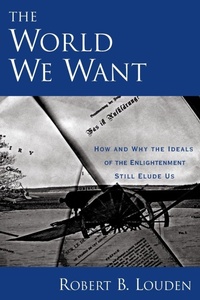
The World We Want
How and Why The Ideals of the Enlightenment Still Elude Us
Published on 1. April 2010
Book
Paperback/Softback
344 pages
978-0-19-974353-7 (ISBN)
Description
The World We Want compares the future world that Enlightenment intellectuals had hoped for with our own world at present. In what respects do the two worlds differ, and why are they so different? To what extent is and isn't our world the world they wanted, and to what extent do we today still want their world? Unlike previous philosophical critiques and defenses of the Enlightenment, the present study focuses extensively on the relevant historical and empirical record first, by examining carefully what kind of future Enlightenment intellectuals actually hoped for; second, by tracking the different legacies of their central ideals over the past two centuries.
But in addition to documenting the significant gap that still exists between Enlightenment ideals and current realities, the author also attempts to show why the ideals of the Enlightenment still elude us. What does our own experience tell us about the appropriateness of these ideals? Which Enlightenment ideals do not fit with human nature? Why is meaningful support for these ideals, particularly within the US, so weak at present? Which of the means that Enlightenment intellectuals advocated for realizing their ideals are inefficacious? Which of their ideals have devolved into distorted versions of themselves when attempts have been made to realize them? How and why, after more than two centuries, have we still failed to realize the most significant Enlightenment ideals? In short, what is dead and what is living in these ideals?
"The author should be applauded for the manner in which he is able to successfully combine philosophical investigation with empirical research. The frequent citing of original sources, especially those of Kant, as well as a rich collection of endnotes, make this volume an important contribution to Early Modern Philosophy and Enlightenment studies. But perhaps most important, this is a text that should resonate with any member of the educated citizenry who perceives the discrepancy between Enlightenment ideals and current realities and is deeply troubled by the current state of our world."-- The Review of Metaphysics
"This book will interest readers seeking to familiarize themselves with Enlightenment views on the issues discussed."-- CHOICE
"Rich in empirical study and powerful in philosophical analysis, Louden's book belies everybody who declares the Enlightenment project dead. Once again the author of Kant's Impure Ethics presents an impressive volume."--Notre Dame Philosophical Reviews
But in addition to documenting the significant gap that still exists between Enlightenment ideals and current realities, the author also attempts to show why the ideals of the Enlightenment still elude us. What does our own experience tell us about the appropriateness of these ideals? Which Enlightenment ideals do not fit with human nature? Why is meaningful support for these ideals, particularly within the US, so weak at present? Which of the means that Enlightenment intellectuals advocated for realizing their ideals are inefficacious? Which of their ideals have devolved into distorted versions of themselves when attempts have been made to realize them? How and why, after more than two centuries, have we still failed to realize the most significant Enlightenment ideals? In short, what is dead and what is living in these ideals?
"The author should be applauded for the manner in which he is able to successfully combine philosophical investigation with empirical research. The frequent citing of original sources, especially those of Kant, as well as a rich collection of endnotes, make this volume an important contribution to Early Modern Philosophy and Enlightenment studies. But perhaps most important, this is a text that should resonate with any member of the educated citizenry who perceives the discrepancy between Enlightenment ideals and current realities and is deeply troubled by the current state of our world."-- The Review of Metaphysics
"This book will interest readers seeking to familiarize themselves with Enlightenment views on the issues discussed."-- CHOICE
"Rich in empirical study and powerful in philosophical analysis, Louden's book belies everybody who declares the Enlightenment project dead. Once again the author of Kant's Impure Ethics presents an impressive volume."--Notre Dame Philosophical Reviews
Reviews / Votes
The author should be applauded for the manner in which he is able to successfully combine philosophical investigation with empirical research. The frequent citing of original sources, especially those of Kant, as well as a rich collection of endnotes, make this volume an important contribution to Early Modern Philosophy and Enlightenment studies. But perhaps most important, this is a text that should resonate with any member of the educated citizenry who perceives the discrepancy between Enlightenment ideals and current realities and is deeply troubled by the current state of our world. * David W. Rodick, The Review of Metaphysics *More details
Language
English
Place of publication
New York
United States
Dimensions
Height: 234 mm
Width: 156 mm
Thickness: 18 mm
Weight
518 gr
ISBN-13
978-0-19-974353-7 (9780199743537)
Copyright in bibliographic data and cover images is held by Nielsen Book Services Limited or by the publishers or by their respective licensors: all rights reserved.
Schweitzer Classification
Other editions
Additional editions
E-Book
03/2010
1st Edition
OUP eBook
€16.49
Available for download
Book
10/2007
Oxford University Press Inc
€83.90
Shipment within 15-20 days
E-Book
09/2007
1st Edition
OUP eBook
€16.49
Available for download
Person
Robert B. Louden is Professor of Philosophy at the University of Southern Maine
Content
NOTE ON CITATIONS AND TRANSLATIONS; INTRODUCTION; PART I: THEN; THE UNITY THESIS; THE MORALITY THESIS; TOLERATION; (ALMOST) UNIVERSAL EDUCATION; LEARNING TO USE ONE'S OWN REASON; ENLIGHTENED UNIVERSITIES; COMMERCIAL SOCIETY; INTERNATIONAL TRADE; NATIONALISM; REPUBLICANISM; PEACE THROUGH FEDERATION; PEACE THROUGH LAW; PART II: NOW; THE "RESURGENCE" OF RELIGION; SPLITTING THE DIFFERENCE; A SCHOOLED WORLD; EDUCATION FOR WHAT?; GLOBALIZATION; POVERTY WITHIN AND BETWEEN NATIONS; FROM CIVIC CULTURE TO CONSUMER CULTURE; PROLIFERATION OF SOVEREIGN STATES; DEMOCRITIZATION; LEAGUE OF NATIONS, UNITED NATIONS, WARRING NATIONS; THE MORAL PRESSURE OF HUMAN RIGHTS; GLOBAL JURISDICTION VERSUS NATIONAL SOVEREIGNTY; CONCLUSION; HISTORY TEST; HOPE AFTER HORROR; NOTES; BIBLIOGRAPHY; INDEX