

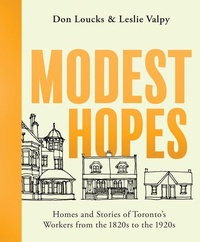
Modest Hopes
Homes and Stories of Toronto's Workers from the 1820s to the 1920s
Published on 25. November 2021
Book
Paperback/Softback
288 pages
978-1-4597-4554-4 (ISBN)
Description
Celebrating Toronto's built heritage of row houses, semis, and cottages and the people who lived in them.
Despite their value as urban property, Toronto's workers' cottages are often characterized as being small, cramped, poorly built, and in need of modernization or even demolition. But for the workers and their families who originally lived in them from the 1820s to the 1920s, these houses were far from modest. Many had been driven off their ancestral farms or had left the crowded conditions of tenements in their home cities abroad. Once in Toronto, many lived in unsanitary conditions in makeshift shantytowns or cramped shared houses in downtown neighbourhoods such as The Ward. To then move to a self-contained cottage or rowhouse was the result of an unimaginably strong hope for the future and a commitment to family life.
Through the stories of eight families who lived in these "Modest Hopes," authors Don Loucks and Leslie Valpy bring an important but forgotten part of the Toronto narrative to life. They illuminate the development of Toronto's working-class neighbourhoods, such as Leslieville, Corktown, and others, and explain the designs and architectural antecedents of these undervalued heritage properties.
Despite their value as urban property, Toronto's workers' cottages are often characterized as being small, cramped, poorly built, and in need of modernization or even demolition. But for the workers and their families who originally lived in them from the 1820s to the 1920s, these houses were far from modest. Many had been driven off their ancestral farms or had left the crowded conditions of tenements in their home cities abroad. Once in Toronto, many lived in unsanitary conditions in makeshift shantytowns or cramped shared houses in downtown neighbourhoods such as The Ward. To then move to a self-contained cottage or rowhouse was the result of an unimaginably strong hope for the future and a commitment to family life.
Through the stories of eight families who lived in these "Modest Hopes," authors Don Loucks and Leslie Valpy bring an important but forgotten part of the Toronto narrative to life. They illuminate the development of Toronto's working-class neighbourhoods, such as Leslieville, Corktown, and others, and explain the designs and architectural antecedents of these undervalued heritage properties.
More details
Language
English
Place of publication
Toronto
Canada
Product notice
Paperback (trade)
Illustrations
Illustrations
Dimensions
Height: 178 mm
Width: 216 mm
Thickness: 20 mm
Weight
514 gr
ISBN-13
978-1-4597-4554-4 (9781459745544)
Copyright in bibliographic data and cover images is held by Nielsen Book Services Limited or by the publishers or by their respective licensors: all rights reserved.
Schweitzer Classification
Other editions
Additional editions
Don Loucks | Leslie Valpy
Modest Hopes
Homes and Stories of Toronto's Workers from the 1820s to the 1920s
E-Book
09/2021
Dundurn Press
€14.49
Available for download
Persons
Don Loucks is an architect, urban designer, and cultural heritage planner, with forty years of project experience. He is committed to environmental, economic, and cultural sustainability and to preserving the variety of rich urban forms that contain the stories of our communities' history. He lives in Toronto.
Leslie Valpy is a conservation practitioner, researcher, and writer, with a passion for built heritage, history, architecture, and conservation. Working with both intangible and tangible dimensions of heritage, she has participated in a range of projects throughout Ontario. She lives in Toronto.
Leslie Valpy is a conservation practitioner, researcher, and writer, with a passion for built heritage, history, architecture, and conservation. Working with both intangible and tangible dimensions of heritage, she has participated in a range of projects throughout Ontario. She lives in Toronto.
Content
Authors' Note
Introduction: Home Is Where the Heart Is
1. Origins: The History and Antecedents of Workers' Housing Movements
2. The Architecture: Five Model Hope House Types
3. The Newcomers: Early Immigrants to Toronto Who Built and Lived in Modest Hopes
4. Toronto: 1820*#8211;1920
5. The Neighbourhoods: A Selection of Historic Toronto Areas Where Modest Hopes Were Concentrated
6. The Stories: Portraits fo the People and Their Modest Hope Homes
Bridget Ann Tracey McTague
Murray Buchman
Sam Ching and Dennis Chow
William Joseph O'Connor
Thomas T. Ferguson
Anne O'Rourke
The Moore Family
Albert Jackson
Conclusion: Why Are Modest Hopes Important Today?
Acknowledgements
Notes
Bibliography
Image Credits
Index
Introduction: Home Is Where the Heart Is
1. Origins: The History and Antecedents of Workers' Housing Movements
2. The Architecture: Five Model Hope House Types
3. The Newcomers: Early Immigrants to Toronto Who Built and Lived in Modest Hopes
4. Toronto: 1820*#8211;1920
5. The Neighbourhoods: A Selection of Historic Toronto Areas Where Modest Hopes Were Concentrated
6. The Stories: Portraits fo the People and Their Modest Hope Homes
Bridget Ann Tracey McTague
Murray Buchman
Sam Ching and Dennis Chow
William Joseph O'Connor
Thomas T. Ferguson
Anne O'Rourke
The Moore Family
Albert Jackson
Conclusion: Why Are Modest Hopes Important Today?
Acknowledgements
Notes
Bibliography
Image Credits
Index