

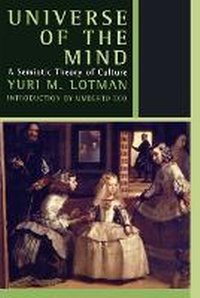
Universe of the Mind
A Semiotic Theory of Culture
Published on 22. March 2001
Book
Paperback/Softback
302 pages
978-0-253-21405-8 (ISBN)
Description
Universe of the Mind A Semiotic Theory of Culture Yuri M. Lotman Introduction by Umberto Eco Translated by Ann Shukman A major book by one of the initiators of cultural studies. "Universe of the Mind is an ambitious, complex, and wide-ranging book that semioticians, textual critics, and those interested in cultural studies will find stimulating and immensely suggestive." -Journal of Communication "Soviet semiotics offers a distinctive, richly productive approach to literary and cultural studies and Universe of the Mind represents a summation of the intellectual career of the man who has done most to guarantee this." -Slavic and East European Journal Universe of the Mind addresses three main areas: meaning and text, culture, and history. The result is a full-scale attempt to demonstrate the workings of the semiotic space or intellectual world. Part One is concerned with the ways that texts generate meaning. Part Two addresses Lotman's central idea of the semiosphere-the domain in which all semiotic systems can function-presented through an analogy with the global biosphere. Part Three focuses on semiotics from the point of view of history.
A seminal text in cultural semiotics, the book's ambitious scope also makes it applicable to disciplines outside semiotics. The book will be of great interest to those concerned with cultural studies, anthropology, Slavic studies, critical theory, philosophy, and historiography. Yuri Mikhailovich Lotman is the founder of the Moscow-Tartu School and the initiator of the discipline of cultural semiotics.
A seminal text in cultural semiotics, the book's ambitious scope also makes it applicable to disciplines outside semiotics. The book will be of great interest to those concerned with cultural studies, anthropology, Slavic studies, critical theory, philosophy, and historiography. Yuri Mikhailovich Lotman is the founder of the Moscow-Tartu School and the initiator of the discipline of cultural semiotics.
More details
Series
Language
English
Place of publication
Bloomington, IN
United States
Target group
College/higher education
Professional and scholarly
Product notice
Paperback (trade)
Dimensions
Height: 232 mm
Width: 156 mm
Weight
454 gr
ISBN-13
978-0-253-21405-8 (9780253214058)
Copyright in bibliographic data and cover images is held by Nielsen Book Services Limited or by the publishers or by their respective licensors: all rights reserved.
Schweitzer Classification
Person
Yuri Mikhailovich Lotman is the founder of the Moscow-Tartu School and the initiator of the discipline of cultural semiotics.
Content
Introduction by Unberto Eco Preface Notes to Preface Part One: The Text as a Meaning-Generating Mechanism 1. Three Functions of the Text 2. Autocommunication: 'I' and 'Other' as Addressees 3. Rhetoric as a Mechanism for Meaning-Generation 4. Iconic Rhetoric 5. The Text as Process of Movement: Author to Audience, Author to Text 6. The Symbol as Plot-Gene 7. The Symbol in the Cultural System Notes to Part One Part Two: The Semiosphere 8. Semiotic Space 9. The Notion of Boundary 10. Dialogue Mechanisms 11. The Semiosphere and the Problem of Plot 12. Symbolic Spaces 1. Geographical Space in Russian Medieval Texts 2. The Journey of Ulysses in Dante's Divine Comedy 3. The 'Home' in Bulgakov's The Master and Margarita 4. The Symbolism of St. Petersburg 13. Some Conclusions Notes to Part Two Part Three: Cultural Memory, History, and Semiotics 14. The Problem of the Historical Fact 15. Historical Laws and the Structure of the Text 16. An Alternative: Culture Without Literacy or Culture Before Culture? 17. The Role of Typological Symbols in the History of Culture 18. Can There Be a Science of History and What Are Its Functions in the Cultural System? 19. Conclusion Notes to Part Three Index