

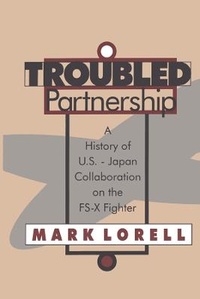
Troubled Partnership
History of US-Japan Collaboration on the FS-X Fighter
1st Edition
Published on 18. December 2020
Book
Hardback
469 pages
978-1-138-53991-4 (ISBN)
Description
During World War II, Japanese fighters, such as the famed Zero, were among the most respected and feared combat aircraft in the world. But for decades following the defeat of Japan in 1945, a variety of political and economic factors prevented Japan from developing its own modern national fighter.
This changed in the 1980s. Japan began independently developing its first world-class fighter since World War II. After several years of contentious negotiations, the Japanese agreed to work with the United States to cooperatively develop a minimally modified F-16, the FS-X. The new fighter, however, has evolved into a world-class aircraft developed largely by Japanese industry primarily due to errors committed by the U.S. side. By the fall of 1995, fifty years after the end of World War II, the Zero for the 1990s will have made its first flight, catapulting Japan into the elite ranks of nations capable of developing the most advanced weapon systems.
In Troubled Partnership, Mark Lorell traces the evolution of the FS-X, disclosing the conflicting economic and security objectives advanced by U.S. officials, the flawed U.S. policy of technology reciprocity, and the challenges of international collaboration. Its deep intimacy with the interplay of policy and economy will make this volume of intense interest to political scientists, military studies specialists, historians, and government officials.
This changed in the 1980s. Japan began independently developing its first world-class fighter since World War II. After several years of contentious negotiations, the Japanese agreed to work with the United States to cooperatively develop a minimally modified F-16, the FS-X. The new fighter, however, has evolved into a world-class aircraft developed largely by Japanese industry primarily due to errors committed by the U.S. side. By the fall of 1995, fifty years after the end of World War II, the Zero for the 1990s will have made its first flight, catapulting Japan into the elite ranks of nations capable of developing the most advanced weapon systems.
In Troubled Partnership, Mark Lorell traces the evolution of the FS-X, disclosing the conflicting economic and security objectives advanced by U.S. officials, the flawed U.S. policy of technology reciprocity, and the challenges of international collaboration. Its deep intimacy with the interplay of policy and economy will make this volume of intense interest to political scientists, military studies specialists, historians, and government officials.
More details
Language
English
Place of publication
London
United Kingdom
Publishing group
Taylor & Francis Ltd
Target group
College/higher education
Product notice
sewn/stitched
Cloth over boards
Dimensions
Height: 229 mm
Width: 152 mm
Thickness: 27 mm
Weight
826 gr
ISBN-13
978-1-138-53991-4 (9781138539914)
Copyright in bibliographic data and cover images is held by Nielsen Book Services Limited or by the publishers or by their respective licensors: all rights reserved.
Schweitzer Classification
Other editions
Additional editions
E-Book
03/2020
1st Edition
Routledge
€64.49
Available for download
E-Book
03/2020
1st Edition
Routledge
€64.49
Available for download
Book
04/1996
1st Edition
Routledge
€80.65
Article not available at the moment
Person
Mark Lorell is a senior analyst at RAND in the International Policy Department. He is the author of numerous works on aerospace collaboration and foreign research and development policies.
Content
Preface, Figures, Tables, Acknowledgments, Abbreviations, INTRODUCTION, Background, Overview: What Went Wrong?, Organization of This Document, THE U.S. QUEST FOR TECHNOLOGY RECIPROCITY, Introduction, Japan's Defense Build-Up and the Concept of Burden-Sharing, Developing a Legal Framework for Access to Japanese Defense Technology, Early U.S. Initiatives, New Initiatives from the Reagan Administration, Japanese Resistance-And Eventual Compromise, The Exchange of Notes and the Establishment of the Joint Military Technology Commission, The U.S. Demands for "Free and Automatic Flowback" of Derived Technology, Negotiating the Implementation Arrangements, In Search of a Technology, Of Gallium Arsenide, Integrated Circuits, and Military Radars, The First TAT Visit to Japan, A Brief Glimpse at Japan's New Military Radar Technologies, Taking a Second Look at Japanese Defense-Related Technologies, Going After the Keiko Surface-to-Air Missile, Pentagon Frustration on the Eve of FS-X, JAPAN'S POSTWAR QUEST FOR A NATIONAL FIGHTER, Introduction, Development of Japan's Postwar Defense Industry, First Steps, Reviving the Postwar Military Aircraft Industry, Fighters Versus Commercial Aircraft, The Push Toward Indigenous Military Aircraft in the 1970s, Inception of the Rising Sun Fighter, BUILDING THE FIGHTER TECHNOLOGY BASE, Introduction, Learning from Licensed Production, The Unique Nature of the F-15 Program, Military Versus Commercial Spin-Offs from the F-15, Gaining Experience in System Integration, The F-4EJ&aZ Fighter, The XSH-60J Helicopter, The T-4 Jet Trainer, Targeting Development of Key Technologies for the Future Fighter, Advanced Flight-Control Technology, Composite Materials and Aircraft Structures, The MELCO Active Phased-Array Radar, THE BATTLE JOINED: STOPPING THE RISING SUN FIGHTER, Introduction, Background: U.S. Industry Confronts a Shrinking Global Market, The U.S. Government Enters the Fray, Military and Strategic Reasons Behind the Pentagon's Opposition,