

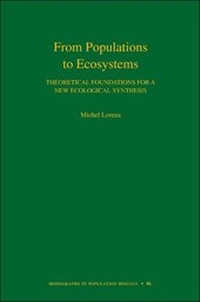
From Populations to Ecosystems
Theoretical Foundations for a New Ecological Synthesis
Published on 21. July 2010
Book
Hardback
320 pages
978-0-691-12269-4 (ISBN)
Description
The major subdisciplines of ecology - population ecology, community ecology, ecosystem ecology, and evolutionary ecology - have diverged increasingly in recent decades. What is critically needed today is an integrated, real-world approach to ecology that reflects the interdependency of biodiversity and ecosystem functioning. "From Populations to Ecosystems" proposes an innovative theoretical synthesis that will enable us to advance our fundamental understanding of ecological systems and help us to respond to today's emerging global ecological crisis. Michel Loreau begins by explaining how the principles of population dynamics and ecosystem functioning can be merged. He then addresses key issues in the study of biodiversity and ecosystems, such as functional complementarity, food webs, stability and complexity, material cycling, and metacommunities. Loreau describes the most recent theoretical advances that link the properties of individual populations to the aggregate properties of communities, and the properties of functional groups or trophic levels to the functioning of whole ecosystems, placing special emphasis on the relationship between biodiversity and ecosystem functioning.
Finally, he turns his attention to the controversial issue of the evolution of entire ecosystems and their properties, laying the theoretical foundations for a genuine evolutionary ecosystem ecology. "From Populations to Ecosystems" points the way to a much-needed synthesis in ecology, one that offers a fuller understanding of ecosystem processes in the natural world.
Finally, he turns his attention to the controversial issue of the evolution of entire ecosystems and their properties, laying the theoretical foundations for a genuine evolutionary ecosystem ecology. "From Populations to Ecosystems" points the way to a much-needed synthesis in ecology, one that offers a fuller understanding of ecosystem processes in the natural world.
Reviews / Votes
This reviewer was particularly intrigued by the author's resurrection of the hypothesis that ecosystem complexity and biodiversity supports ecosystem stability, an early romantic notion that turned out to be extremely difficult to demonstrate. He makes a convincing case that this hypothesis may have merit after all. -- ChoiceMore details
Series
Language
English
Place of publication
New Jersey
United States
Target group
College/higher education
Professional and scholarly
Product notice
Trade binding
Illustrations
19 halftones. 54 line illus. 4 tables.
Dimensions
Height: 229 mm
Width: 152 mm
Weight
567 gr
ISBN-13
978-0-691-12269-4 (9780691122694)
Copyright in bibliographic data and cover images is held by Nielsen Book Services Limited or by the publishers or by their respective licensors: all rights reserved.
Schweitzer Classification
Other editions
Additional editions
Book
07/2010
Princeton University Press
€57.90
Shipment within 10-20 days
Person
Michel Loreau is professor and Canada Research Chair in theoretical ecology at McGill University.
Content
Acknowledgments vii Preface: On Unifying Approaches in Ecology ix Chapter 1: Population and Ecosystem Approaches in Ecology 1 Chapter 2: The Maintenance and Functional Consequences of Species Diversity 19 Chapter 3: Biodiversity and Ecosystem Functioning 56 Chapter 4: Food Webs, Interaction Webs, and Ecosystem Functioning 79 Chapter 5: Stability and Complexity of Ecosystems: New Perspectives on an Old Debate 123 Chapter 6: Material Cycling and the Overall Functioning of Ecosystems 164 Chapter 7: Spatial Dynamics of Biodiversity and Ecosystem Functioning: Metacommunities and Metaecosystems 196 Chapter 8: Evolution of Ecosystems and Ecosystem Properties 225 Chapter 9: Postface: Toward an Integrated, Predictive Ecology 260 References 269 Index 291