

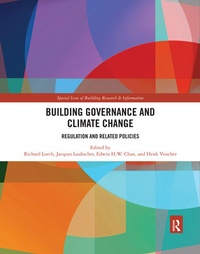
Building Governance and Climate Change
Regulation and Related Policies
1st Edition
Published on 30. June 2020
Book
Paperback/Softback
242 pages
978-0-367-51939-1 (ISBN)
Description
The contribution of buildings to climate change is widely acknowledged. This book investigates how building regulatory systems are addressing the current and future effects of climate change, and how these systems can be improved. After presenting a comprehensive overview of how the current building regulatory system developed, some of the inadequacies are identified. The largest part of the book examines the potential for innovative policy solutions to address the real world problem of mitigating and adapting buildings to climate change. This publication contributes significantly to our understanding of the complexities of long-term energy efficiency in buildings. This book was originally published as a special issue of the Building Research & Information journal.
More details
Language
English
Place of publication
London
United Kingdom
Publishing group
Taylor & Francis Ltd
Target group
College/higher education
Professional and scholarly
Dimensions
Height: 276 mm
Width: 219 mm
Weight
453 gr
ISBN-13
978-0-367-51939-1 (9780367519391)
Copyright in bibliographic data and cover images is held by Nielsen Book Services Limited or by the publishers or by their respective licensors: all rights reserved.
Schweitzer Classification
Other editions
Additional editions
Richard Lorch | Jacques Laubscher | Edwin Hon-wan Chan
Building Governance and Climate Change
Regulation and Related Policies
E-Book
10/2019
1st Edition
Routledge
€59.49
Available for download
Richard Lorch | Jacques Laubscher | Edwin Hon-wan Chan
Building Governance and Climate Change
Regulation and Related Policies
E-Book
10/2019
1st Edition
Routledge
€59.49
Available for download
Richard Lorch | Jacques Laubscher | Edwin Hon-wan Chan
Building Governance and Climate Change
Regulation and Related Policies
Book
04/2018
1st Edition
Routledge
€215.41
Shipment within 15-20 days
Persons
Richard Lorch studied architecture at Washington University, USA, and the University of Cambridge, UK, and is a licensed architect. He is a researcher, writer, policy consultant on energy and buildings, and the editor in chief of Building Research & Information.
Jacques Laubscher is a practising architect and academic. He is currently head of the technology research group in the Department of Architecture at the Tshwane University of Technology, South Africa.
Edwin H. W. Chan is a Chartered Architect (Authorized Person), Chartered Surveyor and also a Barrister-at-Law called to the UK and Hong Kong Bars. He obtained his Ph.D. from King's College, University of London, UK.
Henk Visscher is Full Professor in Housing Quality and Process Innovation at Delft University of Technology, where he is director of the Graduate School in the faculty of Architecture and the Built Environment.
Jacques Laubscher is a practising architect and academic. He is currently head of the technology research group in the Department of Architecture at the Tshwane University of Technology, South Africa.
Edwin H. W. Chan is a Chartered Architect (Authorized Person), Chartered Surveyor and also a Barrister-at-Law called to the UK and Hong Kong Bars. He obtained his Ph.D. from King's College, University of London, UK.
Henk Visscher is Full Professor in Housing Quality and Process Innovation at Delft University of Technology, where he is director of the Graduate School in the faculty of Architecture and the Built Environment.
Content
Introduction: Building governance and climate change: roles for regulation and related polices Part I: Impact of building regulations on the built environment 1. Sustainability and resiliency objectives in performance building regulations 2. The realpolitik of building codes: overcoming practical limitations to climate resilience Part II: Inadequacy of current building regulatory systems 3. Transforming building regulatory systems to address climate change 4. The impact of regulations on overheating risk in dwellings Part III: Addressing the performance gap 5. Framework for selecting occupancy-focused energy interventions in buildings 6. Improved governance for energy efficiency in housing Part IV: Innovative policy solutions 7. Energy efficiency and the policy mix 8. Alternative building emission-reduction measure: outcomes from the Tokyo Cap-and-Trade Program 9. Governance strategies to achieve zero-energy buildings in China 10. Multilevel governance for building energy conservation in rural China 11. The evolution of green leases: towards inter-organizational environmental governance Part V: Historic buildings 12. Governance of heritage buildings: Australian regulatory barriers to adaptive reuse Part VI: Financial incentives 13. Regulatory incentives for green buildings: gross floor area concessions Part VII: Future governance 14. The new governance for low-carbon buildings: mapping, exploring, interrogating 15. Reducing CO2 emissions from residential energy use Part VIII: Enforcement 16. Comparative review of building commissioning regulation: a quality perspective