

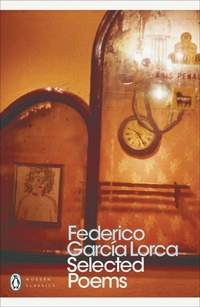
Selected Poems
Published on 6. December 2001
Book
Paperback/Softback
368 pages
978-0-14-118583-5 (ISBN)
Description
Spain's greatest and most well-loved modern poet, Lorca has long been admired for the emotional intensity and dark brilliance of his work, which drew on music, drama, mythology and the songs of his Andulucian childhood. From the playful Suites and stylized Gypsy Ballads, to his own dark vision of urban life, Poet in New York, and his elegaic meditation on death, Lament for Ignacio Sanchez Mejias; his range was remarkable. This bilingual edition provides versions by distinguished poets and translators, drawing on every book of poems published by Lorca and on his uncollected works.
More details
Series
Language
English
Place of publication
London
United Kingdom
Publishing group
Penguin Books Ltd
Product notice
Paperback (UK-B)
Dimensions
Height: 197 mm
Width: 129 mm
Thickness: 22 mm
Weight
255 gr
ISBN-13
978-0-14-118583-5 (9780141185835)
Copyright in bibliographic data and cover images is held by Nielsen Book Services Limited or by the publishers or by their respective licensors: all rights reserved.
Schweitzer Classification
Persons
Federico Garcia Lorca was born into an educated family of small landowners in Fuente Vaqueros in 1898. A poet, dramatist, musician and artist, he attended the university at Granada, where he acquired a fine knowledge of literature. In 1919 he went to the Residencia de Estudiantes in Madrid and during his long stay there he met all the principal writers, critics and scholars who visited the place, which was then a flourishing centre of cultural liberalism. In 1928 his Gipsy-Ballad Book (Romancero gitano) received much public acclaim. In 1929 he went to New York with Fernando de los Rios and his volume of poems Poet in New York (Poeta en Nueva York) was published posthumously in 1940.
On his return to republican Spain, he devoted himself to the theatre, as co-director of La Barraca, a government-sponsored student theatrical company that toured the country. He now wrote fewer poems, but these include his masterpiece Lament for Ignacio Sanchez Mejias (Llanto por la muerte de Ignacio Sanchez Mejias, 1935), a lament for a dead bullfighter. He wrote classical plays, pantomimic interludes, puppet plays, La zapatera prodigiosa (1930) and three tragedies: Blood Wedding (Bodas de sangre, 1933), Yerma (1934) and The House of Bernarda Alba (La casa de Bernarda Alba, 1936). Just after the outbreak of the Spanish Civil War in 1936 he was murdered at Granada by Nationalist partisans, in mysterious circumstances.
On his return to republican Spain, he devoted himself to the theatre, as co-director of La Barraca, a government-sponsored student theatrical company that toured the country. He now wrote fewer poems, but these include his masterpiece Lament for Ignacio Sanchez Mejias (Llanto por la muerte de Ignacio Sanchez Mejias, 1935), a lament for a dead bullfighter. He wrote classical plays, pantomimic interludes, puppet plays, La zapatera prodigiosa (1930) and three tragedies: Blood Wedding (Bodas de sangre, 1933), Yerma (1934) and The House of Bernarda Alba (La casa de Bernarda Alba, 1936). Just after the outbreak of the Spanish Civil War in 1936 he was murdered at Granada by Nationalist partisans, in mysterious circumstances.