

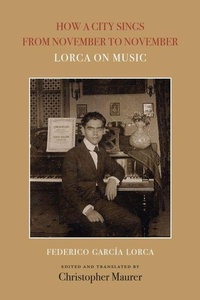
How a City Sings from November to November
Lorca on Music
Will be published approx. on 9. June 2026
Book
Paperback/Softback
200 pages
978-1-961056-12-1 (ISBN)
Description
Illuminates the place of music in the life and poetry of Federico Garcia Lorca.
"Yo ante todo, soy musico," Federico Garcia Lorca once remarked: "Before all else, I am a musician." Whether seated at the piano, collecting folksongs on his travels through Spain, or composing music for his plays, few poets have lived music so deeply. For Lorca, songs were "living creatures." How a City Sings from November to November: Lorca on Music brings together for the first time in English the poet's writing on music and musicians. In these pages, through lectures, letters, and interviews, Lorca celebrates the musical seasons of Granada, "a city enclosed by mountains and made for music"; the sources of cante jondo (flamenco deep song); the haunting melodies of Spanish cradle songs; and the dance of La Argentina. He describes learning the guitar, staging Spanish ballads in Buenos Aires, and listening to spirituals in New York. In bed with a fever, he compares it to a "delicate tempo rubato of Chopin." Based on recent archival research, edited and newly translated by noted Lorca scholar Christopher Maurer, this collection offers an intricate and enjoyable counterpoint to Lorca's poetry and theater.
"Yo ante todo, soy musico," Federico Garcia Lorca once remarked: "Before all else, I am a musician." Whether seated at the piano, collecting folksongs on his travels through Spain, or composing music for his plays, few poets have lived music so deeply. For Lorca, songs were "living creatures." How a City Sings from November to November: Lorca on Music brings together for the first time in English the poet's writing on music and musicians. In these pages, through lectures, letters, and interviews, Lorca celebrates the musical seasons of Granada, "a city enclosed by mountains and made for music"; the sources of cante jondo (flamenco deep song); the haunting melodies of Spanish cradle songs; and the dance of La Argentina. He describes learning the guitar, staging Spanish ballads in Buenos Aires, and listening to spirituals in New York. In bed with a fever, he compares it to a "delicate tempo rubato of Chopin." Based on recent archival research, edited and newly translated by noted Lorca scholar Christopher Maurer, this collection offers an intricate and enjoyable counterpoint to Lorca's poetry and theater.
More details
Language
English
Spanish
Place of publication
Chicago
United States
Edition type
Bilingual edition
Product notice
Paperback (trade)
Unsewn / adhesive bound
Illustrations
35 color plates, 15 halftones, 6 musical examples
Dimensions
Height: 229 mm
Width: 152 mm
Weight
454 gr
ISBN-13
978-1-961056-12-1 (9781961056121)
Copyright in bibliographic data and cover images is held by Nielsen Book Services Limited or by the publishers or by their respective licensors: all rights reserved.
Schweitzer Classification
Persons
Federico Garcia Lorca (1898-1936) is Spain's best-known and most beloved poet and playwright. Christopher Maurer is professor of Spanish at Boston University. He is editor and translator of Sebastian's Arrows: Letters and Mementos of Salvador Dali and Federico Garcia Lorca, New Letters to a Young Poet, and The Complete Perfectionist, all published by Swan Isle Press.
Content
List of Illustrations
Introduction: "Before all else I am a musician"
The Architecture of Deep Song
On Spanish Lullabies
How a City Sings From November to November
In Praise of La Argentina
Lorca on music: A chronology
Notes
Music: A Sampling
Abbreviations
Bibliography: Works Cited
Introduction: "Before all else I am a musician"
The Architecture of Deep Song
On Spanish Lullabies
How a City Sings From November to November
In Praise of La Argentina
Lorca on music: A chronology
Notes
Music: A Sampling
Abbreviations
Bibliography: Works Cited