

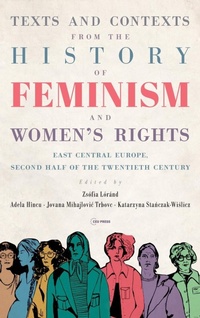
Texts and Contexts from the History of Feminism and Women's Rights
East Central Europe, Second Half of the Twentieth Century
Published on 31. October 2024
Book
Hardback
700 pages
978-963-386-453-1 (ISBN)
Description
A compendium of one hundred sources, preceded by a short author's bio and an introduction, this volume offers an English language selection of the most representative texts on feminism and women's rights from East Central Europe between the end of the Second World War and the early 1990s. While communist era is the primary focus, the interwar years and the post-1989 transition period also receive attention. All texts are new translations from the original.
The book is organised around themes instead of countries; the similarities and differences between nations are nevertheless pointed out. The editors consider women not only in their local context, but also in conjunction with other systems of thought-including shared agendas with socialism, liberalism, nationalism, and even eugenics.
The choice of texts seeks to demonstrate how feminism as political thought was shaped and organised in the region. They vary in type and format from political treatises, philosophy to literary works, even films and the visual arts, with the necessary inclusion of the personal and the private. Women's political rights, right to education, their role in nation-building, women, and war (and especially women and peace) are part of the anthology, alongside the gendered division of labour, violence against women, the body, and reproduction.
The book is organised around themes instead of countries; the similarities and differences between nations are nevertheless pointed out. The editors consider women not only in their local context, but also in conjunction with other systems of thought-including shared agendas with socialism, liberalism, nationalism, and even eugenics.
The choice of texts seeks to demonstrate how feminism as political thought was shaped and organised in the region. They vary in type and format from political treatises, philosophy to literary works, even films and the visual arts, with the necessary inclusion of the personal and the private. Women's political rights, right to education, their role in nation-building, women, and war (and especially women and peace) are part of the anthology, alongside the gendered division of labour, violence against women, the body, and reproduction.
Reviews / Votes
"This eagerly-awaited collection brings more than one hundred texts on feminism and women's rights in twentieth-century East Central Europe to English-speaking audiences. Showcasing an exceptionally wide range of voices from every country in the region, and covering an impressive array of themes, the source book is the result of an ambitious collaboration between the editors and an international team of over one hundred scholars and translators. Each translated text is accompanied by a lucid introduction contextualizing the source and its original author, making this an essential resource for anyone interested in the past, present, and future of feminism in East Central Europe and beyond."--Celia Donert, Wolfson College, University of Cambridge
"This volume is a milestone in the research of feminist ideas and experiences of women in East Central Europe. It makes it impressively clear that the intellectual map of Europe cannot be read and understood if these ideas and experiences are left out. East Central Europe is more than just an intermediate or transit space between West and East, and feminist thought is not just an appendix to the major political currents of thought of the 20th century. The book places East Central Europe as a region and the interrelationship between feminism and socialism at the heart of understanding modern European history. Biographies, contexts and sources create a dense fabric of intellectual and political interdependencies. The group of editors, authors and translators have explicitly refrained from establishing a canon but offer a powerful intervention in the history of political ideas and political agency."
-Claudia Kraft, Universitaet Wien
"This extraordinary collection features women's voices from modern East Central Europe, many translated into English for the first time. Hitherto marginalized in both mainstream and feminist historiography, these female thinkers engaged with a wide variety of topics and concerns, from political upheavals to everyday hardships and visions of a just society. We meet philosophers, writers, artists, birth control activists, and leaders from diverse ethnic and cultural backgrounds, including marginalized groups such as Romani and Muslim women. Highlighting the interaction between local and global feminist ideas, this masterful work is essential to anyone interested in global women's movements."
- Malgorzata Fidelis, University of Illinois Chicago
More details
Language
English
Place of publication
Amsterdam
Hungary
Target group
Professional and scholarly
Academic
Product notice
sewn/stitched
Cloth over boards
Dimensions
Height: 235 mm
Width: 157 mm
Thickness: 62 mm
Weight
1682 gr
ISBN-13
978-963-386-453-1 (9789633864531)
Copyright in bibliographic data and cover images is held by Nielsen Book Services Limited or by the publishers or by their respective licensors: all rights reserved.
Schweitzer Classification
Persons
Adela Hincu is an intellectual historian whose work focuses on the history of social sciences, Marxist social theory, and women's political thought in East Central Europe after the Second World War. Currently a Marie Sklodowska-Curie postdoctoral fellow, she is conducting research on the transnational history of social expertise from Eastern Europe from the 1970s to the early 2000s. Zsofia Lorand is an intellectual historian of feminism in post-WWII state-socialist Eastern Europe. Katarzyna Stanczak-Wislicz is a social historian working in the Institute of Literary Research, Polish Academy of Sciences. Jovana Mihajlovic Trbovc is a political scientist dealing with political issues from the perspective of culture studies.
Content
Introduction
1. The legacy of the pre-1945 period
? Ecaterina Arbore, The Working Woman in the Struggle towards Emancipation, 1911 (Romania)
? Zemaite (Julija Beniuseviciute-Zymantiene), To the Enemies of Women's Equality, 1912 (Lithuania)
? Rosika Schwimmer, The Grievances of Feminism under the Proletarian Dictatorship, 1919 (Hungary)
? Mariska Gardos, On Sexuality, Prostitution, and Feminism, 1906 and 1941 (Hungary)
? Shaqe Marie Coba, On Feminism, 1921 (Albania)
? Johanna Paets, Why Must Women Elect Women to Parliament?, 1932 (Estonia)
? Irena Krzywicka, The Fall of Male Civilization, 1932 (Poland)
? Halina Krahelska, The Roots of Changing Sexual Mores, 1937 (Poland)
? Angela Vode, The Woman in Contemporary Society, 1934 (Yugoslavia/Slovenia)
2) Women and war
? Zena danas Editorial Board, The New Feminism, 1936 (Yugoslavia/Serbia)
? Ina Jun-Broda, Two Poems by a Partizanka, 1943/44 (Yugoslavia)
? Maca Grzetic, Report on Women in the People's Liberation Struggle, 1945 (Yugoslavia/Croatia)
? Romanian Workers Party, Fallen in Battle: Olga Bancic, 1949 (Romania)
? Lina Kostenko, A Female Poetic Voice against Totalitarianism and War, 1957, 1962, 1987 (Ukraine/USSR)
? Stasa Zajovic, Antiwar Activism in Serbia, 1996 (Serbia)
? Sviatlana Aleksijevic, What is Our Memory?, 1998 (Belarus)
3) Ideologies of women's emancipation
? Hana Gregorova, About 8th March and Feminism, n.d. (Slovakia/ Czechoslovakia)
? Anna Kethly, Women in Politics, 1945 (Hungary)
? Milada Horakova, Women in Politics, 1945 ....
1. The legacy of the pre-1945 period
? Ecaterina Arbore, The Working Woman in the Struggle towards Emancipation, 1911 (Romania)
? Zemaite (Julija Beniuseviciute-Zymantiene), To the Enemies of Women's Equality, 1912 (Lithuania)
? Rosika Schwimmer, The Grievances of Feminism under the Proletarian Dictatorship, 1919 (Hungary)
? Mariska Gardos, On Sexuality, Prostitution, and Feminism, 1906 and 1941 (Hungary)
? Shaqe Marie Coba, On Feminism, 1921 (Albania)
? Johanna Paets, Why Must Women Elect Women to Parliament?, 1932 (Estonia)
? Irena Krzywicka, The Fall of Male Civilization, 1932 (Poland)
? Halina Krahelska, The Roots of Changing Sexual Mores, 1937 (Poland)
? Angela Vode, The Woman in Contemporary Society, 1934 (Yugoslavia/Slovenia)
2) Women and war
? Zena danas Editorial Board, The New Feminism, 1936 (Yugoslavia/Serbia)
? Ina Jun-Broda, Two Poems by a Partizanka, 1943/44 (Yugoslavia)
? Maca Grzetic, Report on Women in the People's Liberation Struggle, 1945 (Yugoslavia/Croatia)
? Romanian Workers Party, Fallen in Battle: Olga Bancic, 1949 (Romania)
? Lina Kostenko, A Female Poetic Voice against Totalitarianism and War, 1957, 1962, 1987 (Ukraine/USSR)
? Stasa Zajovic, Antiwar Activism in Serbia, 1996 (Serbia)
? Sviatlana Aleksijevic, What is Our Memory?, 1998 (Belarus)
3) Ideologies of women's emancipation
? Hana Gregorova, About 8th March and Feminism, n.d. (Slovakia/ Czechoslovakia)
? Anna Kethly, Women in Politics, 1945 (Hungary)
? Milada Horakova, Women in Politics, 1945 ....