

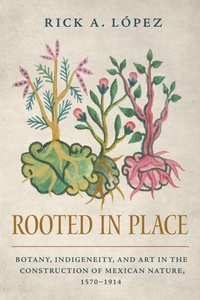
Rooted in Place
Botany, Indigeneity, and Art in the Construction of Mexican Nature, 1570-1914
Published on 28. October 2025
Book
Hardback
312 pages
978-0-8165-5565-9 (ISBN)
Description
Since the first moment of conquest, colonizers and the colonized alike in Mexico confronted questions about what it meant to be from this place, what natural resources it offered, and who had the right to control those resources and on what basis.
Focusing on the ways people, environment, and policies have been affected by political boundaries, historian Rick A. Lopez explores the historical connections between political identities and the natural world. Lopez analyzes how scientific intellectuals laid claim to nature within Mexico, first on behalf of the Spanish Empire and then in the name of the republic, during three transformative moments: the Hernandez expedition of the late sixteenth century; the Royal Botanical Expedition of the late eighteenth century; and the heyday of scientific societies such as the Sociedad Mexicana de Historia Natural of the late nineteenth century.
This work traces how scientific intellectuals studied and debated what it meant to know and claim the flora that sprang from Mexican soil-ranging from individual plants to forests and vegetated landscapes-and the importance they placed on indigeneity. It also points to the short- and long-term consequences of these efforts. Lopez draws on archival and published sources produced from the sixteenth century through the start of the twentieth century and gives special attention to the use of visual images such as scientific illustrations and landscape art. Lopez employs the term "visualization" in recognition of the degree to which officials, botanists, and draftsmen produced imagery and also how they and others viewed nature.
Rooted in Place reveals how scientific endeavors were not just about cataloging flora but were deeply intertwined with the construction of identity and the political landscape at three pivotal moments in Mexican history.
Focusing on the ways people, environment, and policies have been affected by political boundaries, historian Rick A. Lopez explores the historical connections between political identities and the natural world. Lopez analyzes how scientific intellectuals laid claim to nature within Mexico, first on behalf of the Spanish Empire and then in the name of the republic, during three transformative moments: the Hernandez expedition of the late sixteenth century; the Royal Botanical Expedition of the late eighteenth century; and the heyday of scientific societies such as the Sociedad Mexicana de Historia Natural of the late nineteenth century.
This work traces how scientific intellectuals studied and debated what it meant to know and claim the flora that sprang from Mexican soil-ranging from individual plants to forests and vegetated landscapes-and the importance they placed on indigeneity. It also points to the short- and long-term consequences of these efforts. Lopez draws on archival and published sources produced from the sixteenth century through the start of the twentieth century and gives special attention to the use of visual images such as scientific illustrations and landscape art. Lopez employs the term "visualization" in recognition of the degree to which officials, botanists, and draftsmen produced imagery and also how they and others viewed nature.
Rooted in Place reveals how scientific endeavors were not just about cataloging flora but were deeply intertwined with the construction of identity and the political landscape at three pivotal moments in Mexican history.
Reviews / Votes
"This book provides a sweeping, evocative, and compelling overview of the ways scientists in Mexico have studied nature. Covering nearly four centuries and an incredible cast of characters, the book stitches together different disciplinary approaches and cases to create a cohesive whole. In short, this book contains that missing piece of historical storytelling that links the traditional knowledge about the diversity of the Mexican landscape with the modern pride in its continuing protection."-Emily Wakild, author of Revolutionary Parks: Conservation, Social Justice, and Mexico's National Parks, 1910-1940More details
Series
Language
English
Place of publication
Tucson
United States
Target group
Professional and scholarly
Product notice
sewn/stitched
Cloth over boards
Illustrations
32 colour illustrations, 3 maps
Dimensions
Height: 232 mm
Width: 154 mm
Thickness: 26 mm
Weight
590 gr
ISBN-13
978-0-8165-5565-9 (9780816555659)
Copyright in bibliographic data and cover images is held by Nielsen Book Services Limited or by the publishers or by their respective licensors: all rights reserved.
Schweitzer Classification
Person
Rick A. Lopez is Anson D. Morse 1871 Professor of Latin American History and Environmental Studies at Amherst College. He is author of Crafting Mexico: Intellectuals, Artisans, and the State after the Revolution and has published articles and essays on the history of nation formation, race, aesthetics, and the environment in Mexico, as well as on U.S. Latinx history.