

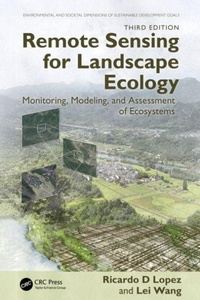
Remote Sensing for Landscape Ecology
Monitoring, Modeling, and Assessment of Ecosystems
3rd Edition
Will be published approx. on 9. September 2026
Book
Hardback
400 pages
978-1-041-04668-4 (ISBN)
Description
This third edition offers a comprehensive and updated exploration of how remote sensing technologies can be effectively applied in landscape ecology. A major highlight of this edition is the addition of a new chapter on theoretical frameworks, which bridges practical applications and case studies, enhancing the book's relevance across different landscape scales. It strengthens the connection between theory and real-world practice, providing readers with deeper insights into urban green spaces, forests, and the broader ecological systems. It also provides insights into innovative technologies like machine learning and big data analytics, which are vital in solving complex environmental problems.
New in the Third Edition
Introduces significant technological advances in remote sensing such as high-resolution imagery and data use, along with more accurate and effective algorithms, which are transforming how landscape data is collected and analyzed.
Offers both updated content and new case studies to reflect the maturing fields of remote sensing and landscape ecology.
Includes a new chapter explaining theories and models in remote sensing-based landscape ecology framework.
Includes an additional chapter with case studies discussing applied analyses of local scale landscapes, and expanded materials throughout on the future trends in landscape monitoring and assessment.
Expands on the use of satellite imagery and LiDAR for evaluating land-use changes, monitoring ecosystems, and designing resilient landscapes.
Integrates new case studies, new methods, and new models to address a wide range of ecological and societal challenges.
This is an excellent book for professionals, students, and entry level personnel in need of training in remote sensing applications for the fields of Landscape Architecture; Environmental Sciences; Geography; Urban Planning and Policy Development; Forestry and Natural Resource Conservation; as well as Ecology and Evolutionary Biology.
New in the Third Edition
Introduces significant technological advances in remote sensing such as high-resolution imagery and data use, along with more accurate and effective algorithms, which are transforming how landscape data is collected and analyzed.
Offers both updated content and new case studies to reflect the maturing fields of remote sensing and landscape ecology.
Includes a new chapter explaining theories and models in remote sensing-based landscape ecology framework.
Includes an additional chapter with case studies discussing applied analyses of local scale landscapes, and expanded materials throughout on the future trends in landscape monitoring and assessment.
Expands on the use of satellite imagery and LiDAR for evaluating land-use changes, monitoring ecosystems, and designing resilient landscapes.
Integrates new case studies, new methods, and new models to address a wide range of ecological and societal challenges.
This is an excellent book for professionals, students, and entry level personnel in need of training in remote sensing applications for the fields of Landscape Architecture; Environmental Sciences; Geography; Urban Planning and Policy Development; Forestry and Natural Resource Conservation; as well as Ecology and Evolutionary Biology.
More details
Series
Edition
3rd edition
Language
English
Place of publication
London
United Kingdom
Publishing group
Taylor & Francis Ltd
Target group
College/higher education
Professional and scholarly
Postgraduate, Professional Reference, and Undergraduate Advanced
Illustrations
86 farbige Abbildungen, 6 s/w Photographien bzw. Rasterbilder, 68 Farbfotos bzw. farbige Rasterbilder, 4 s/w Zeichnungen, 18 farbige Zeichnungen, 31 s/w Tabellen, 10 s/w Abbildungen
31 Tables, black and white; 18 Line drawings, color; 4 Line drawings, black and white; 68 Halftones, color; 6 Halftones, black and white; 86 Illustrations, color; 10 Illustrations, black and white
Dimensions
Height: 234 mm
Width: 156 mm
ISBN-13
978-1-041-04668-4 (9781041046684)
Copyright in bibliographic data and cover images is held by Nielsen Book Services Limited or by the publishers or by their respective licensors: all rights reserved.
Schweitzer Classification
Other editions
Additional editions

Ricardo D. Lopez | Lei Wang
Remote Sensing for Landscape Ecology
Monitoring, Modeling, and Assessment of Ecosystems
E-Book
approx. 09/2026
3rd Edition
CRC Press
€172.99
Not yet available
Ricardo D. Lopez | Lei Wang
Remote Sensing for Landscape Ecology
Monitoring, Modeling, and Assessment of Ecosystems
E-Book
approx. 09/2026
3rd Edition
CRC Press
€172.99
Not yet available
Previous edition
Ricardo Lopez | Robert Frohn
Remote Sensing for Landscape Ecology: New Metric Indicators
Monitoring, Modeling, and Assessment of Ecosystems
Book
10/2017
2nd Edition
CRC Press
€230.65
Shipment within 15-20 days
Persons
Dr. Ricardo "Ric" D. Lopez has provided leadership on diverse environmental science issues for the last four decades, with a current focus on integrating environmental science, social, and governance frameworks at multiple scales, internationally. During his tenure in both academia and in public service with the U.S. Environmental Protection Agency, the U.S. Forest Service, and the U.S. Fish and Wildlife Service, Ric has inspired scientific research teams and natural resource managers across a variety of geographic areas, from Asia and the Indo-Pacific Regions to the Americas. His current work centers on shifting organizational mindsets from compliance to holistic risk resilience, leveraging advanced sensing technologies to model environmental conditions across multiple scales. Dr. Lopez most recently led a large team of science and management professionals, as Administrator of all U.S. National Wildlife Refuges and Marine National Monuments in the Pacific.
Dr. Lei Wang is currently a Professor at Northeast Forestry University in Harbin, China, specializing in the spatial structure and functional services of urban and rural ecosystems. As a visiting scholar and research assistant, Dr. Wang has also completed two academic positions at the University of Wisconsin-Madison, USA. Upon return to China, she is leading a research team in ecological urban landscape construction optimizing and restructuring urban and rural ecological landscapes. She has published a monograph and two textbooks, has led over ten projects funded by the National Natural Science Foundation of China, the National Key Research and Development Program of China, among others. Additionally, she received the Higher Education Scientific Research Excellence Award from the Ministry of Education. Moreover, her team won the 2023 American Society of Landscape Architects Honor Award.
Dr. Lei Wang is currently a Professor at Northeast Forestry University in Harbin, China, specializing in the spatial structure and functional services of urban and rural ecosystems. As a visiting scholar and research assistant, Dr. Wang has also completed two academic positions at the University of Wisconsin-Madison, USA. Upon return to China, she is leading a research team in ecological urban landscape construction optimizing and restructuring urban and rural ecological landscapes. She has published a monograph and two textbooks, has led over ten projects funded by the National Natural Science Foundation of China, the National Key Research and Development Program of China, among others. Additionally, she received the Higher Education Scientific Research Excellence Award from the Ministry of Education. Moreover, her team won the 2023 American Society of Landscape Architects Honor Award.
Content
1. Introduction. 2. Theories and Models in Landscape Ecology Based on a Remote Sensing Framework. 3. Key Processes for Effective Remote-Sensing-Based Landscape Ecology Projects. 4. Utilizing Remote Sensing to Solve Landscape Ecology Challenges. 5. Applied Analyses of Broad Scale Landscape Gradients of Condition. 6. Applied Analyses of Regional Scale Landscape Gradients of Condition. 7. Applied Analyses of the Condition of Local-Scale Landscape Gradients. 8. Meeting the Landscape Ecology Challenges of the Future with Remote Sensing.