

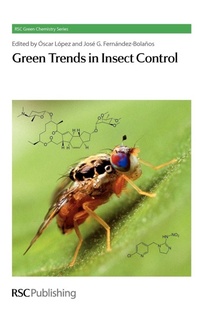
Green Trends in Insect Control
Published on 13. June 2011
Book
Hardback
374 pages
978-1-84973-149-2 (ISBN)
Description
This book presents the current approaches for insect pest control as a "green" alternative to classical and more toxaic agrochemicals. An overview of the recent advances in insecticide chemistry is also included, which will be of interest to a vast group of researchers - agrochemists, biochemists, chemists and toxicologists. The combination of both chemical and toxicological aspects of insecticides is unique and the book includes contributions from synthetic chemists, entomologists, environmentalists and toxicologists giving it wide appeal. Throughout the book, the different approaches that involve "greener chemicals" are emphasized. The book is divided into 9 chapters, each considering the state of art of each family of insecticides, together with future expectations. Each chapter gives a description of useful biorational insecticides, highlighting environmentally-friendly processes and then the mode of action is fully-described, emphasizing selectivity towards targeted species. Finally, for every family of compounds, their environmental effects (toxicity, bioaccumulation and metabolism) is considered, comparing them to classical insecticides, including human and environmental risk assessments. In addition the formulation, dispersal and persistence in the environment are covered as key aspects in developing greener agrochemicals. The book also includes a general introduction to entomology, with special emphasis on those insects that act as vectors in the spread of diseases. Insects that may be potential pests against humans and livestock are included, focusing on their life cycles, and physiology, as a logical comprehension of mode of action of insecticides. In addition there is a chapter on classical insecticides (covering both, approaches prior to the chemical era, and classical chemical insecticides, organochlorinated, organophosphorus, and carbamates) for comparison with current trends in pest control. The negative environmental effects that such insecticides have caused in nature, such as poisonings, bioaccumulation or toxic effects are highlighted. It is hoped that the use of more specific agrochemicals and approaches may avoid, or at least considerably reduce such severe and irreversible effects in nature. The insecticides covered are considered from numerous points of views: chemistry, toxicological profile, risk assessment, legal status, environmental behaviour and selectivity. The most important families of currently used insecticides are covered and critical discussions about future perspectives are included with frequent comparisons to classical insecticides. The following topics are covered in the book, as greener alternatives to classical insecticides: "Pyrethrins and pyrethroids "Neonicotinoids "Spynosins "Insect growth regulators "Botanical insecticides "Microbial insecticides "Integrated Pest Management Programs (IPM)
Reviews / Votes
The recent advances in insecticide control are well summarized and are of interest for agrochemists, biochemists, chemists, chemical engineers, biologists and toxicologists. The book may also be useful in academia to utilize its up-to-date knowledge in the training of students. * Current Green Chemistry, 2014, Vol. 1, No. 3, 273 *More details
Series
Language
English
Place of publication
Cambridge
United Kingdom
Target group
College/higher education
Professional and scholarly
Product notice
Unsewn / adhesive bound
Dimensions
Height: 240 mm
Width: 161 mm
Thickness: 26 mm
Weight
685 gr
ISBN-13
978-1-84973-149-2 (9781849731492)
Copyright in bibliographic data and cover images is held by Nielsen Book Services Limited or by the publishers or by their respective licensors: all rights reserved.
Schweitzer Classification
Other editions
Additional editions
Oscar Lopez | Jose Fernandez-Bolanos
Green Trends in Insect Control
E-Book
06/2011
1st Edition
Royal Society of Chemistry
€182.99
Available for download
Complete work / Part of the work
Other
02/2014
Royal Society of Chemistry
€739.50
Article not available at the moment
Persons
Dr Escar L3/4pez received his PhD at Seville University in 2003 under the direction of Professor JosU G Fernssndez-Bola+/-os, JosU Fuentes and InUs Maya. In March 2004, he was appointed as lecturer in Environmental Organic Chemistry at the University of Huelva, Spain. In June 2004, he was appointed as lecturer in Organic Chemistry at the University of Seville, Spain, in the Faculty of Chemistry. He spent 16 months (2005-2006) in a postdoctoral stay in Aarhus University, Denmark under the direction of Professor Mikael Bols working on the design of glycosidase inhibitors and the preparation of cyclodextrin derivatives as artificial enzymes. In 2009 he got a position as an Associate Professor in the Organic Chemistry Department, University of Seville, Spain. His research interests include Carbohydrate Chemistry, Heterocyclic Chemistry, Green Chemistry, Organoselenium Chemistry, Cyclodextrins and Supramolecular Chemistry, Glycosidase Inhibitors and Antioxidants. Professor JosU G Fernssndez-Bola+/-os completed his PhD at Seville University in 1984, after working on the synthesis of C-nucleoside of imidazol, under the direction of Professor JosU Fernssndez-Bola+/-os, his father, and Professor JosU Fuentes. He spent one year in a postdoctoral stay at the Technical University of Denmark, Lyngby, working on the synthesis and conformational analysis of sterically hindered oligosaccharides, under the direction of Professor Klaus Bock. He got a position as Professor at Seville University in 1987, and is currently a Professor of Organic Chemistry. His research interests include Carbohydrate Chemistry, Heterocyclic Chemistry, Green Chemistry, Organoselenium Chemistry, Cyclodextrins, Antioxidants from natural sources and Alkaloid Insecticides.
Content
1. Main topics in entomology. Insects as diseases vectors (tentative title) 2. Classical insecticides: past, present and future 3. Pyrethrins and Pyrethroid Insecticides 4. Basic and applied aspects of neonicotinoid insecticides 5.The spinosyns (tentative title) 6. The Diacylhydrazine Insecticides 7. Needles in the haystack: Exploring chemical diversity of botanical insecticides 8.Towards a healthy control of insect pests: Potential use of Microbial Insecticides 9. The Challenge of Green in a Pesticide-Dominant IPM World