

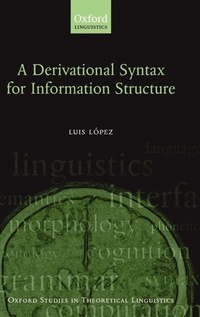
A Derivational Syntax for Information Structure
Published on 26. February 2009
Book
Hardback
320 pages
978-0-19-955740-0 (ISBN)
Description
In this volume, Luis Lopez sheds new light on information structure and makes a significant contribution to work on grammatical operations in the Minimalist Program. Through a careful analysis of dislocations and focus fronting in Romance, the author shows that notions such as 'topic' and 'focus', as usually defined, yield no predictions and proposes instead a feature system based on the notions 'discourse anaphor' and 'contrast'. He presents a detailed model of syntax---information-structure interaction and argues that this interaction takes place at the phase level, with a privileged role for the edge of the phase. Further, he investigates phenomena concerning the syntax of objects in Romance and Germanic - accusative A, p-movement, clitic doubling, scrambling, object shift - and shows that there are cross-linguistic correlations between syntactic configuration and specificity, independent of discourse connectedness. The volume ends with an extended analysis of the syntax of dislocations in Romance.
More details
Series
Language
English
Place of publication
Oxford
United Kingdom
Target group
College/higher education
Dimensions
Height: 240 mm
Width: 161 mm
Thickness: 21 mm
Weight
628 gr
ISBN-13
978-0-19-955740-0 (9780199557400)
Copyright in bibliographic data and cover images is held by Nielsen Book Services Limited or by the publishers or by their respective licensors: all rights reserved.
Schweitzer Classification
Other editions
Additional editions
Book
02/2009
Oxford University Press
€78.50
Shipment within 15-20 days
Person
Luis Lopez is Professor of Spanish Linguistics at the University of Illinois, Chicago. He is the author of Locality and the Architecture of Syntactic Dependencies (2007) and co-editor, along with Rafael Nunez-Cedeno and Richard Cameron, of Language Knowledge and Language Use (2004).
Content
1. Introduction ; 2. Information Structure ; 3. The Syntax of Dislocations and Focus Fronting ; 4. The Derivation of Information Structure ; 5. Moving Objects ; 6. Dislocation Debates ; References