

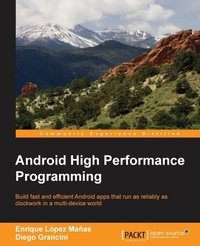
Android High Performance Programming
Build fast and efficient Android apps that run as reliably as clockwork in a multi-device world
Published on 29. August 2016
Book
Paperback/Softback
412 pages
978-1-78528-895-1 (ISBN)
Description
Build fast and efficient Android apps that run as reliably as clockwork in a multi-device world
Key Features
[*]Wide coverage of various topics that help in developing optimal applications
[*]Explore the concepts of Advanced Native Coding in depth
[*]A must-have for professional-standard Android developers for whom performance failures and the sloppy use of resources are simply unacceptable
Book DescriptionPerformant applications are one of the key drivers of success in the mobile world. Users may abandon an app if it runs slowly. Learning how to build applications that balance speed and performance with functionality and UX can be a challenge; however, it's now more important than ever to get that balance right.
Android High Performance will start you thinking about how to wring the most from any hardware your app is installed on, so you can increase your reach and engagement. The book begins by providing an introduction to state-of-the-art Android techniques and the importance of performance in an Android application. Then, we will explain the Android SDK tools regularly used to debug and profile Android applications. We will also learn about some advanced topics such as building layouts, multithreading, networking, and security. Battery life is one of the biggest bottlenecks in applications; and this book will show typical examples of code that exhausts battery life, how to prevent this, and how to measure battery consumption from an application in every kind of situation to ensure your apps don't drain more than they should.
This book explains techniques for building optimized and efficient systems that do not drain the battery, cause memory leaks, or slow down with time.What you will learn
[*]Create Android applications that squeeze the most from the limited resource capacity of devices
[*]Swap code that isn't performing
[*]Efficient memory management by identifying problems such as leaks
[*]Reap the benefits of multithreaded and asynchronous programming
[*]Maximize the security and encryption mechanisms natively provided by Android
[*]Perform efficient network operations and techniques to retrieve data from servers
[*]Master the NDK to write native code that can perform faster operations
Who this book is forThis book is aimed at developers with an advanced knowledge of Android and who want to test their skills and learn new techniques to increase the performance of their applications. We assume they are comfortable working with the entire Android SDK, and have been doing it for a few years. They need to be familiar with frameworks such as NDK to use native code, which is crucial for app performance
Key Features
[*]Wide coverage of various topics that help in developing optimal applications
[*]Explore the concepts of Advanced Native Coding in depth
[*]A must-have for professional-standard Android developers for whom performance failures and the sloppy use of resources are simply unacceptable
Book DescriptionPerformant applications are one of the key drivers of success in the mobile world. Users may abandon an app if it runs slowly. Learning how to build applications that balance speed and performance with functionality and UX can be a challenge; however, it's now more important than ever to get that balance right.
Android High Performance will start you thinking about how to wring the most from any hardware your app is installed on, so you can increase your reach and engagement. The book begins by providing an introduction to state-of-the-art Android techniques and the importance of performance in an Android application. Then, we will explain the Android SDK tools regularly used to debug and profile Android applications. We will also learn about some advanced topics such as building layouts, multithreading, networking, and security. Battery life is one of the biggest bottlenecks in applications; and this book will show typical examples of code that exhausts battery life, how to prevent this, and how to measure battery consumption from an application in every kind of situation to ensure your apps don't drain more than they should.
This book explains techniques for building optimized and efficient systems that do not drain the battery, cause memory leaks, or slow down with time.What you will learn
[*]Create Android applications that squeeze the most from the limited resource capacity of devices
[*]Swap code that isn't performing
[*]Efficient memory management by identifying problems such as leaks
[*]Reap the benefits of multithreaded and asynchronous programming
[*]Maximize the security and encryption mechanisms natively provided by Android
[*]Perform efficient network operations and techniques to retrieve data from servers
[*]Master the NDK to write native code that can perform faster operations
Who this book is forThis book is aimed at developers with an advanced knowledge of Android and who want to test their skills and learn new techniques to increase the performance of their applications. We assume they are comfortable working with the entire Android SDK, and have been doing it for a few years. They need to be familiar with frameworks such as NDK to use native code, which is crucial for app performance
More details
Language
English
Place of publication
Birmingham
United Kingdom
Dimensions
Height: 235 mm
Width: 191 mm
Thickness: 23 mm
Weight
766 gr
ISBN-13
978-1-78528-895-1 (9781785288951)
Copyright in bibliographic data and cover images is held by Nielsen Book Services Limited or by the publishers or by their respective licensors: all rights reserved.
Schweitzer Classification
Other editions
Additional editions
Enrique Lopez Manas | Diego Grancini
Android High Performance Programming
Build fast and efficient Android apps that run as reliably as clockwork in a multi-device world
E-Book
07/2025
Packt Publishing
from
€41.99
Available for download
Persons
Enrique Lpez Maas is a Google Developer Expert and independent IT consultant. He has been working with mobile technologies and learning from them since 2007. He is an avid contributor to the open source community and a FLOSS (Free Libre Open Source Software) kind of guy, being among the top 10 open source Java contributors in Germany. He is a part of the Google LaunchPad accelerator, where he participates in Google global initiatives to influence hundreds of the best startups from all around the globe. He is also a big data and machine learning aficionado. In his free time he rides his bike, take pictures, and travels until exhaustion. He also writes literature and enjoys all kinds of arts. He likes to write about himself in third person. You can follow him on Twitter (@eenriquelopez) to stay updated on his latest movements. Diego Grancini has a degree in telecommunications and IT engineering from Perugia University. He has developed his skills on Android development for more than six years leading and contributed to several projects, teaching and sharing his skills during his career. He joined Engineering Ingegneria Informatica S.P.A. after his degree, defining his own knowledge about Java and Android development working as the lead Android developer for years. Then he joined J.P. Morgan & Chase, strengthening his skills about security and performance in software development and Android platform in particular.
Content
Table of Contents
Introduction: Understanding performance, purpose and benefits
Performance Debugging Tips: an advanced overview of common helpful tools that can reduce the effort and reach the target in a shorter time:
Building Layouts
Memory: main performance concepts with detailed walk-through, best practices and tools
Multithreading
Networking
Security
Battery Life
Native Coding
Performance Coding Tips: a classified collection of coding hints and tips to guide developers through main common situations.
Introduction: Understanding performance, purpose and benefits
Performance Debugging Tips: an advanced overview of common helpful tools that can reduce the effort and reach the target in a shorter time:
Building Layouts
Memory: main performance concepts with detailed walk-through, best practices and tools
Multithreading
Networking
Security
Battery Life
Native Coding
Performance Coding Tips: a classified collection of coding hints and tips to guide developers through main common situations.